Maurizia Boscagli - Böcker
Visar alla böcker från författaren Maurizia Boscagli. Handla med fri frakt och snabb leverans.
3 produkter
3 produkter
407 kr
Skickas inom 10-15 vardagar
Stuff, the hoard of minor objects which have shed their commodity glamor but which we refuse to recycle, flashes up in fiction, films and photographs as alluring, unruly reminder of how people and matter are intertwined. Stuff is modern materiality out of bounds that refuses to be contained by the western semiotic system. It declines its role as the eternal sidekick of the subject, and is thus the ideal basis for a counter-narrative of materiality in flux. Can such a narrative, developed by the new materialism, reinvigorate the classical materialist account of human alienation from commodities under capital? By shifting the discussion of materiality toward the aesthetic and the everyday, the book both embraces and challenges the project of new materialism. It argues that matter has a politics, and that its new plasticity offers a continued possibility of critique.Stuff Theory's five chapters illustrate the intermittent flashes of modern 'minor' materiality in twentieth-century modernity as fashion, memory object, clutter, home décor, and waste in a wide range of texts: Benjamin's essays, Virginia Woolf's and Elfriede Jelinek's fiction, Rem Koolhaas' criticism, 1920s German photography and the cinema of Tati, Bertolucci, and Mendes. To call the commodified, ebullient materiality the book tracks stuff, is to foreground its plastic and transformative power, its fluidity and its capacity to generate events. Stuff Theory interrogates the political value of stuff's instability. It investigates the potential of stuff to revitalize the oppositional power of the object.Stuff Theory traces a genealogy of materiality: flashpoints of one kind of minor matter in a succession of cultural moments. It asserts that in culture, stuff becomes a rallying point for a new critique of capital, which always works to reassign stuff to a subaltern position. Stuff is not merely unruly: it becomes the terrain on which a new relation between people and matter might be built.
1 544 kr
Skickas inom 10-15 vardagar
Stuff, the hoard of minor objects which have shed their commodity glamor but which we refuse to recycle, flashes up in fiction, films and photographs as alluring, unruly reminder of how people and matter are intertwined. Stuff is modern materiality out of bounds that refuses to be contained by the western semiotic system. It declines its role as the eternal sidekick of the subject, and is thus the ideal basis for a counter-narrative of materiality in flux. Can such a narrative, developed by the new materialism, reinvigorate the classical materialist account of human alienation from commodities under capital? By shifting the discussion of materiality toward the aesthetic and the everyday, the book both embraces and challenges the project of new materialism. It argues that matter has a politics, and that its new plasticity offers a continued possibility of critique.Stuff Theory's five chapters illustrate the intermittent flashes of modern 'minor' materiality in twentieth-century modernity as fashion, memory object, clutter, home décor, and waste in a wide range of texts: Benjamin's essays, Virginia Woolf's and Elfriede Jelinek's fiction, Rem Koolhaas' criticism, 1920s German photography and the cinema of Tati, Bertolucci, and Mendes. To call the commodified, ebullient materiality the book tracks stuff, is to foreground its plastic and transformative power, its fluidity and its capacity to generate events. Stuff Theory interrogates the political value of stuff's instability. It investigates the potential of stuff to revitalize the oppositional power of the object.Stuff Theory traces a genealogy of materiality: flashpoints of one kind of minor matter in a succession of cultural moments. It asserts that in culture, stuff becomes a rallying point for a new critique of capital, which always works to reassign stuff to a subaltern position. Stuff is not merely unruly: it becomes the terrain on which a new relation between people and matter might be built.
1 428 kr
Skickas inom 5-8 vardagar
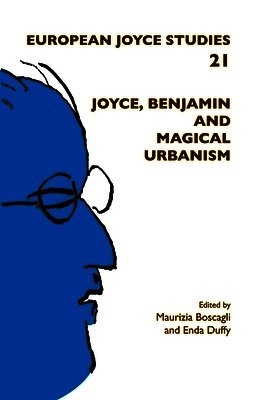
Joyce, Benjamin and Magical Urbanism offers for the first time a sustained exploration of parallels between the fiction of James Joyce and the cultural criticism of Walter Benjamin. Benjamin is perhaps modernism’s most eloquent theorist, Joyce its finest writer of fiction; both haunted the same Paris streets at the height of the modernist moment, and both developed accounts of the flaneur’s encounter with the city, with commodity culture and with others, that were revolutionary in their day and continue to set the agendas for culture and cultural critique. To place some of the work of each side by side is to make evident their affinities: the skills of each as new cartographers of the urban, the interest of each in ethnicity, nationalism, and exile, the way in which the ‘Profane illumination’ celebrated by Benjamin meets the ‘Epiphany’ of Joyce’s A Portrait, as each rethought the epistemology of insight in the modernist moment. This collection explores these parallels between two of the greatest modernists, casting the aesthetic strategies of Joyce in the light of the aesthetic critique of Benjamin, opening up the politics of the one in the light of those of the other, and discerning the parallels between Joyce’s version of a modern urban world in which self and society effect an uneasy rapprochement and Benjamin’s modernist scenarios in which the aura might still linger. This collection discovers extraordinary parallels between the two writers who, writing in Paris, offered new accounts of urban selfhood and survival to the world.