Max Jones - Böcker
Visar alla böcker från författaren Max Jones. Handla med fri frakt och snabb leverans.
4 produkter
4 produkter
196 kr
Skickas inom 5-8 vardagar
Scott's last Antarctic expedition is one of the great adventure stories of the twentieth century. On 1 November 1911, a British team set out on the gruelling 800-mile journey across the coldest and highest continent on Earth to travel to the South Pole. Five men battled through unimaginably harsh conditions only to find the Norwegian flag had been planted at the Pole just weeks before. Captain Robert Falcon Scott, Lieutenant Henry Bowers, Petty Officer Edgar Evans, Captain Lawrence Oates, and Dr Edward Wilson all died on the return trek, starved and frozen to death, only eleven miles from a supply camp. In November 1912, a rescue party discovered their last letters and diaries, which told a story of bravery, hardship, and self-sacrifice that shocked the world.Recent decades have seen controversy rage over whether Scott was the last of a line of great Victorian explorers, intent on discovering uncharted lands, or a hopeless incompetent driven by personal ambition. Rejecting the stereotypes, Max Jones reveals a complex figure, a product of the passions and preoccupations of an imperial age. He also shows how heroes are made and manipulated, through a close examination of the unprecedented outpouring of public grief at the news of the death of Scott and his companions.Max Jones uses fascinating new evidence and prevously unseen illustrations to take us back to this remarkable moment in modern history, and tells for the first time the full story of The Last Great Quest.
114 kr
Skickas inom 5-8 vardagar
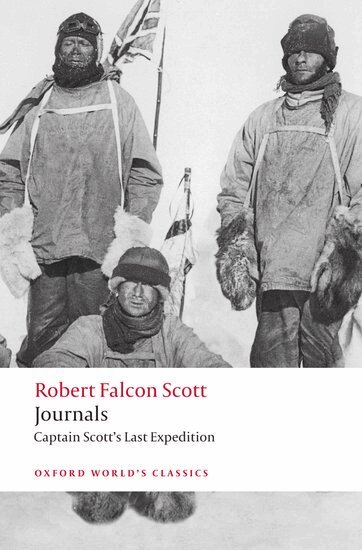
'For God's sake look after our people'Captain Scott's harrowing account of his expedition to the South Pole in 1910-12 was first published in 1913. In his journals Scott records his party's optimistic departure from New Zealand, the hazardous voyage of theTerra Nova to Antarctica, and the trek with ponies and dogs across the ice to the Pole. On the way the explorers conduct scientific experiments, collect specimens, and get to know each other's characters. Their discovery that Amundsen has beaten them to their goal, and the endurance with which they face an 850-mile march to safety, have become the stuff of legend.This new edition publishes for the first time a complete list of the changes made to Scott's original text before publication. In his Introduction Max Jones illuminates the Journals' writing and publication, Scott's changing reputation, and the continued attraction of heroes in our cynical age. ABOUT THE SERIES: For over 100 years Oxford World's Classics has made available the widest range of literature from around the globe. Each affordable volume reflects Oxford's commitment to scholarship, providing the most accurate text plus a wealth of other valuable features, including expert introductions by leading authorities, helpful notes to clarify the text, up-to-date bibliographies for further study, and much more.
Decolonising Imperial Heroes
Cultural legacies of the British and French Empires
Inbunden, Engelska, 2016
2 096 kr
Skickas inom 10-15 vardagar
The heroes of the British and French empires stood at the vanguard of the vibrant cultures of imperialism that emerged in Europe in the second-half of the nineteenth century. Their stories are well known. Scholars have tended to assume that figures such as Livingstone and Gordon, or Marchand and Brazza, vanished rapidly at the end of empire. Yet imperial heroes did not disappear after 1945, as British and French flags were lowered around the world. On the contrary, their reputations underwent a variety of metamorphoses in both the former metropoles and the former colonies. This book develops a framework to understand the complex legacies of decolonisation, both political and cultural, through the case study of imperial heroes. We demonstrate that the ‘decolonisation’ of imperial heroes was a much more complex and protracted process than the political retreat from empire, and that it is still an ongoing phenomenon, even half a century after the world has ceased to be ‘painted in red’. Whilst Decolonising Imperial Heroes explores the appeal of the explorers, humanitarians and missionaries whose stories could be told without reference to violence against colonized peoples, it also analyses the persistence of imperial heroes as sites of political dispute in the former metropoles. Demonstrating that the work of remembrance was increasingly carried out by diverse, fragmented groups of non-state actors, in a process we call ‘the privatisation of heroes’, the book reveals the surprising rejuvenation of imperial heroes in former colonies, both in nation-building narratives and as heritage sites. This book was originally published as a special issue of the Journal of Imperial and Commonwealth History.
Decolonising Imperial Heroes
Cultural legacies of the British and French Empires
Häftad, Engelska, 2018
752 kr
Skickas inom 10-15 vardagar
The heroes of the British and French empires stood at the vanguard of the vibrant cultures of imperialism that emerged in Europe in the second-half of the nineteenth century. Their stories are well known. Scholars have tended to assume that figures such as Livingstone and Gordon, or Marchand and Brazza, vanished rapidly at the end of empire. Yet imperial heroes did not disappear after 1945, as British and French flags were lowered around the world. On the contrary, their reputations underwent a variety of metamorphoses in both the former metropoles and the former colonies. This book develops a framework to understand the complex legacies of decolonisation, both political and cultural, through the case study of imperial heroes. We demonstrate that the ‘decolonisation’ of imperial heroes was a much more complex and protracted process than the political retreat from empire, and that it is still an ongoing phenomenon, even half a century after the world has ceased to be ‘painted in red’. Whilst Decolonising Imperial Heroes explores the appeal of the explorers, humanitarians and missionaries whose stories could be told without reference to violence against colonized peoples, it also analyses the persistence of imperial heroes as sites of political dispute in the former metropoles. Demonstrating that the work of remembrance was increasingly carried out by diverse, fragmented groups of non-state actors, in a process we call ‘the privatisation of heroes’, the book reveals the surprising rejuvenation of imperial heroes in former colonies, both in nation-building narratives and as heritage sites. This book was originally published as a special issue of the Journal of Imperial and Commonwealth History.