McMahon - Böcker
Visar alla böcker från författaren McMahon. Handla med fri frakt och snabb leverans.
4 produkter
4 produkter
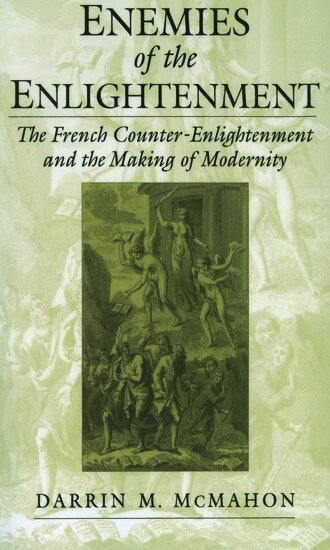
Enemies of the Enlightenment
The French Counter-Enlightenment and the Making of Modernity
Häftad, Engelska, 2002
350 kr
Skickas inom 5-8 vardagar
Critics have long treated the most important intellectual movement of modern hstory - the Enlightenment - as if it took shape in the absence of opposition. In this ground-breaking new study, Darrin McMahon demonstrates that, on the contrary, contemporary resistance to the Enlightenment was a major cultural force, shaping and defining the Enlightenment from the moment of its inception, while giving rise to an entirely new ideological phenomenon - what we have come to think of as the "Right". Born in France, but spread throughout Europe and the New World in the eighteenth and early nineteenth centuries, the Counter-Enlightenment was neither a rarified current in the history of ideas nor an atavistic relic of the past, but an extensive, international, and thoroughly modern affair.Drawing on a range od primary sources, McMahon shows that well before the French Revolution, enemies of the Enlightenment were warning that the secular thrust of modern philosophy would give way to horrors of an unprecedented kind, Greeting 1789, in turn, as the realization of their worst fears, they fought the Revolution from its onset, profoundly affecting its subsequent course, The radicalization - and violence - of the Revolution was as much the product of militant resistance as any inherent logic.In the wake of Revolutionary upheaval, enemies of the Enligtenment assumed positions of immense cultural authority, consolidating their political vision of the Right in the first third of the nineteenth century, and spreading their construction of the Enlightenment throughout the world. In doing so they developed a critique of modernity that remains with us to the present day.
625 kr
Skickas inom 3-6 vardagar
1 989 kr
Skickas inom 5-8 vardagar
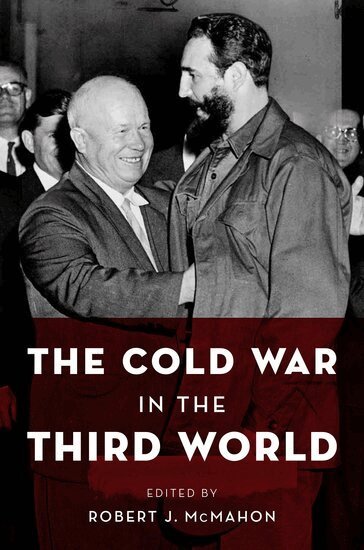
THE COLD WAR IN THE THIRD WORLD explores the complex interrelationships between the Soviet-American struggle for global preeminence and the rise of the Third World. Those two distinct but overlapping phenomena placed a powerful stamp on world history throughout the second half of the twentieth century. Featuring original essays by twelve leading scholars, this collection examines the influence of the newly emerging states of the Third World on the course of the Cold War and on the international behavior and priorities of the two superpowers. To what extent, it asks, did the Third World help determine the course of the Cold War? It also analyzes the impact of the Cold War on the developing states and societies of Asia, Africa, the Middle East, and Latin America. To what extent, it asks, did the Cold War make a difference within non-Western nations and regions. Blending the new, internationalist approaches to the Cold War with the latest research on the global south in a tumultuous era of decolonization and state-building, The Cold War in the Third World bring together diverse strands of scholarship to address some of the most compelling issues in modern world history.
1 899 kr
Skickas inom 5-8 vardagar
In relative terms, intellectual history is currently enjoying a moment of prominence and self-confidence greater than it has known in decades. Yet surprisingly for a field whose practitioners pride themselves on intellectual self-awareness, its star may have risen along with a decline in self-reflection. Few recent theoretical statements have attempted to "justify" intellectual history, to explain what makes its practice worthwhile and methodologically sound. This situation is ironic. The time of bitter and divisive disputes about the place of intellectual history in the humanities may be a living memory, but it is an improbably distant one. Everyone seems to be getting along these days: intellectual historians with other kinds of historians, and intellectual historians with one another. Yet only a generation ago, the field was faced with marginalization - if not extinction - by powerful external forces, which imposed a kind of exile, prompting a period of intense theoretical self-examination and contention. Now intellectual history is ascendant in the profession, and a kind of mutual admiration, almost to the point of complacency, flourishes where bitter polemics once festered. To reflect on this extraordinary reversal and to chart future directions in the field are the purposes of this collection of essays. They appear at an "interim " moment because the field of European intellectual history stands at a critical juncture. Despite recent successes, intellectual historians can claim today no widespread agreement about how to conduct their work, and they often seem to lack the will to argue out the alternatives. The situation is comfortable. Yet the absence of self-reflection and theoretical contest - which were once compulsory, and arguably taken to excess - risks devolving into a celebration of eclecticism under a large and cozy tent.If eclecticism is a risk, it is also an opportunity, which offers to intellectual historians the prospect of enriching their own field and the broader practice of history through novel openings and exchange. A wider disciplinary world beckons, as does a frequently elusive interdisciplinary (and international) space. Intellectual historians have an important role to play in fostering such spaces, and European intellectual historians, in particular, have an interest in doing so at a moment when the study of "Europe" seems increasingly parochial to many when not connected to the faraway lands Europeans once ruled and where their ideas have long traveled. In this global and globalizing age, at this juncture for the field, it is appropriate to step back from practice to engage in a bout of theoretical reflection. The time is right to take stock of where European intellectual history has been, to assess where it is now, and to reflect on future possibilities.