Meghan Marie Hammond - Böcker
Visar alla böcker från författaren Meghan Marie Hammond. Handla med fri frakt och snabb leverans.
3 produkter
3 produkter
2 652 kr
Skickas inom 10-15 vardagar
In recent years, a growing field of empathy studies has started to emerge from several academic disciplines, including neuroscience, social psychology, and philosophy. Because literature plays a central role in discussions of empathy across disciplines, reconsidering how literature relates to "feeling with" others is key to rethinking empathy conceptually. This collection challenges common understandings of empathy, asking readers to question what it is, how it works, and who is capable of performing it. The authors reveal the exciting research on empathy that is currently emerging from literary studies while also making productive connections to other areas of study such as psychology and neurobiology.While literature has been central to discussions of empathy in divergent disciplines, the ways in which literature is often thought to relate to empathy can be simplistic and/or problematic. The basic yet popular postulation that reading literature necessarily produces empathy and pro-social moral behavior greatly underestimates the complexity of reading, literature, empathy, morality, and society. Even if empathy were a simple neurological process, we would still have to differentiate the many possible kinds of empathy in relation to different forms of art. All the complexities of literary and cultural studies have still to be brought to bear to truly understand the dynamics of literature and empathy.
941 kr
Skickas inom 10-15 vardagar
In recent years, a growing field of empathy studies has started to emerge from several academic disciplines, including neuroscience, social psychology, and philosophy. Because literature plays a central role in discussions of empathy across disciplines, reconsidering how literature relates to "feeling with" others is key to rethinking empathy conceptually. This collection challenges common understandings of empathy, asking readers to question what it is, how it works, and who is capable of performing it. The authors reveal the exciting research on empathy that is currently emerging from literary studies while also making productive connections to other areas of study such as psychology and neurobiology.While literature has been central to discussions of empathy in divergent disciplines, the ways in which literature is often thought to relate to empathy can be simplistic and/or problematic. The basic yet popular postulation that reading literature necessarily produces empathy and pro-social moral behavior greatly underestimates the complexity of reading, literature, empathy, morality, and society. Even if empathy were a simple neurological process, we would still have to differentiate the many possible kinds of empathy in relation to different forms of art. All the complexities of literary and cultural studies have still to be brought to bear to truly understand the dynamics of literature and empathy.
275 kr
Kommande
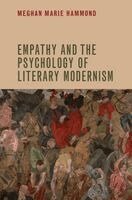
Shows how fin de siècle conceptions of empathy are woven into the fabric of literary modernismEmpathy is a cognitive and affective structure of feeling, a bridge across interpersonal distance. Coined in 1909 to combine English ‘sympathy’ and German ‘Einfühlung,’ ‘empathy’ is a specifically twentieth-century concept of fellow feeling. Empathy and the Psychology of Literary Modernism looks into the little-known history of empathy, revealing how this multi-faceted concept had a profound effect on literary modernism.Meghan Marie Hammond shows how five exemplary writers (Henry James, Dorothy Richardson, Katherine Mansfield, Ford Madox Ford, and Virginia Woolf) tackle the so-called ‘problem of other minds’ in ways that reflect and enrich early twentieth-century discourses of fellow feeling. Hammond argues that these authors reconfigure notions of intersubjective experience; their writings mark a key shift away from sympathetic forms of literary representation toward empathic forms that strive to provide an immediate sense of another’s thoughts and feelings. But while literary modernism values empathic experience as an ideal, it is also teeming with voices that recognize potential for danger, even violence, in acts of empathy. These voices illuminate our culture’s ongoing concern with empathy’s limits.Key Features:Recovers early psychology, a discipline that has often been neglected in favor of psychoanalysis, as a framework for literary modernismProvides a conceptual history of empathy that expands our understanding of the modernist worldGrants new insight into modernist technique by explaining how it relates to contemporaneous psychological and aesthetic theories on empathyPrompts a rethinking of empathy, a capacity that is as widely misunderstood as it is celebrated