Mehrsa Baradaran - Böcker
Visar alla böcker från författaren Mehrsa Baradaran. Handla med fri frakt och snabb leverans.
8 produkter
8 produkter
188 kr
Skickas inom 7-10 vardagar
Why has the racial wealth gap between the median white households and median Black households in America remained stagnant over the past century, never narrowing below six to one? Mehrsa Baradaran attempts to answer this question in this sweeping yet accessible history. She shows how decades of the laws rooted in white supremacy–from slavery and the broken Reconstruction-era promise of “40 acres and a mule”, to the racist policies of the Jim Crow and New Deal eras–have restricted Black access to capital, credit, homeownership and other mechanisms of wealth creation while subsidising the rising economic fortunes of white families.An infuriating and compelling read, The Racial Wealth Gap offers a devastating analysis of one of America’s most pressing systemic issues.A Norton Short
177 kr
Skickas inom 7-10 vardagar
“Read this book. It explains so much about the moment…Beautiful, heartbreaking work.” —Ta-Nehisi Coates“A deep accounting of how America got to a point where a median white family has 13 times more wealth than the median black family.”—The Atlantic“Extraordinary…Baradaran focuses on a part of the American story that’s often ignored: the way African Americans were locked out of the financial engines that create wealth in America.”—Ezra KleinWhen the Emancipation Proclamation was signed in 1863, the black community owned less than 1 percent of the total wealth in America. More than 150 years later, that number has barely budged. The Color of Money seeks to explain the stubborn persistence of this racial wealth gap by focusing on the generators of wealth in the black community: black banks.With the civil rights movement in full swing, President Nixon promoted “black capitalism,” a plan to support black banks and minority-owned businesses. But the catch-22 of black banking is that the very institutions needed to help communities escape the deep poverty caused by discrimination and segregation inevitably became victims of that same poverty. In this timely and eye-opening account, Baradaran challenges the long-standing belief that black communities could ever really hope to accumulate wealth in a segregated economy.“Black capitalism has not improved the economic lives of black people, and Baradaran deftly explains the reasons why.”—Los Angeles Review of Books“A must read for anyone interested in closing America’s racial wealth gap.”—Black Perspectives
165 kr
Skickas
Help kids learn all about banks and the magic of money.This is a kids’ book about banking. When you think of a bank, what comes to mind? A building? A safe filled with gold? What if we told you banks weren't any of these things? And (get ready for this)... most money isn't even kept in the bank!This book was made to help kids aged 5-9 understand banking and how it works. They will learn how banks allow money to move from one place to another, creating opportunities and growth – but they only work with a shared belief in the magic of money!A Kids Book About Banking features: A large and bold, yet minimalist font design that allows kids freedom to imagine themselves in the words on the pages.A friendly, approachable, empowering and child-appropriate tone throughout.An incredible and diverse group of authors in the series who are experts or have first-hand experience of the topic.Tackling important discourse together! The A Kids Book About titles are best used when read together. Helping to kickstart important, challenging, and empowering conversations for kids and their grown-ups through beautiful and thought-provoking pages. The series supports an incredible and diverse group of authors, who are either experts in their field, or have first-hand experience on the topic. A Kids Co. is a new kind of media company enabling kids to explore big topics in a new and engaging way, with a growing series of books, podcasts and blogs made to empower. Learn more about us online by searching for A Kids Co.
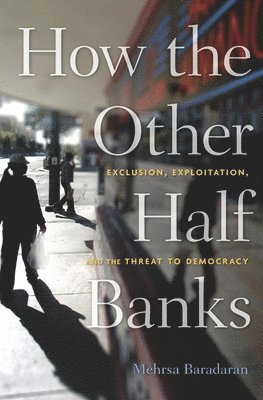
How the Other Half Banks
Exclusion, Exploitation, and the Threat to Democracy
Inbunden, Engelska, 2015
290 kr
Tillfälligt slut
The United States has two separate banking systems today—one serving the well-to-do and another exploiting everyone else. How the Other Half Banks contributes to the growing conversation on American inequality by highlighting one of its prime causes: unequal credit. Mehrsa Baradaran examines how a significant portion of the population, deserted by banks, is forced to wander through a Wild West of payday lenders and check-cashing services to cover emergency expenses and pay for necessities—all thanks to deregulation that began in the 1970s and continues decades later.In an age of corporate megabanks with trillions of dollars in assets, it is easy to forget that America’s banking system was originally created as a public service. Banks have always relied on credit from the federal government, provided on favorable terms so that they could issue low-interest loans. But as banks grew in size and political influence, they shed their social contract with the American people, demanding to be treated as a private industry free from any public-serving responsibility. They abandoned less profitable, low-income customers in favor of wealthier clients and high-yield investments. Fringe lenders stepped in to fill the void. This two-tier banking system has become even more unequal since the 2008 financial crisis.Baradaran proposes a solution: reenlisting the U.S. Post Office in its historic function of providing bank services. The post office played an important but largely forgotten role in the creation of American democracy, and it could be deployed again to level the field of financial opportunity.
202 kr
Skickas inom 7-10 vardagar
The United States has two separate banking systems today—one serving the well-to-do and another exploiting everyone else. How the Other Half Banks contributes to the growing conversation on American inequality by highlighting one of its prime causes: unequal credit. Mehrsa Baradaran examines how a significant portion of the population, deserted by banks, is forced to wander through a Wild West of payday lenders and check-cashing services to cover emergency expenses and pay for necessities—all thanks to deregulation that began in the 1970s and continues decades later.“Baradaran argues persuasively that the banking industry, fattened on public subsidies (including too-big-to-fail bailouts), owes low-income families a better deal…How the Other Half Banks is well researched and clearly written…The bankers who fully understand the system are heavily invested in it. Books like this are written for the rest of us.”—Nancy Folbre, New York Times Book Review“How the Other Half Banks tells an important story, one in which we have allowed the profit motives of banks to trump the public interest.”—Lisa J. Servon, American Prospect
290 kr
Skickas inom 7-10 vardagar
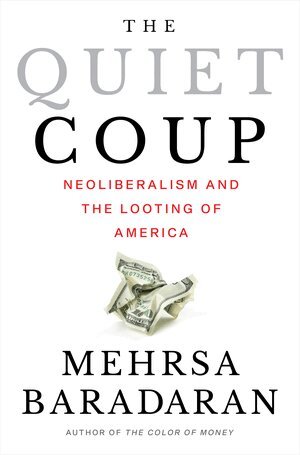
Many Americans believe that something fundamental has gone wrong in their country. Why does full-time work no longer guarantee financial stability? Why does college cost a lifetime of debt? And why have decades of free-market promises yielded not more freedom and liberty but more debt and constraints? In The Quiet Coup, Mehrsa Baradaran, a premier public intellectual, argues that America's problems stem from the market-centred doctrine of neoliberalism. Far more than a mere economic theory, neoliberalism and its adherents transformed American law—yielding not fewer laws but more-complex laws and regulations that benefit the wealthy. From neoliberalism’s role as a tool of ideological warfare against racial justice movements in the 1960s to its complete institutional takeover in the 1980s to the crypto meltdowns of the 2020s, Baradaran’s essential chronicle shows that the neoliberal era—and legalised mass looting—is far from over and in fact is only accelerating.
267 kr
Skickas inom 3-6 vardagar
With the nation lurching from one crisis to the next, many Americans believe that something fundamental has gone wrong. Why aren’t college graduates able to achieve financial security? Why is government completely inept in the face of natural disasters? And why do pundits tell us that the economy is strong even though the majority of Americans can barely make ends meet? In The Quiet Coup, Mehrsa Baradaran, one of our leading public intellectuals, argues that the system is in fact rigged toward the powerful, though it wasn’t the work of evil puppet masters behind the curtain. Rather, the rigging was carried out by hundreds of (mostly) law-abiding lawyers, judges, regulators, policy makers, and lobbyists. Adherents of a market-centered doctrine called neoliberalism, these individuals, over the course of decades, worked to transform the nation—and succeeded.They did so by changing the law in unseen ways. Tracing this largely unknown history from the late 1960s to the present, Baradaran demonstrates that far from yielding fewer laws and regulations, neoliberalism has in fact always meant more—and more complex—laws. Those laws have uniformly benefited the wealthy. From the work of a young Alan Greenspan in creating "Black Capitalism," to Supreme Court Justice Lewis Powell’s efforts to unshackle big money donors, to the establishment of the "Law and Economics" approach to legal interpretation—in which judges render opinions based on the principles of right-wing economics—Baradaran narrates the key moments in the slow-moving coup that was, and is, neoliberalism. Shifting our focus away from presidents and national policy, she tells the story of how this nation’s laws came to favor the few against the many, threatening the integrity of the market and the state.Some have claimed that the neoliberal era is behind us. Baradaran shows that such thinking is misguided. Neoliberalism is a failed economic idea—it doesn’t, in fact, create more wealth or more freedom. But it has been successful nevertheless, by seizing the courts and enabling our age of crypto fraud, financial instability, and accelerating inequality. An original account of the forces that have brought us to this dangerous moment in American history, The Quiet Coup reshapes our understanding of the recent past and lights a path toward a better future.
378 kr
Skickas inom 5-8 vardagar