Melvin W. Reder – författare
Visar alla böcker från författaren Melvin W. Reder. Handla med fri frakt och snabb leverans.
4 produkter
4 produkter
Häftad, Engelska, 2001
323 kr
Skickas inom 5-8 vardagar
Economics has always had an unstable reputation in the academic world as well as in the public eye. Some consider economists to be scientists while others see them as disguised ideologues. The resulting insecurity of their discipline's status has driven economists continually to redefine its scope, methods, and content. Since the 1930s economists have increasingly emphasized the scientific, quantitative side of their field, which has directed research to topics that can be elaborated through mathematical models. Economist Melvin Reder argues that this ongoing historical shift has been the result of pressure from two directions: from society's demand that expert advice be based on "scientific findings", and from economists themselves, who have wanted to view their own profession as a science. This book describes the profession of economics as it has developed in response to these challenges. The diversity of the responses points to persistent internal disagreements within the economics community about its proper scope and methods. These disagreements, in turn, have led to incompatible proposals for the direction of research and divergent recommendations for public policy.Although Reder does not pretend to resolve these difficulties, he appraises different arguments and demonstrates how they have influenced both economists' behaviour and public esteem for the profession. While recognizing that serious questions remain about economics's scientific status and practical utility of economics, this text shows where economics has obtained practically usable results and where its fruits have been limited to elaboration of analytical constructions of uncertain applicability.
E-bok
PDF, Engelska, 2014807 kr
Läs direkt efter köp
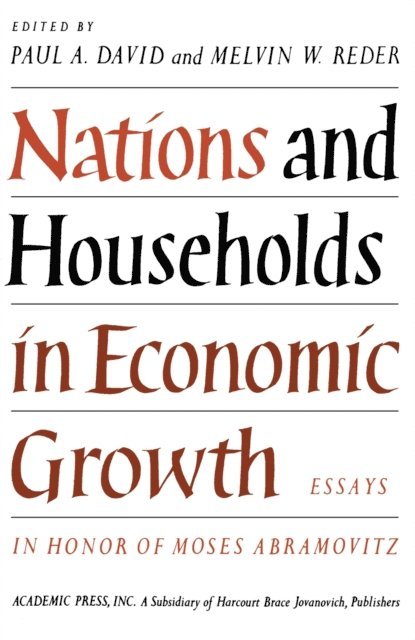
Nations and Households in Economic Growth: Essays in Honor of Moses Abramovitz is a collection of papers that reflect the broad sweep of Moses Abramovitz''s interests within the disciplines of economics and economic history. This work is organized into two parts encompassing 14 chapters. The first part discusses the individual and social welfare significance of quantitative indices of economic growth. This part also deals with the mechanisms of economic-demographic interdependence and their bearing particularly upon "long swings in the rate of growth. The second part highlights the changing role of international relations in processes generating national economic development and domestic economic instability. This book will be of value to economists, historians, and researchers.
Inbunden, Engelska, 1999
631 kr
Tillfälligt slut
Economics has always had an unstable reputation in the academic world as well as in the public eye. Some consider economists to be scientists while others see them as disguised ideologues. The resulting insecurity of their discipline's status has driven economists continually to redefine its scope, methods, and content. Since the 1930s economists have increasingly emphasized the scientific, quantitative side of their field, which has directed research to topics that can be elaborated through mathematical models. Economist Melvin Reder argues that this ongoing historical shift has been the result of pressure from two directions: from society's demand that expert advice be based on "scientific findings", and from economists themselves, who have wanted to view their own profession as a science. This book describes the profession of economics as it has developed in response to these challenges. The diversity of the responses points to persistent internal disagreements within the economics community about its proper scope and methods. These disagreements, in turn, have led to incompatible proposals for the direction of research and divergent recommendations for public policy.Although Reder does not pretend to resolve these difficulties, he appraises different arguments and demonstrates how they have influenced both economists' behaviour and public esteem for the profession. While recognizing that serious questions remain about economics's scientific status and practical utility, this text shows where economics has obtained practically usable results and where its fruits have been limited to elaboration of analytical constructions of uncertain applicability.