• Fri frakt över 249 kr
  • •
  • Snabba leveranser
  • •
  • Billiga böcker
Kundservice

Du är på sajten för privatpersoner.

Företag, bibliotek eller offentlig verksamhet?

Du handlar på classic.bokus.com, där alla dina funktioner finns intakta.
Till classic.bokus.com
Bokus logotyp. Gå till startsidan.
  • Erbjudanden
  • Nyheter
  • Student
  • Topplistor
  • Barn & ungdom
  • Bokus Play
  • E-böcker
  • Pocketböcker
  • Spel & pussel

10% rabatt på allt med kod NYSTART10 →

Sidfot

Mina sidor

    Hjälp

    • Kundservice
    • Vanliga frågor och svar
    • Frakt och leverans
    • Retur vid ångerrätt
    • Reklamera vara
    • Betalning
    • Köpvillkor
    • Allmänna villkor
    • Information om webbplatsens tillgänglighet

    Om Bokus

    • Om oss
    • Pressrum
    • För studenter
    • För företag
    • För bibliotek och offentlig verksamhet
    • För leverantörer
    • Hållbarhet

    Populärt

    • Aktuella erbjudanden
    • Presentkort
    • Studentlitteratur
    • Nya böcker
    • Topplistor
    • Signerade böcker
    • Engelska böcker

    Inspiration

    • Boktips
    • BookTok
    • Populära bokserier
    • Barnbokskaraktärer
    • Populära författare
    Logotyp för Bokus
    Följ oss på Facebook (extern länk)Följ oss på Instagram (extern länk)Följ oss på YouTube (extern länk)Följ oss på TikTok (extern länk)
    bokus @ CookiesAnpassa cookiesIntegritetspolicyKöpvillkor
    Till Citymail hemsida (extern länk)Till Budbee hemsida (extern länk)Till Postnord hemsida (extern länk)Till Schenker hemsida (extern länk)Till Early Bird hemsida (extern länk)Till Walleys hemsida (extern länk)
    1. Ekonomi och Ledarskap
    2. Nationalekonomi

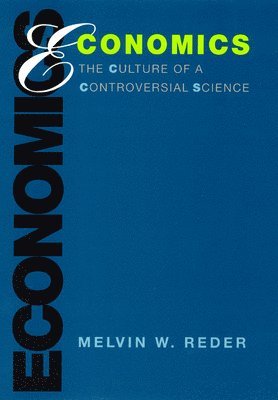
    Economics

    The Culture of a Controversial Science

    AvMelvin W. Reder

    Inbunden, Engelska, 1999

    631 kr

    Tillfälligt slut

    Fler format och utgåvor

    Häftad

    317 kr

    Beskrivning

    Economics has always had an unstable reputation in the academic world as well as in the public eye. Some consider economists to be scientists while others see them as disguised ideologues. The resulting insecurity of their discipline's status has driven economists continually to redefine its scope, methods, and content. Since the 1930s economists have increasingly emphasized the scientific, quantitative side of their field, which has directed research to topics that can be elaborated through mathematical models. Economist Melvin Reder argues that this ongoing historical shift has been the result of pressure from two directions: from society's demand that expert advice be based on "scientific findings", and from economists themselves, who have wanted to view their own profession as a science. This book describes the profession of economics as it has developed in response to these challenges. The diversity of the responses points to persistent internal disagreements within the economics community about its proper scope and methods. These disagreements, in turn, have led to incompatible proposals for the direction of research and divergent recommendations for public policy.Although Reder does not pretend to resolve these difficulties, he appraises different arguments and demonstrates how they have influenced both economists' behaviour and public esteem for the profession. While recognizing that serious questions remain about economics's scientific status and practical utility, this text shows where economics has obtained practically usable results and where its fruits have been limited to elaboration of analytical constructions of uncertain applicability.

    Produktinformation

    • Utgivningsdatum:1999-01-15
    • Mått:16 x 24 x 3 mm
    • Vikt:680 g
    • Format:Inbunden
    • Språk:Engelska
    • Antal sidor:391
    • Förlag:The University of Chicago Press
    • ISBN:9780226706092

    Utforska kategorier

    • Nationalekonomi inom Ekonomi och Ledarskap

    Innehållsförteckning

    • Preface Pt. 1: Culture and Science 1: Overview 2: Economics and other Sciences Pt. 2: Paradigms and Anomalies 3: The Dominant Paradigm: RAP 4: The Keynesian Paradigm: KP 5: Of Debt and Taxes: DP Versus RAP 6: Some other Paradigms 7: The Criteria of Validity in Economics 8: "Successes" of Positive Economics: Two Examples Pt. 3: Welfare Economics and Ideology 9: Welfare Economics 10: RAP and the Ideology of Laissez-Faire Pt. 4: Economics and Society 11: What is Economics Good for? 12: What is Good Economics? 13: Prizes, Establishments, and Heroes 14: The Boundaries of Economics Name Index Subject Index