Michael A. Ross - Böcker
Visar alla böcker från författaren Michael A. Ross. Handla med fri frakt och snabb leverans.
3 produkter
3 produkter
The Great New Orleans Kidnapping Case
Race, Law, and Justice in the Reconstruction Era
Häftad, Engelska, 2017
284 kr
Skickas inom 5-8 vardagar
In June 1870, the residents of the city of New Orleans were already on edge when two African American women kidnapped seventeen-month-old Mollie Digby from in front of her New Orleans home. It was the height of Radical Reconstruction, and the old racial order had been turned upside down: black men now voted, held office, sat on juries, and served as policemen. Nervous white residents, certain that the end of slavery and resulting "Africanization" of the city would bring chaos, pointed to the Digby abduction as proof that no white child was safe. Louisiana's twenty-eight-year old Reconstruction governor, Henry Clay Warmoth, hoping to use the investigation of the kidnapping to validate his newly integrated police force to the highly suspicious white population of New Orleans, saw to it that the city's best Afro-Creole detective, John Baptiste Jourdain, was put on the case, and offered a huge reward for the return of Mollie Digby and the capture of her kidnappers. When the Associated Press sent the story out on the wire, newspaper readers around the country began to follow the New Orleans mystery. Eventually, police and prosecutors put two strikingly beautiful Afro-Creole women on trial for the crime, and interest in the case exploded as a tense courtroom drama unfolded.In The Great New Orleans Kidnapping Case, Michael Ross offers the first full account of this event that electrified the South at one of the most critical moments in the history of American race relations. Tracing the crime from the moment it was committed through the highly publicized investigation and sensationalized trial that followed, all the while chronicling the public outcry and escalating hysteria as news and rumors surrounding the crime spread, Ross paints a vivid picture of the Reconstruction-era South and the complexities and possibilities that faced the newly integrated society. Leading readers into smoke-filled concert saloons, Garden District drawing rooms, sweltering courthouses, and squalid prisons, Ross brings this fascinating era back to life. A stunning work of historical recreation, The Great New Orleans Kidnapping Case is sure to captivate anyone interested in true crime, the Civil War and its aftermath, and the history of New Orleans and the American South.
The Great New Orleans Kidnapping Case
Race, Law, and Justice in the Reconstruction Era
Inbunden, Engelska, 2014
367 kr
Skickas inom 5-8 vardagar
In June 1870, the residents of the city of New Orleans were already on edge when two African American women kidnapped seventeen-month old Mollie Digby from in front of her New Orleans home. It was the height of Radical Reconstruction. The old racial order had been turned upside down and black men now voted, held office, sat on juries, and served as policemen. Nervous white residents fearing impeding chaos pointed to the Digby abduction as proof that no white child was safe now that slavery had ended and the South had been "Africanized." Newspapers opposed to Louisiana's biracial Reconstruction government stoked those fears by reprinting rumors that the stolen Digby baby had been sacrificed in a Voodoo ceremony on the shore of Lake Pontchartrain. Louisiana's twenty-eight year old Reconstruction Governor Henry Clay Warmoth, in turn, hoped to use the kidnapping to prove that his newly integrated police force, trained in the latest investigative techniques from Boston and New York, could solve the crime. He offered a huge reward for the return of Mollie Digby and the capture of her kidnappers, and his police chief put his best Afro-Creole detective, the dashing Jean Baptiste Jourdain, on the case. The Associated Press sent the story out on the wire and newspaper readers around the country began to follow the New Orleans mystery. Leads poured in from across the Gulf Coast and from as far north as Ohio and New York, and Jourdain became the first black detective in the United States to make national news. Interest in the story only grew when police and prosecutors put two strikingly beautiful Afro-Creole women on trial for the crime and a tense courtroom drama unfolded against the backdrop of a yellow fever epidemic and the momentous events of Reconstruction in the South.A stunning work of historical recreation, Michael Ross's The Great New Orleans Kidnapping Case is the first full account ever written about an event that electrified the South at one of the most critical moments in the history of American race relations. Ross brings the era back to life, leading readers into smoke filled concert saloons, Garden District drawing rooms, sweltering courthouses, and squalid prisons, and he uses the Digby kidnapping, investigation, and trial to offer important new insights into the complexities and possibilities of the Reconstruction era.
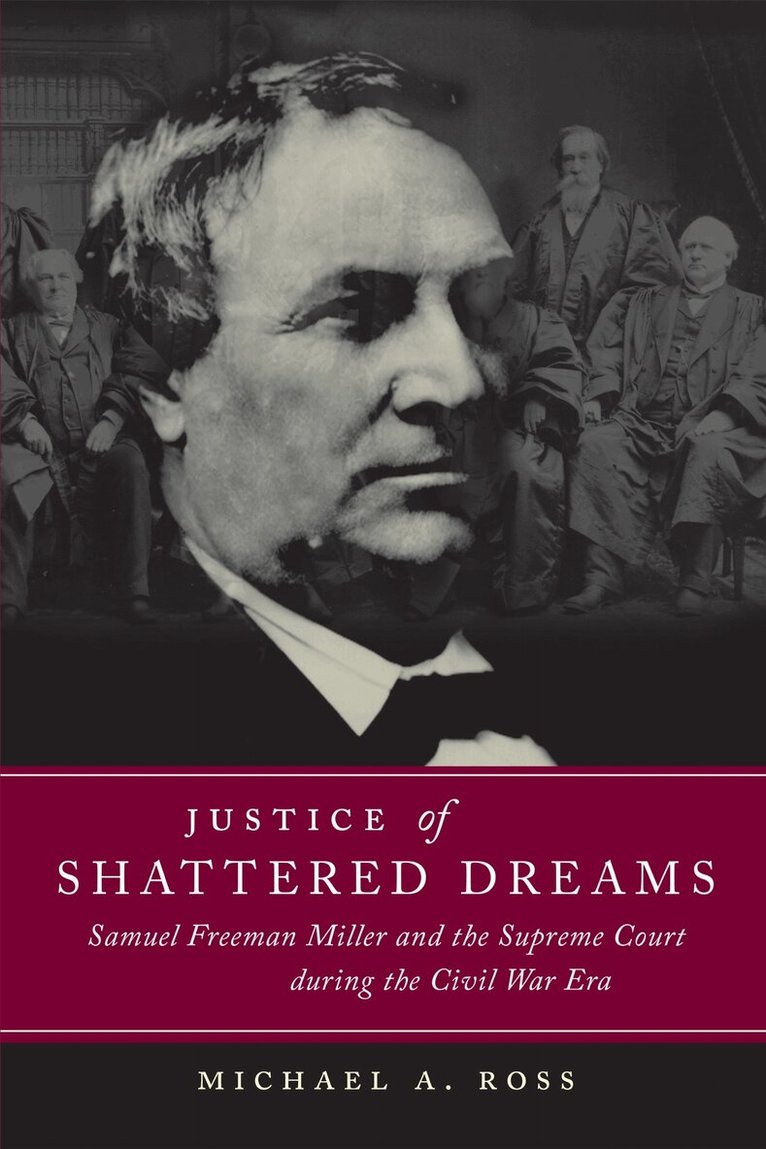
Justice of Shattered Dreams
Samuel Freeman Miller and the Supreme Court During the Civil War Era
Häftad, Engelska, 2003
390 kr
Skickas inom 10-15 vardagar
Appointed by Abraham Lincoln to the U.S. Supreme Court during the Civil War, Samuel Freeman Miller (1816-1890) served on the nation's highest tribunal for twenty-eight tumultuous years and holds a place in legal history as one of the Court's most influential justices. Michael A. Ross creates a colourful portrait of a passionate man grappling with the difficult legal issues arising from a time of wrenching social and political change. He also explores the impact President Lincoln's Supreme Court appointments made on American constitutional history.Best known for his opinions in cases dealing with race and the Fourteenth Amendment, particularly the 1873 Slaughter-House Cases, Miller has often been considered a misguided opponent of Reconstruction and racial equality. In this major reinterpretation, Ross argues that historians have failed to study the evolution of Miller's views during the war and explains how Miller, a former slaveholder, became a champion of African Americans' economic and political rights. He was also the staunchest supporter of the Court of Lincoln's controversial war measures, including the decision to suspend such civil liberties as habeas corpus.Although commonly portrayed as an agrarian folk hero, Miller in fact initially foresaw and embraced a future in which frontier and rivertown settlements would bloom into thriving metropolises. The optimistic vision grew from the free-labor ideology Miller brought to the Iowa Republican Party he helped found, one that celebrated ordinatry citizens' right to rise in station an driches. Disillusioned by the eventual failure of the boomtowns and repelled by the swelling coffers of eastern financiers, corporations, and robber barons, Miller became an insistent judicial voice for western Republicans embittered and marginalized in the Gilded Age. The first biography of Miller since 1939, this welcome volume draws on Miller's previously unavailable papers to shed new light on a man who saw his dreams for America shattered but whose essential political and social values, as well as his personal integrity, remained intact.