Michael D. Torre - Böcker
Visar alla böcker från författaren Michael D. Torre. Handla med fri frakt och snabb leverans.
4 produkter
4 produkter
1 341 kr
Skickas inom 10-15 vardagar
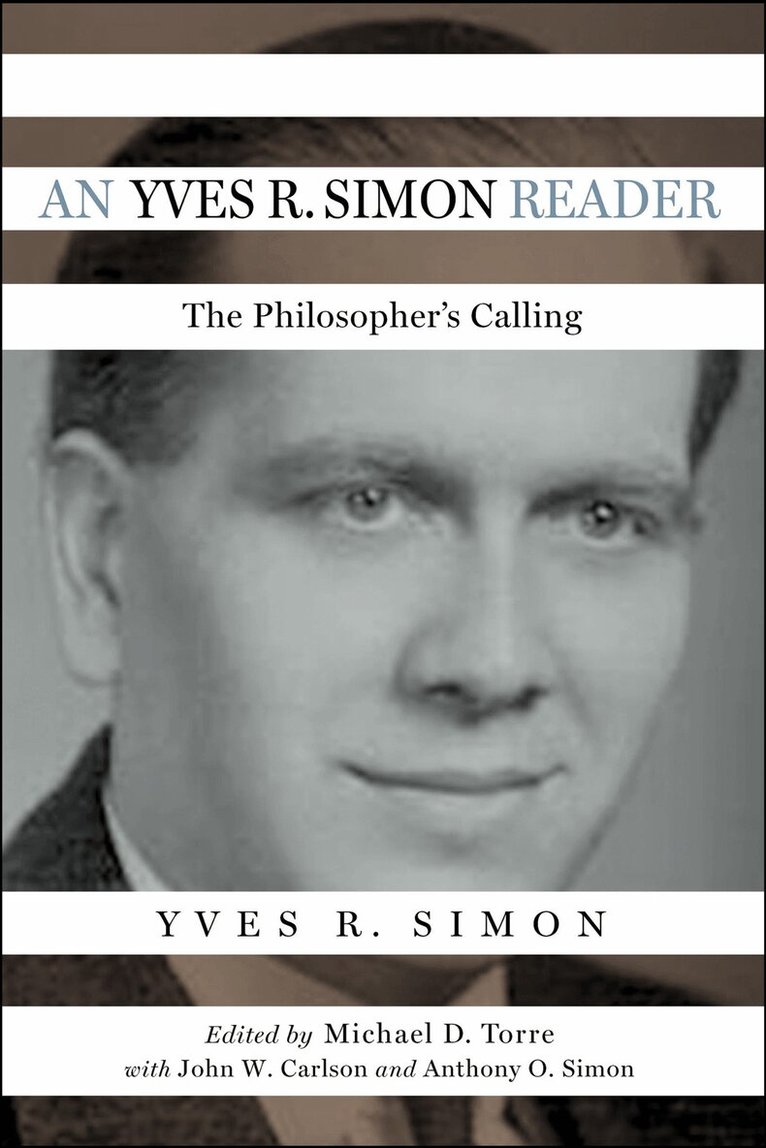
An Yves R. Simon Reader is the first collection of texts from the entirety of the philosopher's work.French Catholic (and then American) political philosopher Yves R. Simon was a student of Jacques Maritain and one of the most important figures in the revival of Thomism. His work, however, is still little known in English, and there is as yet no English biography of him. In An Yves R. Simon Reader: The Philosopher's Calling, Michael D. Torre provides an erudite and helpful introduction to Simon's life and thought. The volume contains selected key texts from all of Simon's twenty books, half of which were published posthumously, dividing them into three sections. The first fundamentally defends the Aristotelian and Thomistic account of human knowing. The second begins with his groundbreaking discussion of human freedom and ends with his account of practical wisdom. The third then expands this account to cover the chief concerns of his social and political philosophy. The selections are long enough to be substantive and contain sustained and complete arguments. Each selection has its own foreword by an eminent commentator, familiar with Simon's work, who lays out the necessary context for the reader.An Yves R. Simon Reader includes sections from several of Simon's last and most important essays: on sensitive knowledge and on the analogous nature of "act." It includes a number of excerpts from his justly famous account and defense of democratic government. The hallmarks of his work—his careful conceptual analysis, his genius for finding undervalued examples, and his talent for creating expressions that revivified an outworn idea—are on display throughout. Indeed, as one of the book's contributors says, Simon touched nothing that he did not adorn. The result is a highly readable introduction to the thought of a key and underappreciated modern philosopher.Contributors: Michael D. Torre, Jude P. Dougherty, Raymond Dennehy, John C. Cahalan, Steven A. Long, Ralph Nelson, John P. Hittinger, Ralph McInerny, David B. Burrell, CSC, Laurence Berns, Catherine Green, W. David Solomon, V. Bradley Lewis, Joseph W. Koterski, SJ, James V. Schall, SJ, George Anastaplo, Walter J. Nicgorski, John A. Gueguen, Jr., Thomas R. Rourke, Jeanne Heffernan Schindler, and Robert Royal.
474 kr
Skickas inom 10-15 vardagar
An Yves R. Simon Reader is the first collection of texts from the entirety of the philosopher's work.French Catholic (and then American) political philosopher Yves R. Simon was a student of Jacques Maritain and one of the most important figures in the revival of Thomism. His work, however, is still little known in English, and there is as yet no English biography of him. In An Yves R. Simon Reader: The Philosopher's Calling, Michael D. Torre provides an erudite and helpful introduction to Simon's life and thought. The volume contains selected key texts from all of Simon's twenty books, half of which were published posthumously, dividing them into three sections. The first fundamentally defends the Aristotelian and Thomistic account of human knowing. The second begins with his groundbreaking discussion of human freedom and ends with his account of practical wisdom. The third then expands this account to cover the chief concerns of his social and political philosophy. The selections are long enough to be substantive and contain sustained and complete arguments. Each selection has its own foreword by an eminent commentator, familiar with Simon's work, who lays out the necessary context for the reader.An Yves R. Simon Reader includes sections from several of Simon's last and most important essays: on sensitive knowledge and on the analogous nature of "act." It includes a number of excerpts from his justly famous account and defense of democratic government. The hallmarks of his work—his careful conceptual analysis, his genius for finding undervalued examples, and his talent for creating expressions that revivified an outworn idea—are on display throughout. Indeed, as one of the book's contributors says, Simon touched nothing that he did not adorn. The result is a highly readable introduction to the thought of a key and underappreciated modern philosopher.Contributors: Michael D. Torre, Jude P. Dougherty, Raymond Dennehy, John C. Cahalan, Steven A. Long, Ralph Nelson, John P. Hittinger, Ralph McInerny, David B. Burrell, CSC, Laurence Berns, Catherine Green, W. David Solomon, V. Bradley Lewis, Joseph W. Koterski, SJ, James V. Schall, SJ, George Anastaplo, Walter J. Nicgorski, John A. Gueguen, Jr., Thomas R. Rourke, Jeanne Heffernan Schindler, and Robert Royal.
849 kr
Skickas inom 7-10 vardagar
The relationship of God's grace and man's free will is one of the most disputed topics in the history of Catholic theology. At the time of the Counter-Reformation, a famous quarrel arose between Jesuit defenders of Molina and Dominican defenders of Bañez. This led to a series of Roman congregations on the ""aids of God's grace"" (de auxiliis), which looked into the matter but settled very little, beyond the pope declaring that neither position was heretical. Leo XIII's call to advance Thomism led to this quarrel resurfacing with renewed force in the first quarter of the twentieth century. Into this fray stepped a renowned Dominican of the University of Fribourg, Francisco Marín-Sola (1873-1932), whose published work on the development of Catholic doctrine had secured his fame among Catholic theologians. In three celebrated articles published in the Ciencia Tomista in 1925 and 1926, he presented a new and revised version of the Dominican position on this question. Marín-Sola suggested that his new version rightly developed the principles of Aquinas and was supported in major part, if only implicitly, by earlier Dominican commentators. Marín-Sola's position was instantly controversial, with some respondents decrying an abandonment of Dominican ideas and others declaring that Marín-Sola had resolved central objections and ended the quarrel of de auxiliis. In this book, Michael D. Torre makes Marín-Sola's articles available in English for the first time. The articles are preceded by an introduction on Marín-Sola and followed by a conclusion that traces the reception of his thought within the Catholic theological community. In Torre's afterword, he defends Marín-Sola's position as substantively the same as that of Aquinas.
901 kr
Skickas inom 7-10 vardagar
This book dedicates three essays each to three different theological problems regarding the Holy Spirit: In God and for Us (The "Filioque" and "Uncreated Grace"); Thomas's Understanding (Not His Commentators) of the Relation between nature and sanctifying grace; and our ability (and that of the angels at their creation) in fact to resist God' grace and thus be the first cause of sin. This later problem is developed in an "excursus" on the way God moves the free will, one that takes into consideration much recent work on this issue and situates the essays' position in relation to it. The book ends with a brief epilogue on the credibility of God, again giving Thomas's account of this.The principal aim throughout is to understand the doctrine of Thomas Aquinas. It places his views in relation to three audiences: chiefly to the orthodox regarding the first issue; to Catholics in relation to the second; and to Protestants in relation to the third. Thus, its second aim is to join "ecumenical debate" about these matters. The essays were mostly written to be delivered orally, to an informed audience of philosophers and theologians., but one that consisted of "generalists" and serious students of Thomas, as well as of "professional" philosophers and theologians. All three of the debated issues discussed have generated an enormous amount of disagreement and debate, not a little of it being quite "technical." Thus, each issue would easily require a long and significant book to be addressed as it deserves. The essays do not do this, but they do indicate what Torre holds is the "directive line" of Thomas's thought that deserves to be defended and developed in each case, and, in each case, this line is held to be markedly different than many have thought it to be.