Michael G. Laramie – författare
Visar alla böcker från författaren Michael G. Laramie. Handla med fri frakt och snabb leverans.
6 produkter
6 produkter
European Invasion of North America
Colonial Conflict Along the Hudson-Champlain Corridor, 1609–1760
Inbunden, Engelska, 2012
809 kr
Skickas inom 10-15 vardagar
This comprehensive resource follows the pivotal and often overlooked efforts of the Iroquois Confederacy, the Dutch, the French, and the English colonies to control the strategic waterways of the Hudson-Champlain corridor from their discovery to the fall of New France.From Champlain and Hudson's initial voyages some 400 years ago, to the surrender of Montreal in 1760, The European Invasion of North America: Colonial Conflict Along the Hudson - Champlain Corridor, 1609–1760 offers unprecedented coverage of the 150-year struggle between New World rivals along this natural invasion route—a struggle which would ultimately determine the destiny of North America.Unlike other volumes on this period, The European Invasion of North America includes extensive coverage from the French and Dutch as well as British perspectives, examining events in the context of larger colonial confrontations. Drawing on hundreds of firsthand accounts, it recaps political maneuvers and blunders, military successes and failures, and the remarkable people behind them all: cabinet ministers in Paris, Amsterdam, and London; colonial leaders such as Stuyvesant, Frontenac, and Montcalm; shrewd diplomats of the Iroquois Confederacy; and soldiers and families on all sides of the conflict. It also highlights the growing friction between Britain and her American colonies, which would soon lead to a different war.
432 kr
Skickas inom 3-6 vardagar
388 kr
Skickas inom 3-6 vardagar
The British campaign to capture Fort Carillon on the Ticonderoga Peninsula in 1758 resulted in the largest battle of the French and Indian War. Crafted by Prime Minister William Pitt, the scope and scale of the British effort was staggering, calling for their northern colonies to raise 20,000 men to rendezvous with the British Regulars at Albany. The directive would test the patience, resources, and will of the colonial governments as well as that of the newly appointed the British commander-in-chief, General James Abercrombie. For the defenders of New France matters were dire. Reports were arriving that Abercrombie’s numbers were over twice the entire fighting strength of Canada. For the French field commander, the Marquis de Montcalm, there were few options. The Marquis had long opposed defending frontier forts, calling for abandoning these posts at the first sign of threat in order to conserve the colony’s resources. The French Governor disagreed and dispatched Montcalm and his white-coated French regulars with orders to defend Fort Carillon. With his army the only thing that stood between the British and the interior of Canada, there appeared to be a single path before the Marquis. Whether the Governor liked it or not, a rearguard action followed by a retreat down Lake Champlain was the only answer that would leave the army of Canada in position to fight again. Yet, within the span of a few days Montcalm would set these views aside, and suddenly risk both his army and the fate of Canada on a single risky battle.Based on journals, letters, and accounts of the participants on both sides, The Road to Ticonderoga: The Campaign of 1758 in the Champlain Valley by Michael G. Laramie recounts this unexpected tale of victory and defeat on the North American frontier. Here we learn how the unexpected death of a dynamic leader, George Howe, elder brother of Richard and William, nearly crushed “the soul of General Abercrombie’s army,” leading to misinterpreted orders and hesitation on the part of the British. At the same time, the French commander perilously underestimated the ability of his own forces while overestimating his enemy’s before his fateful and unexpected decision to make his stand at Ticonderoga. With lessons and repercussions for future warfare in North America, The Road to Ticonderoga shows how a series of small mistakes can cascade into a catastrophe under weak leadership—or be exploited by a strong one.
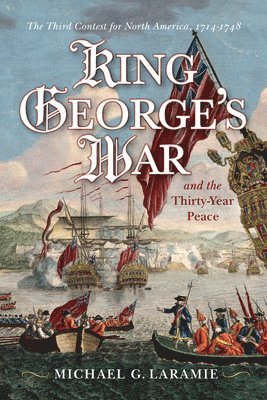
King George's War and the Thirty Year Peace
The Third Contest for North America
Inbunden, Engelska, 2025
432 kr
Skickas inom 3-6 vardagar
The Final Volume in the Award-Winning Wars for North America Trilogy: King William's, Queen Anne's and King George's WarsKing George’s War and the Thirty-Year Peace continues the contest for North America from the end of Queen Anne’s War in 1713, marking the beginning of the Thirty-Year Peace, through the start of King George’s War in 1744, to its conclusion with the signing of Treaty of Aix-la-Chapelle four years later. While there would be little fighting between the French, Spanish, and British colonies in North America during the Thirty-Year Peace—the Franco-Spanish conflict of 1719 being an exception—for the French and British internally it did not prove to be peaceful. Conflicts with former Indigenous allies erupted, including with the Three Years War, the Yamassee War, and the Natchez and Chickasaw Wars. In the south the peace was ruptured by the opening of the War of Jenkin’s Ear in 1739, which led to an attempt by South Carolina and the new colony of Georgia to seize Spanish St. Augustine, and a counter-attack by St. Augustine and Cuba aimed at the destruction of the two British colonies. While this Anglo-Spanish conflict would shift farther south into the Caribbean, to the north, news of another war between France and Britain would arrive in 1744. King George’s War, the North American component of Europe’s War of Austrian Succession, would start in Nova Scotia with French attacks on the weakly held British colony. This provocation inspired a response in the form of one of the boldest expeditions of the colonial period—Massachusetts Governor William Shirley’s successful campaign against Louisbourg on Cape Breton Island. With the French fortress in British hands and the cry of delenda est Canadaechoing through the American colonial assemblies, Shirley turned to the conquest of French Canada and convinced London to dispatch a fleet to assist in the capture of Montreal and Quebec. In Paris, news of Louisbourg’s surrender elicited an unexpected reaction in the form of one of the largest French naval expeditions ever sent to North America, with explicit orders to retake Cape Breton and expel the British from Nova Scotia. Thus, by the summer of 1746, both British and French sentries scanned the eastern horizon daily for a fleet that would determine the destiny of the conflict, but neither would be happy with what they found. The final volume in Michael G. Laramie’s acclaimed histories of the European struggle for North America that set the stage for the French and Indian War, King George’s War and the Thirty-Year Peace: The Third Contest for North America, 1714–1748, takes the reader along with the combatants into the field and waterways, including Native American, French, Spanish, Provincial, and British. Based on a rich variety of primary sources and fully illustrated with original maps, this volume joins the author’s King William’s War and Queen Anne’s War as the modern history of these lesser-known—but enormously important—conflicts that shaped the political story of North America.

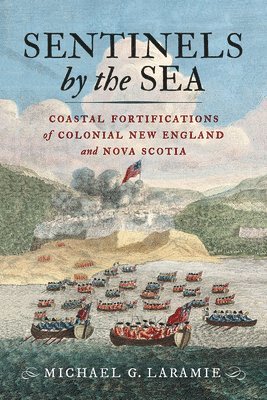
Sentinels by the Sea
Coastal Fortifications of Colonial New England and Nova Scotia
Inbunden, Engelska, 2026
367 kr
Skickas inom 3-6 vardagar
Seventeenth- and eighteenth-century warfare centered on sieges, not seeking out and destroying the enemy’s army in battle. A captured fortress or town was a bargaining piece in the inevitable peace treaty between warring monarchs, an approach even more prevalent during the long and bitter colonial conflicts in North America. Given the vast distances involved, the lack of manpower, and limited logistical resources, each war in North America became one of position—a war of forts. Sentinels by the Sea: Coastal Fortifications of Colonial New England and Nova Scotia by award-winning historian Michael G. Laramie examines the network of forts that stood in opposition to one another during the lengthy conflict between France and England, from 1689 to 1763, in northeastern North America.The story of these strongholds, from the earliest in Boston Harbor to the major fortress at Louisbourg, Nova Scotia, is compiled from a wide range of primary sources: firsthand letters, journals, and accounts from the cabinet ministers and policy makers in Paris, London, Quebec, and Boston, to the personal correspondence and observations of the military engineers and soldiers who faced the challenge of the building these works, as well as the perils that came with attacking or defending them. Their exploits and efforts would not only determine the fate of these fortifications, but also play a prominent role in settling the matter of whether France or Great Britain would control North America and its resources. Fully illustrated, Sentinels by the Sea provides details of the design, construction, armaments, and battles surrounding these important forts that stretched across one of the most contested areas in North American history.
425 kr
Kommande
During the American Civil War the term “Brown Water Navy” was coined to distinguish naval riverine and coastal duties from the activities of the Blue Water, or ocean-going fleet. A Brown Water Navy faced a much different set of challenges then the ocean-going fleet. Coastal and inland waterway operations were always prevalent in North America due to the unique geography of the continent. Lakes such as Erie, Ontario, and Champlain were deep enough and large enough that fleets of vessels could contest their waters, while bays, sounds, and the outlets of large navigable rivers abounded along the continent’s east coast from Hudson Bay to New Orleans. The first volume in this two-volume story, The Age of Sail, 1697–1814, covers the many attempts to control these waterways before the advent of steam warships, including the first major clash above the magnetic North Pole in the Hudson Straits during King William’s War, Charleston, South Carolina’s, home-made anti-pirate fleet, the unusual flotilla launched during the Fourth Anglo-Wabanki War of 1722–1725, the campaigns and battles on Lake Champlain and Lake Ontario, Commodore Hazelwood’s Delaware Defense Fleet of 1777, the epic Battle of the Virginia Capes in 1781, and the stirring American victories on the Great Lakes during the War of 1812. All along the technical and strategic advances are fully described.