Michael Kremer - Böcker
Visar alla böcker från författaren Michael Kremer. Handla med fri frakt och snabb leverans.
4 produkter
4 produkter
Margaret Macdonald and Analytic Philosophy in the 1930s
Unpublished Letters with Biographical and Interpretive Essays
Inbunden, Engelska, 2025
1 051 kr
Skickas inom 5-8 vardagar
This volume examines the important but, until recently, forgotten work of the British analytic philosopher Margaret Macdonald. Macdonald's career spanned one of the most significant and fascinating periods in the history of analytic philosophy: the pre-war London of Susan Stebbing as she advanced philosophical analysis; the Cambridge of Ludwig Wittgenstein as he lectured on his new practice-centred philosophy; the Oxford of Gilbert Ryle and ordinary language philosophy; and the post-war London of A.J. Ayer as he defended a version of logical positivism. In this predominantly male, elite world, Macdonald was an anomaly: a woman, abandoned as a child, raised by foster parents and in an orphanage, poor for much of her life. Remarkably, she made a highly respected academic life for herself. A talented philosopher, she was a major influence on Ryle, and one of those few who really understood Wittgenstein during the 1930s. She also helped found, and later edited, the journal Analysis, and was a serious scholar of C. S. Peirce, introducing his complex work to her British colleagues. Cheryl Misak and Michael Kremer provide a biographical essay, a transcription of a no-longer accessible paper on Peirce, an essay on Macdonald as a scholar of pragmatism, and an essay on her as a scholar of Wittgenstein. The centrepiece is a set of letters from Macdonald to Max Black, written between 1932 and 1937--a crucial time for the development of the analytic school, embracing Cambridge analysis, Viennese logical positivism, Oxford linguistic philosophy, and American pragmatism and neo-realisms. The letters shed light on the cultural, social, and political situation in Britain in the 1930s and its impact on academic life, revealing that, against the mighty obstacles stacked against them, some women in English philosophy before World War II were able to carve out paths as professional philosophers.
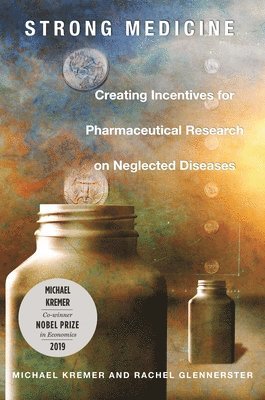
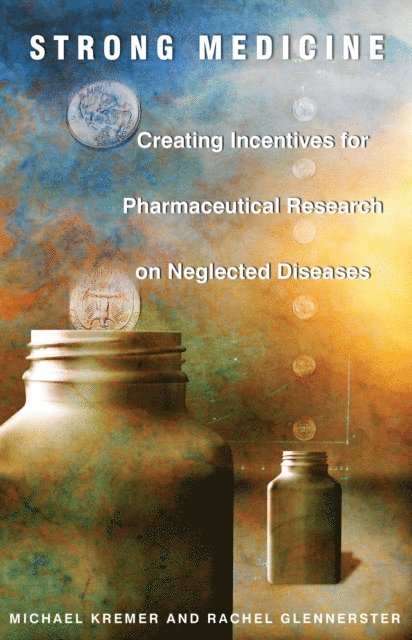
Strong Medicine
Creating Incentives for Pharmaceutical Research on Neglected Diseases
Inbunden, Engelska, 2004
479 kr
Skickas inom 7-10 vardagar
Millions of people in the third world die from diseases that are rare in the first world--diseases like malaria, tuberculosis, and schistosomiasis. AIDS, which is now usually treated in rich countries, still ravages the world's poor. Vaccines offer the best hope for controlling these diseases and could dramatically improve health in poor countries. But developers have little incentive to undertake the costly and risky research needed to develop vaccines. This is partly because the potential consumers are poor, but also because governments drive down prices. In Strong Medicine, Michael Kremer and Rachel Glennerster offer an innovative yet simple solution to this worldwide problem: "Pull" programs to stimulate research. Here's how such programs would work. Funding agencies would commit to purchase viable vaccines if and when they were developed. This would create the incentives for vaccine developers to produce usable products for these neglected diseases. Private firms, rather than funding agencies, would pick which research strategies to pursue. After purchasing the vaccine, funders could distribute it at little or no cost to the afflicted countries.Strong Medicine details just how these legally binding commitments would work. Ultimately, if no vaccines were developed, such a commitment would cost nothing. But if vaccines were developed, the program would save millions of lives and would be among the world's most cost-effective health interventions.
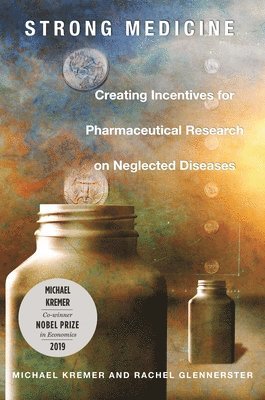
Strong Medicine
Creating Incentives for Pharmaceutical Research on Neglected Diseases
Häftad, Engelska, 2016
483 kr
Skickas inom 3-6 vardagar
Millions of people in the third world die from diseases that are rare in the first world--diseases like malaria, tuberculosis, and schistosomiasis. AIDS, which is now usually treated in rich countries, still ravages the world's poor. Vaccines offer the best hope for controlling these diseases and could dramatically improve health in poor countries. But developers have little incentive to undertake the costly and risky research needed to develop vaccines. This is partly because the potential consumers are poor, but also because governments drive down prices. In Strong Medicine, Michael Kremer and Rachel Glennerster offer an innovative yet simple solution to this worldwide problem: "Pull" programs to stimulate research. Here's how such programs would work. Funding agencies would commit to purchase viable vaccines if and when they were developed. This would create the incentives for vaccine developers to produce usable products for these neglected diseases. Private firms, rather than funding agencies, would pick which research strategies to pursue. After purchasing the vaccine, funders could distribute it at little or no cost to the afflicted countries.Strong Medicine details just how these legally binding commitments would work. Ultimately, if no vaccines were developed, such a commitment would cost nothing. But if vaccines were developed, the program would save millions of lives and would be among the world's most cost-effective health interventions.
198 kr
Skickas inom 7-10 vardagar
Making a commitment in advance to buy vaccines if and when they are developed would create incentives for industry to increase investment in research and development. New commercial investment would complement funding of research and development by public and charitable bodies, accelerating the development of vital new vaccines for the developing world. This report presents the proposal from theory to practice, by showing how a commitment can be consistent with ordinary legal and budgetary principles. By creating arrangements that devote the same scientific effort to diseases of the poor as we put into diseases of the rich, we can make a lasting contribution to the defeat of poverty.