Michael M. Harmon - Böcker
Visar alla böcker från författaren Michael M. Harmon. Handla med fri frakt och snabb leverans.
3 produkter
3 produkter
Del 1 - Rethinking Public Administration
Responsibility as Paradox
A Critique of Rational Discourse on Government
Häftad, Engelska, 1995
1 738 kr
Skickas inom 3-6 vardagar
Sponsored by the Public Administration Theory Network and Lewis and Clark College "A masterly philosophical approach to a question that is of particular interest to those involved in public administration." --International Review of Administrative Sciences "Michael M. Harmon's new book provides a fresh, new approach to issues of administrative responsibility. The dilemmas faced in charting responsible behavior in pursuit of the collective interest are beautifully described. The book is must reading for anyone who wants to confront ethical issues as they really exist in modern government." --Frank P. Sherwood, Reubin O'D. Askew School of Public Administration and Policy, The Florida State University "Harmon's book is the first of a series designed to satisfy a long-standing need 'to reexamine and enrich thinking in the field of public administration.' . . . Harmon argues that acceptance of personal responsibility may enable one to avoid certain pitfalls resulting from compliance with rationalist emphasis on institutional accountability and obligation. The author urges public servants and citizens to resolve the moral uncertainty stemming from the conflict between personal and institutional responsibility." --Choice Creating a new paradigm, Responsibility as Paradox reframes the theoretical and practical discourse on responsibility in government. Mainstream literature on this subject holds that responsible action is synonymous with legally or morally correct action. This belief, the author argues, is fundamentally flawed owing to the paradoxical character of responsibility, which embodies two opposing ideas: moral agency and accountability to institutional authority. By ignoring the personal, subjective nature of responsibility, which inheres in people's status as moral agents, rationalist responsibility generates three "vicious" paradoxes: obligation, agency, and accountability. Responsibility as Paradox demonstrates how, for each of these three paradoxes, the meanings of agency and answerability may be transformed into creative tension with one another, revealing responsibility as a continuing struggle to integrate the requirements of institutional authority with the dictates of conscience and the unique contingencies of administrative situations. Responsibility as Paradox is essential reading for students and others interested in public administration and political science.
Public Administration's Final Exam
A Pragmatist Restructuring of the Profession and the Discipline
Häftad, Engelska, 2016
256 kr
Skickas inom 7-10 vardagar
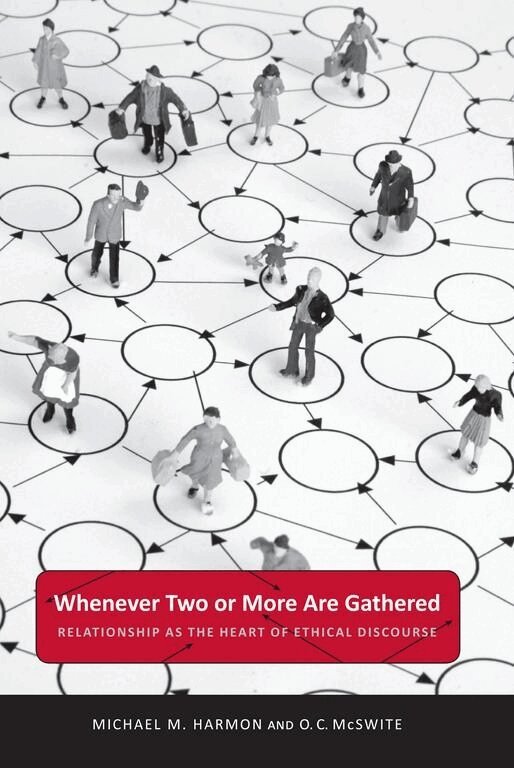
Whenever Two or More Are Gathered
Relationship As the Heart of Ethical Discourse
Häftad, Engelska, 2022
309 kr
Skickas inom 7-10 vardagar
Makes the case for human relationship as the proper foundation of administrative ethicsThis study of the critical role of ethics and moral responsibility in the field of public administration, Michael M. Harmon and O. C. McSwite posit that administrative ethics, as presently conceived and practiced, is largely a failure, incapable of delivering on its original promise of effectively regulating official conduct in order to promote the public interest. They argue that administrative ethics is compromised at its very foundations by two core assumptions: that human beings act rationally and that language is capable of conveying clear, stable, and unambiguous principles of ethical conduct. The result is the illusion that values, principles, and rules of ethical conduct can be specified in workably clear ways, in particular, through their formalization in official codes of ethics; that people are capable of comprehending and responding to them as they are intended; and that the rewards and punishments attached to them will be effective in structuring daily behavior. In a series of essays that draw on both fiction and film, as well as the disciplines of pragmatism, organizational theory, psychoanalysis, structural linguistics, and economics, Harmon and McSwite make their case for human relationship as the proper foundation of administrative ethics. “Exercising responsible ethical practice requires attaining a special kind of relationship with other people. Relationship is how the pure freedom that resides in the human psyche—for ethical choice, creativity, or original action of any type—can be brought into the structured world of human social relations without damaging or destroying it.” Furthermore, they make the case for dropping the term “ethics” in favor of the term “responsibility,” as “responsibility accentuates the social [relational] nature of moral action.”