Michael M.J. Fischer - Böcker
Visar alla böcker från författaren Michael M.J. Fischer. Handla med fri frakt och snabb leverans.
3 produkter
3 produkter
257 kr
Skickas inom 7-10 vardagar
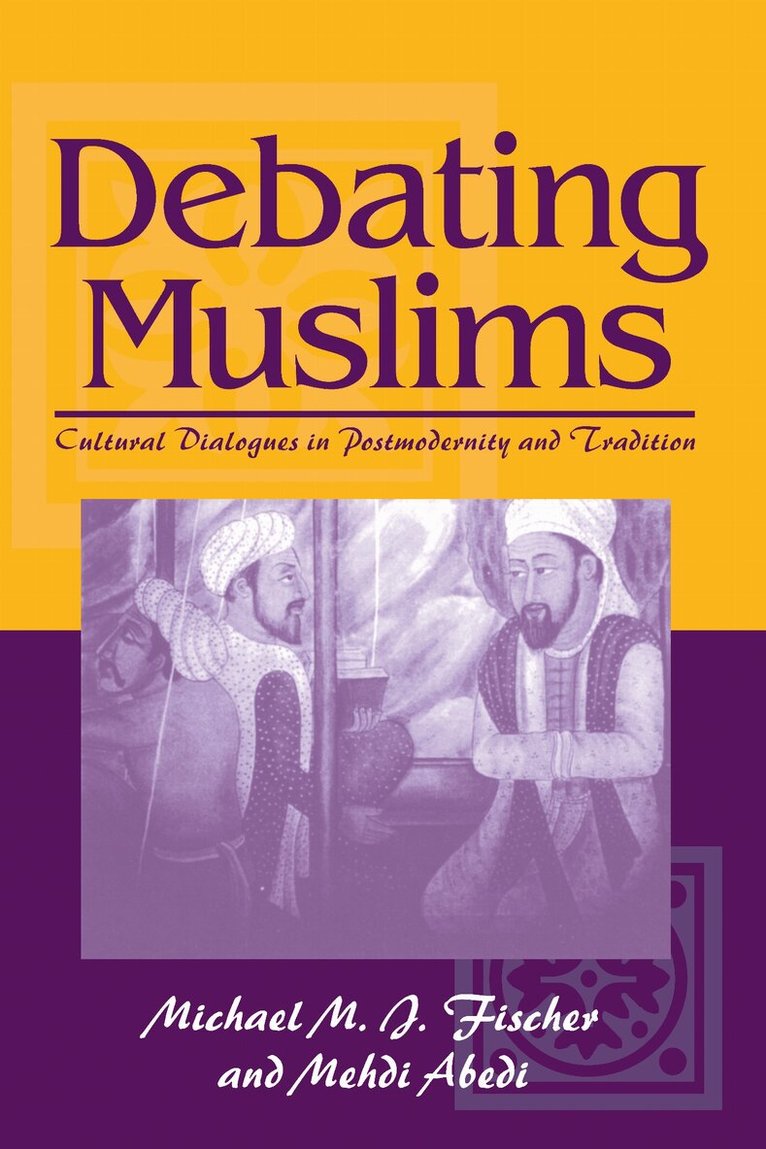
The aim of this book is to present in their historical context the debates that have been taking place in the Muslim world recently. It describes the place of Iranian culture in contemporary art and thought and the increasing influence Muslims are having on Western societies. In an introductory autobiographical chapter, Mehdi Abedi introduces readers to the world of Shi'ite believers. Beginning with the overthrow of Mossadegh in 1953 he describes Iranian class structure, patronage network, socialization, and religious psychology and shows how the political consciousness of an entire generation of Iranian youth - both religious fundamentalist and Marxist - was formed and exercised. Continuing with a description of how Muslims read and interpret the Qur'an, Michael Fischer and Mehdi Abedi set the interpretations against contemporary theories of reading in the modernist and postmodernist West and against contemporary Jewish and Christian thought. Other chapters analyze the hajj, the pilgrimage to Mecca and its various functions; describe the debate about nationalism and Islam between Shariati and Motahhari, two thinkers crucial to the revolution; outline the historical evolution of Baha'ism as apart from Shi'ism; and consider the burgeoning diaspora of Muslims in the West, using Houston as an example. A final chapter considers Iranian art as illustrative of the postmodern, intercultural context of the revolution and of contemporary Islam.
429 kr
Skickas inom 7-10 vardagar
The Post-Global City seeks to open a new field of analytical inquiry that examines knowledge production and technological developments in urban Africa rooted in local, historical realities, while also partaking in transnational, global processes. This work explores the ways in which urban residents have utilized technologies and networks to operate around, under, and beyond the state and the international “order,” and challenges the stereotypical images of Africa as a continent either devoid of technology or filled with either broken technologies or technologies from the Global North or Asia. This book focuses on accounts and critiques of new “Rising Africa” ideologies, examining megaprojects such as geothermal and hydroelectric plants with new networked startups that circumvent state and patriarchal hierarchies, women vendors selling online, youths designing and constructing oil refining technologies and tech startups working across diasporas.Grounded in ethnographic fieldwork carried out in urban spaces in Nigeria, Kenya, the Democratic Republic of Congo, Sudan, Gabon, Cameroon, and Tanzania, The Post-Global City brings together voices from Africa, Europe, and the United States to inquire into the dialectics between technology and the urban on the African continent.
1 356 kr
Skickas inom 7-10 vardagar
The Post-Global City seeks to open a new field of analytical inquiry that examines knowledge production and technological developments in urban Africa rooted in local, historical realities, while also partaking in transnational, global processes. This work explores the ways in which urban residents have utilized technologies and networks to operate around, under, and beyond the state and the international “order,” and challenges the stereotypical images of Africa as a continent either devoid of technology or filled with either broken technologies or technologies from the Global North or Asia. This book focuses on accounts and critiques of new “Rising Africa” ideologies, examining megaprojects such as geothermal and hydroelectric plants with new networked startups that circumvent state and patriarchal hierarchies, women vendors selling online, youths designing and constructing oil refining technologies and tech startups working across diasporas.Grounded in ethnographic fieldwork carried out in urban spaces in Nigeria, Kenya, the Democratic Republic of Congo, Sudan, Gabon, Cameroon, and Tanzania, The Post-Global City brings together voices from Africa, Europe, and the United States to inquire into the dialectics between technology and the urban on the African continent.