Michael Usher - Böcker
Visar alla böcker från författaren Michael Usher. Handla med fri frakt och snabb leverans.
4 produkter
4 produkter
876 kr
Skickas inom 7-10 vardagar
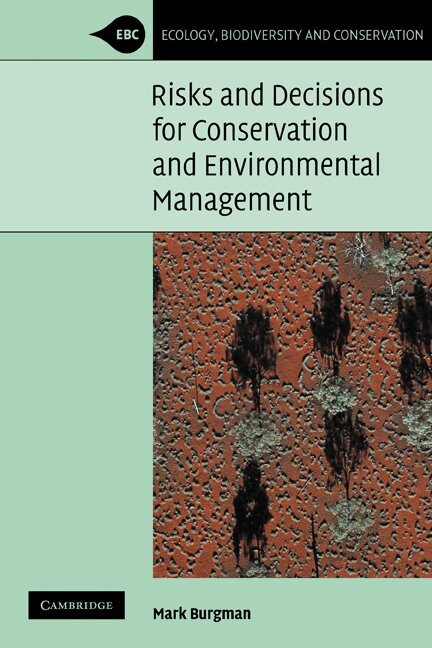
This book outlines how to conduct a complete environmental risk assessment. The first part documents the psychology and philosophy of risk perception and assessment, introducing a taxonomy of uncertainty and the importance of context. It provides a critical examination of the use and abuse of expert judgement and goes on to outline approaches to hazard identification and subjective ranking that account for uncertainty and context. The second part of the book describes technical tools that can assist risk assessments to be transparent and internally consistent. These include interval arithmetic, ecotoxicological methods, logic trees and Monte Carlo simulation. These methods have an established place in risk assessments in many disciplines and their strengths and weaknesses are explored. The last part of the book outlines some new approaches, including p-bounds and information-gap theory, and describes how quantitative and subjective assessments can be used to make transparent decisions.
850 kr
Skickas inom 7-10 vardagar
Soil has generally been regarded as something of a 'black box' by ecologists. The importance of soil is obvious: it provides physical support for plants, and both the living and non-living components contribute to a variety of important environmental functions. Soil is a species-rich habitat, but many questions about the ecological significance of the soil's biological diversity, and in particular how it affects ecosystem function, have never been asked. The linkages between above-ground ecology, which is rich in ecological theory, and below-ground ecology, where investigation has been restricted by methodological difficulties, have not been made. Technical developments, including isotopic and molecular methods as well as experimental and modelling approaches, have led to a renaissance in soil biodiversity research. The key areas are reflected in this exciting volume which brings together many leading contributors to explore the role and importance of soil biota.
191 kr
Skickas inom 5-8 vardagar
538 kr
Skickas inom 10-15 vardagar
In the mid 1970s two events led me to get to know the Yorkshire Dales better than I had previously. Since 1964 I had been to the Malham Tarn Field Centre with groups of students, first from the University of Edinburgh and then from the University of York, and my family very much enjoyed the summer days we spent amid this magnificent hill scenery. In 1976, the British Ecological Society and the National Trust jointly worked on a survey of the biological interest of the National Trust properties of the Kent, East Anglian and Yorkshire Regions. Malham Tarn itself, and the surrounding farms, formed one of the twenty properties of the Yorkshire Region. I spent the bank holiday, that commemorated the Queen's Silver Jubilee, at Malham, looking fairly closely at the National Trust's landholding there. Miss Sarah Priest, who also looked at the National Trust properties, and I produced a report in late 1977, attempting both to describe and to evaluate the nature resources of the National Trust in Yorkshire. In the following year, 1978, the Nature Conservancy Council wanted to survey the whole of the upland area that was known as the Malhaml Arncliffe SSSI (Site of Special Scientific Interest). A contract to look at such an exciting area, considering where boundaries should go, and looking to see if there were important areas of habitat that should be brought within the SSSI, was a superb practical antidote to an office in the University.