Michel Chaouli - Böcker
Visar alla böcker från författaren Michel Chaouli. Handla med fri frakt och snabb leverans.
5 produkter
5 produkter
903 kr
Skickas inom 7-10 vardagar
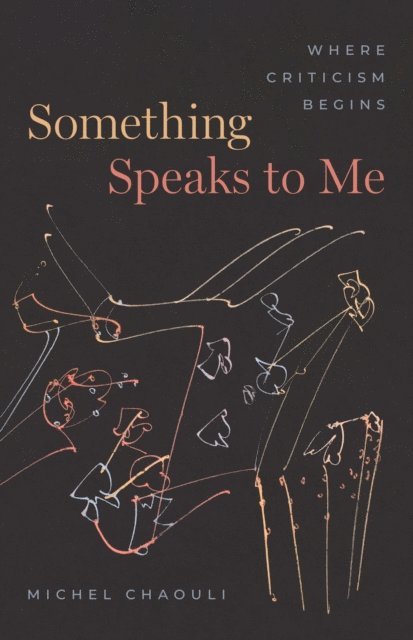
An account of criticism as an urgent response to what moves us.Criticism begins when we put down a book to tell someone about it. It is what we do when we face a work or event that bowls us over and makes us scramble for a response. As Michel Chaouli argues, criticism involves three moments: Something speaks to me. I must tell you about it. But I don’t know how. The heart of criticism, no matter its form, lies in these surges of thoughts and feelings. Criticism arises from the fundamental need to share what overwhelms us.We tend to associate criticism with scholarship and journalism. But Chaouli is not describing professional criticism, but what he calls “poetic criticism”—a staging ground for surprise, dread, delight, comprehension, and incomprehension. Written in the mode of a philosophical essay, Something Speaks to Me draws on a wide range of writers, artists, and thinkers, from Kant and Schlegel to Merleau-Ponty, Bachelard, Barthes, and Cavell. Reflecting on these dimensions of poetic experience, Something Speaks to Me is less concerned with joining academic debates than communicating the urgency of criticism.
225 kr
Skickas inom 7-10 vardagar
An account of criticism as an urgent response to what moves us.Criticism begins when we put down a book to tell someone about it. It is what we do when we face a work or event that bowls us over and makes us scramble for a response. As Michel Chaouli argues, criticism involves three moments: Something speaks to me. I must tell you about it. But I don’t know how. The heart of criticism, no matter its form, lies in these surges of thoughts and feelings. Criticism arises from the fundamental need to share what overwhelms us.We tend to associate criticism with scholarship and journalism. But Chaouli is not describing professional criticism, but what he calls “poetic criticism”—a staging ground for surprise, dread, delight, comprehension, and incomprehension. Written in the mode of a philosophical essay, Something Speaks to Me draws on a wide range of writers, artists, and thinkers, from Kant and Schlegel to Merleau-Ponty, Bachelard, Barthes, and Cavell. Reflecting on these dimensions of poetic experience, Something Speaks to Me is less concerned with joining academic debates than communicating the urgency of criticism.
458 kr
Skickas inom 10-15 vardagar
Why read Kant’s Critique of Judgment today? Does this classic of aesthetic theory still possess the vitality to prompt those of us engaged with art and criticism to think more deeply about issues that move us, issues such as the force of aesthetic experience, the essence of art, and the relationship of beauty and meaning? It does, if we find the right way into it.Michel Chaouli shows us one such way. He unwraps the gray packing paper of Kant’s prose to reveal the fresh and fierce ideas that dwell in this masterpiece—not just the philosopher’s theory of beauty but also his ruminations on organisms and life. Each chapter in Thinking with Kant’s Critique of Judgment unfolds the complexity of a key concept, to disclose its role in Kant’s thought and to highlight the significance it holds for our own thinking.Chaouli invites all who are interested in art and interpretation—novice and expert alike—to set out on the path of thinking with the Critique of Judgment. The rewards are handsome: we see just how profoundly Kant’s book can shape our own ideas about aesthetic experience and meaning. By thinking with Kant, we learn to surpass the horizon of his thought and find ourselves pushed to the very edge of what can be grasped firmly. That is where Kant’s book is at its most thrilling.
585 kr
Tillfälligt slut
Bringing to light an unexpected encounter between the natural sciences and the theory of poetry at the end of the eighteenth century, this book argues that some of romanticism's most daring and enduring innovations owe their form and substance to the subject of chemistry. By focusing on the work of Friedrich Schlegel (1772-1829), The Laboratory of Poetry demonstrates the degree to which romantic poetics, in its language and concepts, relies on the chemistry of its day. This argument revises our very understanding of the period, for rather than taking romanticism to assume a hostile stance toward science, we can now see how it works to embrace fundamental scientific concepts (for example, the experiment, the element, and the combinatorial method). Because our own historical moment continues to be indebted to romanticism, such a shift in understanding prompts a rethinking in our ideas of the interrelation of literature, philosophy, and science. Chemistry around 1800 was a science in upheaval, situated somewhere between modern chemistry and alchemy, between a mechanistic and an organic view of the world.In its concepts and images, as Michel Chaouli demonstrates, Schlegel found the means to imagine the production and reception of verbal artifacts in entirely new ways. In finely detailed close readings, Chaouli shows us Schlegel developing and practicing a highly experimental form of writing in which the elements of language-words, syllables, letters, graphic marks-are subjected to "eternally dividing and mixing forces." This idea, so machinelike in its combinations, represents a sharp departure from the traditional idea of romantic artwork-as-organism. Rather, chemistry opens a space between the organic and the mechanical-a space that turns out to be highly productive for a novel theory of literature. Reconsidering Schlegel in this light, Chaouli shows how the chemical can also be understood as a contribution to the history and theory of media: it registers the disquieting contact of human wants and nonhuman systems of archiving, the intersection of intentions and feelings with material systems such as language and writing-the very intersection that interests and involves us in literature.
1 594 kr
Skickas inom 5-8 vardagar
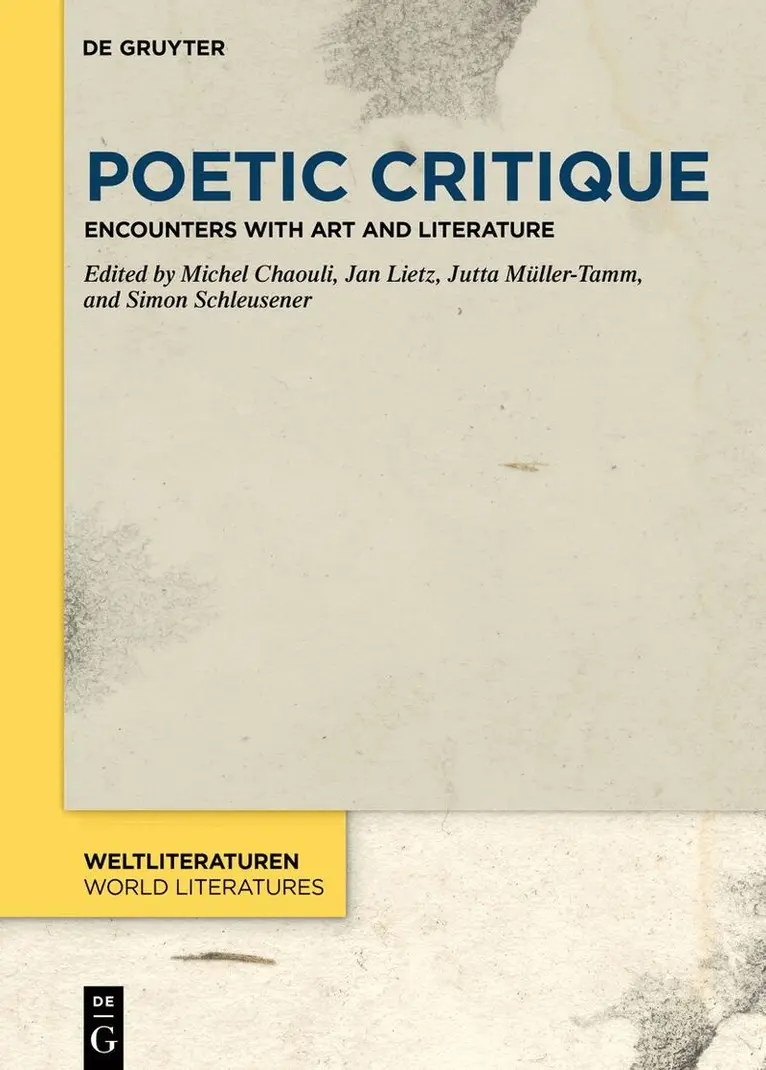
Poetic critique – is that not an oxymoron? Do these two forms of behavior, the poetic and the critical, not pull in different, even opposite, directions? For many scholars working in the humanities today, they largely do, but that has not always been the case. Friedrich Schlegel, for one, believed that critique worthy of its name must itself be poetic. Only then would it stand a chance of responding adequately to the work of art. Taking Schlegel’s idea of poetische Kritik as a starting point, this volume reflects on the possibility of drawing these alleged opposites closer together. In light of current debates about the legacy of critique, it investigates whether a concept such as poetic critique (or poetic criticism) lends itself to enriching our intellectual practice by engaging with the poetic potential of criticism and the critical value of art and literature.