Michel Devoret – Författare
Visar alla böcker från författaren Michel Devoret. Handla med fri frakt och snabb leverans.
3 produkter
3 produkter
Del 96 - Lecture Notes of the Les Houches Summer School
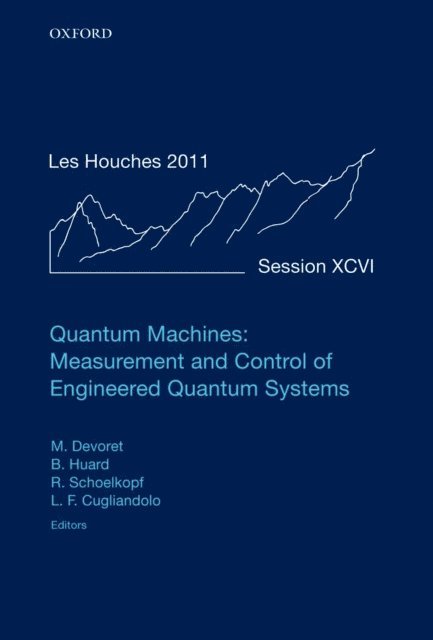
Quantum Machines: Measurement and Control of Engineered Quantum Systems
Lecture Notes of the Les Houches Summer School: Volume 96, July 2011
Inbunden, Engelska, 2014
1 130 kr
Skickas inom 5-8 vardagar
This book gathers the lecture notes of courses given at the 2011 summer school in theoretical physics in Les Houches, France, Session XCVI.What is a quantum machine? Can we say that lasers and transistors are quantum machines? After all, physicists advertise these devices as the two main spin-offs of the understanding of quantum mechanical phenomena. However, while quantum mechanics must be used to predict the wavelength of a laser and the operation voltage of a transistor, it does not intervene at the level of the signals processed by these systems. Signals involve macroscopic collective variables like voltages and currents in a circuit or the amplitude of the oscillating electric field in an electromagnetic cavity resonator. In a true quantum machine, the signal collective variables, which both inform the outside on the state of the machine and receive controlling instructions, must themselves be treated as quantum operators, just as the position of the electron in a hydrogen atom. Quantum superconducting circuits, quantum dots, and quantum nanomechanical resonators satisfy the definition of quantum machines. These mesoscopic systems exhibit a few collective dynamical variables, whose fluctuations are well in the quantum regime and whose measurement is essentially limited in precision by the Heisenberg uncertainty principle. Other engineered quantum systems based on natural, rather than artificial degrees of freedom can also qualify as quantum machines: trapped ions, single Rydberg atoms in superconducting cavities, and lattices of ultracold atoms. This book provides the basic knowledge needed to understand and investigate the physics of these novel systems.
Condensation And Coherence In Condensed Matter - Proceedings Of The Nobel Jubilee Symposium
Inbunden, Engelska, 2003
1 652 kr
Tillfälligt slut
In 2001, the Nobel Foundation celebrated the 100th anniversary of the first Nobel Prize, and all previous Nobel laureates were invited to attend the Nobel ceremonies in Stockholm. This gave an excellent opportunity for arranging jubilee symposia with topics that would attract several of the laureates. The chosen subject of “Condensation and Coherence in Condensed Systems” attracted sixteen Nobel laureates and another thirty-five leading scientists.The idea was to bring scientists together from several related subdisciplines: atomic physics, quantum optics, and condensed matter physics, for cross-breeding of ideas, concepts, and experience. Subjects like phase transitions in strongly coupled systems, Bose-Einstein condensation in weakly coupled systems, macroscopic quantum phenomena, coherence in mesoscopic structures, and quantum information were intensively discussed from different points of view. Coherence phenomena in condensed systems were emphasized. A special session was devoted to the emerging field of quantum computing, with experimental and theoretical results reported for different types of qu-bits. The 2001 Nobel Prize awarded to Eric Cornell, Wolfgang Ketterle, and Carl Wieman, “for the achievement of Bose-Einstein condensation in dilute gases of alkali atoms, and for early fundamental studies of the properties of the condensates,” gave an extra flavor to the theme of the Centennial Symposium.
Condensation And Coherence In Condensed Matter - Proceedings Of The Nobel Jubilee Symposium
Häftad, Engelska, 2003
652 kr
Tillfälligt slut
In 2001, the Nobel Foundation celebrated the 100th anniversary of the first Nobel Prize, and all previous Nobel laureates were invited to attend the Nobel ceremonies in Stockholm. This gave an excellent opportunity for arranging jubilee symposia with topics that would attract several of the laureates. The chosen subject of “Condensation and Coherence in Condensed Systems” attracted sixteen Nobel laureates and another thirty-five leading scientists.The idea was to bring scientists together from several related subdisciplines: atomic physics, quantum optics, and condensed matter physics, for cross-breeding of ideas, concepts, and experience. Subjects like phase transitions in strongly coupled systems, Bose-Einstein condensation in weakly coupled systems, macroscopic quantum phenomena, coherence in mesoscopic structures, and quantum information were intensively discussed from different points of view. Coherence phenomena in condensed systems were emphasized. A special session was devoted to the emerging field of quantum computing, with experimental and theoretical results reported for different types of qu-bits. The 2001 Nobel Prize awarded to Eric Cornell, Wolfgang Ketterle, and Carl Wieman, “for the achievement of Bose-Einstein condensation in dilute gases of alkali atoms, and for early fundamental studies of the properties of the condensates,” gave an extra flavor to the theme of the Centennial Symposium.