Michele E. Commercio - Böcker
Visar alla böcker från författaren Michele E. Commercio. Handla med fri frakt och snabb leverans.
2 produkter
2 produkter
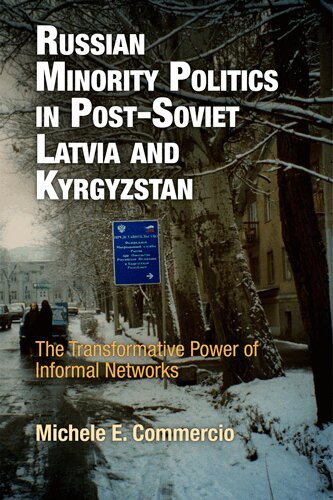
Russian Minority Politics in Post-Soviet Latvia and Kyrgyzstan
The Transformative Power of Informal Networks
Inbunden, Engelska, 2010
806 kr
Skickas inom 10-15 vardagar
The collapse of the Soviet Union suddenly rendered ethnic Russians living in non-Russian successor states like Latvia and Kyrgyzstan new minorities subject to dramatic political, economic, and social upheaval. As elites in these new states implemented formal policies and condoned informal practices that privileged non-Russians, ethnic Russians had to react. In Russian Minority Politics in Post-Soviet Latvia and Kyrgyzstan, Michele E. Commercio draws on extensive field research, including hundreds of personal interviews, to analyze the responses of minority Russians to such policies and practices. In particular, she focuses on the role played by formal and informal institutions in the crystallization of Russian attitudes, preferences, and behaviors in these states.Commercio asks why there is more out-migration and less political mobilization among Russians in Kyrgyzstan, a state that adopts policies that placate both Kyrgyz and Russians, and less out-migration and more political mobilization among Russians in Latvia, a state that adopts policies that favor Latvians at the expense of Russians. Challenging current thinking, she suggests that the answer to this question lies in the power of informal networks.After the fall of the Soviet Union, the Communist party, Komsomol youth organization, and KGB networks were transformed into informal networks. Russians in Kyrgyzstan were for various reasons isolated from such networks, and this isolation restricted their access to the country's private sector, making it difficult for them to create effective associations capable of representing their interests. This resulted in a high level of Russian exit and the silencing of Russian voices. In contrast, Russians in Latvia were well connected to such networks, which provided them with access to the country's private sector and facilitated the establishment of political parties and nongovernmental organizations that represented their interests. This led to a low level of Russian exit and high level of Russian voice. Commercio concludes that informal networks have a stronger influence on minority politics than formal institutions.
821 kr
Skickas inom 7-10 vardagar
During Soviet rule, the state all but imposed atheism on the primarily Islamic people of Kyrgyzstan and limited the tradition of polygyny—a form of polygamy in which one man has multiple wives. Polygyny did continue under communism, though chiefly under concealment. In the decades since the fall of the Soviet Union, the practice has reemerged. Based on extensive fieldwork, Polygynous Marriages among the Kyrgyz argues that this marriage practice has become socially acceptable and widely dispersed not only because it is rooted in customary law and Islamic practice, but because it can also enable men and women to meet societal expectations and solve practical economic problems that resulted from the fall of the Soviet Union. Michele E. Commercio’s analysis suggests the normalization of polygyny among the Kyrgyz in contemporary Kyrgyzstan is due both to institutional change in the form of altered governmental rules and expectations and to institutional endurance in the form of persistent hegemonic constructions of gender.