Milton Osborne – författare
Visar alla böcker från författaren Milton Osborne. Handla med fri frakt och snabb leverans.
4 produkter
4 produkter
240 kr
Skickas inom 3-6 vardagar
299 kr
Tillfälligt slut
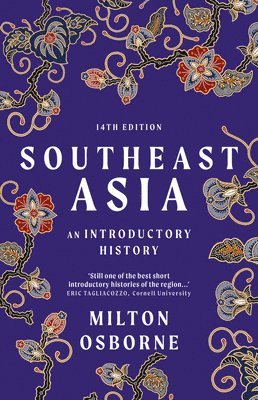
A lively and easy-to-read guide to Southeast Asian history written by one of the world's pre-eminent historians of the area.Southeast Asia: An introductory history was first published in 1979 and immediately filled a need for travellers and students interested in one of the most dynamic and diverse regions of the world. Now in its fourteenth edition, it remains the classic overview for newcomers and locals alike.Dr Milton Osborne has been a resident and fascinated observer of Southeast Asia for decades, and he brings this personal familiarity to his account. He opens with the early history, including the famous Angkor empire and the great traders of Srivijaya. He then concentrates on the changes that have taken place since the 18th century: the impact of colonial rule, the economic transformations of the following two centuries, the emergence and triumph of the independence movements, the rise of the middle classes, and the pivotal roles played by religion, ethnic minorities and immigrant groups. He shows how each country has addressed major economic crises and terrorism, and maps the shifting forms of government.'Still one of the best short introductory histories of the region...' - Eric Tagliacozzo, Cornell University'A short, selective, and well-presented introduction to the modern history of Southeast Asia based on solid scholarship.' -Education About Asia Journal'Students of Southeast Asian history will be grateful to Milton Osborne for writing this appealing and intelligent tour de force; the book is a triumph of organisation.'-David Chandler'He writes books on the region which have two qualities rarely found in combination: impeccable and authoritative scholarship and the vividness and lightness of touch of first-rate travel writing.'-Christopher Koch
163 kr
Skickas
Forever linked in the public mind with the Pol Pot tyranny, Phnom Penh only became Cambodia's permanent capital in 1866. Long neglected by Western travellers, in the sixteenth century it was home to Iberian missionaries and freebooters who briefly held Cambodia's fate in their hands. It faded in significance until France established a colonial protectorate over Cambodia in 1863. As the colonialists robbed the Cambodian king of his temporal power, their protection enhanced his symbolic importance, setting the scene for the emergence of one of the most intriguing rulers of the twentieth century, King Norodom Sihanouk. The city Sihanouk ruled from 1941 to 1970 was a mix of traditional palaces, Buddhist temples and transplanted French architecture. In the 1960s Phnom Penh deserved its reputation as the most attractive city in Southeast Asia.But after 1970 all this was to change, and a terrible civil war was followed by the Khmer Rouge's capture of the city in 1975. Since the defeat of Pol Pot in 1979, Phnom Penh has slowly recovered, once again attracting perceptive travellers.It is a city of royalty and colonizers - Kings, courts and battles with French administrators; royal ceremonies, dancers and elephants; foreign intrigue and carpetbaggers who sought and failed to find riches. It is a city of culture - A rich local culture that became a headache for French officials; traditional architecture and colonial buildings that remain today; notable literary visitors from Somerset Maugham to Andre Malraux. It is a city of evil and rebirth - The terrible rule of Pol Pot; the Tuol Sleng extermination centre where 17,000 men, women and children were tortured and killed as "enemies of the state"; the return to a fragile normality.
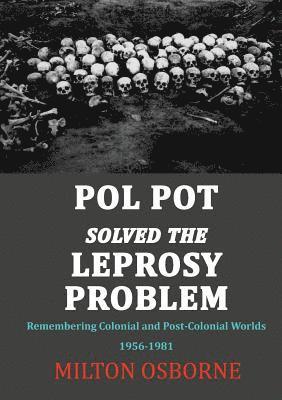
Pol Pot Solved the Leprosy Problem: Remembering Colonial and Post-Colonial Worlds 1956-1981
Häftad, Engelska, 2018
309 kr
Skickas inom 5-8 vardagar