Miriam Goheen - Böcker
Visar alla böcker från författaren Miriam Goheen. Handla med fri frakt och snabb leverans.
3 produkter
3 produkter
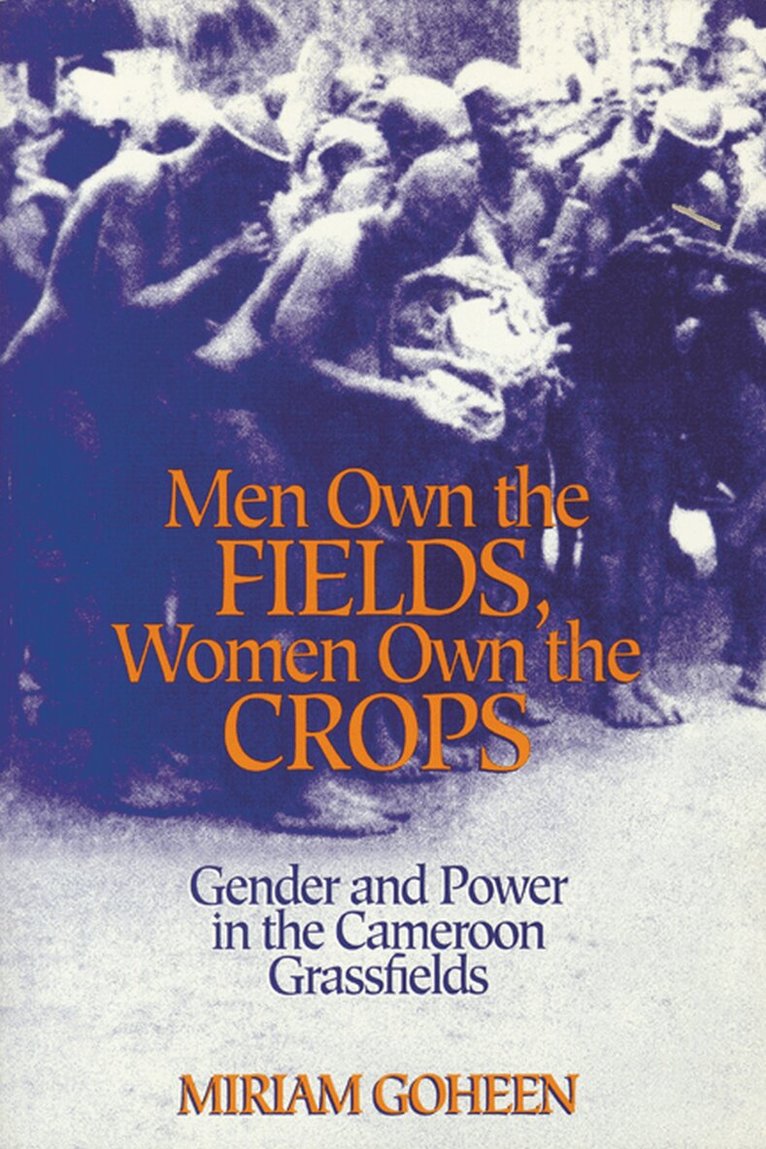
Men Own the Fields, Women Own the Crops
Gender and Power in the Cameroon Grassfields
Häftad, Engelska, 1996
274 kr
Skickas inom 10-15 vardagar
Womens labor producing both crops and children has long been the linchpin of male status and power throughout Africa. This book lucidly interprets the intricate relations of gender to state-building in Africa by looking historically at control over production and reproduction, from the nineteenth century to the present. Miriam Goheen examines struggles over power within the Nso chiefdom in the highlands of Western Cameroon, between the chiefdom and the state, and between men and women, as the women increasingly reject traditional marriages. Based on a decade of fieldwork, this work tracks the negotiations between chiefs and subchiefs and women and men over ritual power, economic power, and administrative power. Though Nso men obviously dominate their society at both the local level and nationally, women have had power of their own by virtue of their status as women. Men may own the land, for example, but women control the crops through their labor. Goheen explains clearly the place of gender in very complex historical processes, such as land tenure systems, title societies, chieftancy, marriage systems, changing ideas of symbolic capital, and internal and external politics. In examining womens resistance to traditional patterns of marriage, Goheen raises the question of whether such actions truly change the balance of power between the sexes, or whether resistance to marriage is instead fostering the formation of a new elite class, since it is only the better-educated women of wealthier families who can change the dynamic of power and labor within the household. The issues raised in this book are not unique to Nso but apply throughout the African subcontinent. Written in a straightforward way with much of the theoretical argument in footnotes, Men Own the Fields, Women Own the Crops marshals important arguments of wide relevance in present-day Africa.
861 kr
Skickas inom 10-15 vardagar
In this volume, leading scholars in anthropology, religion, and area studies engage global and local perspectives dialectically to develop a historically grounded, ethnographically driven social science.The book's chapters, drawing on research in East and Southeast Asia, Africa, Europe, and the Americas, are also in conversation with the extensive work of editor and contributor Stanley J. Tambiah: They all investigate some aspect of what Tambiah has called "multiple orientations to the world." The implicit focus throughout is on human cultural differences and the historically constituted nature of the political potentialities (both positive and negative) that stem from these. As a whole, then, the volume promotes an approach to scholarship that actively avoids privileging any one conceptual framework or cultural form at the expense of recognizing another—a style of inquiry that the editors call "radical egalitarianism."Together, these scholars encourage a comparative examination of contemporary societies, provide insights into the historical development of social scientific and sociopolitical categories, and raise vital questions about the possibilities for achieving equality and justice in the presence of competing realities in the global world today. Michael M.J. Fischer's Afterword provides a brilliant exegesis of Tambiah's multifaceted oeuvre, outlining the primary themes that inform his scholarship and, by extension, all the chapters in this book.
367 kr
Skickas inom 10-15 vardagar
In this volume, leading scholars in anthropology, religion, and area studies engage global and local perspectives dialectically to develop a historically grounded, ethnographically driven social science.The book's chapters, drawing on research in East and Southeast Asia, Africa, Europe, and the Americas, are also in conversation with the extensive work of editor and contributor Stanley J. Tambiah: They all investigate some aspect of what Tambiah has called "multiple orientations to the world." The implicit focus throughout is on human cultural differences and the historically constituted nature of the political potentialities (both positive and negative) that stem from these. As a whole, then, the volume promotes an approach to scholarship that actively avoids privileging any one conceptual framework or cultural form at the expense of recognizing another—a style of inquiry that the editors call "radical egalitarianism."Together, these scholars encourage a comparative examination of contemporary societies, provide insights into the historical development of social scientific and sociopolitical categories, and raise vital questions about the possibilities for achieving equality and justice in the presence of competing realities in the global world today. Michael M.J. Fischer's Afterword provides a brilliant exegesis of Tambiah's multifaceted oeuvre, outlining the primary themes that inform his scholarship and, by extension, all the chapters in this book.