Miriam Silverberg - Böcker
Visar alla böcker från författaren Miriam Silverberg. Handla med fri frakt och snabb leverans.
3 produkter
3 produkter
Del 1 - Asia Pacific Modern
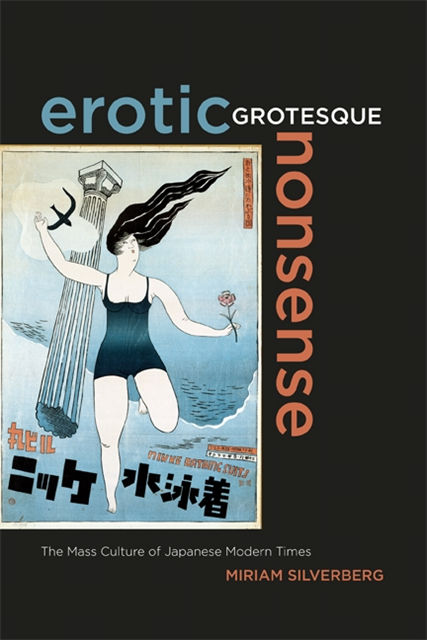
Erotic Grotesque Nonsense
The Mass Culture of Japanese Modern Times
Häftad, Engelska, 2009
297 kr
Skickas inom 7-10 vardagar
This history of Japanese mass culture during the decades preceding Pearl Harbor argues that the new gestures, relationship, and humor of ero-guro-nansensu (erotic grotesque nonsense) expressed a self-consciously modern ethos that challenged state ideology and expansionism. Miriam Silverberg uses sources such as movie magazines, ethnographies of the homeless, and the most famous photographs from this era to capture the spirit, textures, and language of a time when the media reached all classes, connecting the rural social order to urban mores. Employing the concept of montage as a metaphor that informed the organization of Japanese mass culture during the 1920s and 1930s, Silverberg challenges the erasure of Japanese colonialism and its legacies. She evokes vivid images from daily life during the 1920s and 1930s, including details about food, housing, fashion, modes of popular entertainment, and attitudes toward sexuality.Her innovative study demonstrates how new public spaces, new relationships within the family, and an ironic sensibility expressed the attitude of Japanese consumers who identified with the modern as providing a cosmopolitan break from tradition at the same time that they mobilized for war.
817 kr
Skickas inom 3-6 vardagar
Nakano Sigeharu (1902-1979), leading twentieth-century Japanese poet and social critic, transformed the revolutionary culture movement of the 1920s. Positioning Nakano's thought within the very history of Japanese Marxism, Miriam Silverberg applies textual analyses to his pre-war writings to form a new perspective on the history of the politics and culture of the Japanese left.Her book relates Nakano to the Western Marxist tradition, recognizes the existence of a Japanese Marxist theory of commodity culture, and uses this theory to illuminate the era. In particular, Silverberg addresses how Nakano, like his European contemporaries, worked toward a critique of mass culture, illustrating how Japanese thinkers in the 1920s and 1930s adoped Marxism as the dominant method of political and intellectual inquiry.This book draws on Marx's writings and those of Georg Lukacs, Walter Benjamin, Antonio Gramsci, Bertolt Brecht, and Mikhail Bakhtin to present Nakano as a Marxist critic and poet. Close reading of Nakano's essays, poems (most of them appearing for the first time in English), fiction, and prison letters trace Nakano's "changing song" or consciousness through four stages--from his "discovery of history" in the mid-1920s to his refusal to be silenced during the late 1930s, when he produced a series of scthing attacks on intensifying state repression.Miriam Silverberg is Assistant Professor of History at the University of California, Los Angeles.Originally published in 1990.The Princeton Legacy Library uses the latest print-on-demand technology to again make available previously out-of-print books from the distinguished backlist of Princeton University Press. These editions preserve the original texts of these important books while presenting them in durable paperback and hardcover editions. The goal of the Princeton Legacy Library is to vastly increase access to the rich scholarly heritage found in the thousands of books published by Princeton University Press since its founding in 1905.
1 914 kr
Skickas inom 3-6 vardagar
Nakano Sigeharu (1902-1979), leading twentieth-century Japanese poet and social critic, transformed the revolutionary culture movement of the 1920s. Positioning Nakano's thought within the very history of Japanese Marxism, Miriam Silverberg applies textual analyses to his pre-war writings to form a new perspective on the history of the politics and culture of the Japanese left.Her book relates Nakano to the Western Marxist tradition, recognizes the existence of a Japanese Marxist theory of commodity culture, and uses this theory to illuminate the era. In particular, Silverberg addresses how Nakano, like his European contemporaries, worked toward a critique of mass culture, illustrating how Japanese thinkers in the 1920s and 1930s adoped Marxism as the dominant method of political and intellectual inquiry.This book draws on Marx's writings and those of Georg Lukacs, Walter Benjamin, Antonio Gramsci, Bertolt Brecht, and Mikhail Bakhtin to present Nakano as a Marxist critic and poet. Close reading of Nakano's essays, poems (most of them appearing for the first time in English), fiction, and prison letters trace Nakano's "changing song" or consciousness through four stages--from his "discovery of history" in the mid-1920s to his refusal to be silenced during the late 1930s, when he produced a series of scthing attacks on intensifying state repression.Miriam Silverberg is Assistant Professor of History at the University of California, Los Angeles.Originally published in 1990.The Princeton Legacy Library uses the latest print-on-demand technology to again make available previously out-of-print books from the distinguished backlist of Princeton University Press. These editions preserve the original texts of these important books while presenting them in durable paperback and hardcover editions. The goal of the Princeton Legacy Library is to vastly increase access to the rich scholarly heritage found in the thousands of books published by Princeton University Press since its founding in 1905.