Mitchel de S.-O.-l'E. Lasser – författare
Visar alla böcker från författaren Mitchel de S.-O.-l'E. Lasser. Handla med fri frakt och snabb leverans.
4 produkter
4 produkter
Judicial Dis-Appointments
Judicial Appointments Reform and the Rise of European Judicial Independence
Inbunden, Engelska, 2020
1 560 kr
Skickas inom 5-8 vardagar
In 2009 and 2010, the European Court of Justice and the European Court of Human Rights underwent significant reforms to their respective judicial appointments processes. Though very different judicial institutions, they adopted very similar - and rather remarkable - reforms: each would now make use of an expert panel of judicial notables to vet the candidates proposed to sit in Luxembourg or Strasbourg. Once established, these two vetting panels then followed with actions no less extraordinary: they each immediately took to rejecting a sizable percentage of the judicial candidates proposed by the Member State governments. What had happened? Why would the Member States of the European Union and of the Council of Europe, which had established judicial appointments processes that all but ensured themselves the unfettered power to designate their preferred judges to the European courts, and who had zealously maintained and exercised that power over the course of some fifty years, suddenly decide to undermine their own capacity to continue to do so?This book sets out to solve this mystery. Its point of departure is that it would be a mistake to view the 2009-2010 establishment of the two vetting panels in isolation from other European judicial developments. Though these acts of institutional creation are certainly the most notable recent developments, they actually represent but the crowning achievement of a process of European judicial appointments reform that has been running unremittingly since the 1990's. This longstanding and tenacious movement has actually triggered a broad set of interrelated debates and reforms, encompassing not only judicial appointments per se, but also a much wider set of issues, including judicial independence, judicial quality, judicial councils, the separation of powers, judicial gender equity, and more.
Inbunden, Engelska, 2004
981 kr
Skickas inom 3-6 vardagar
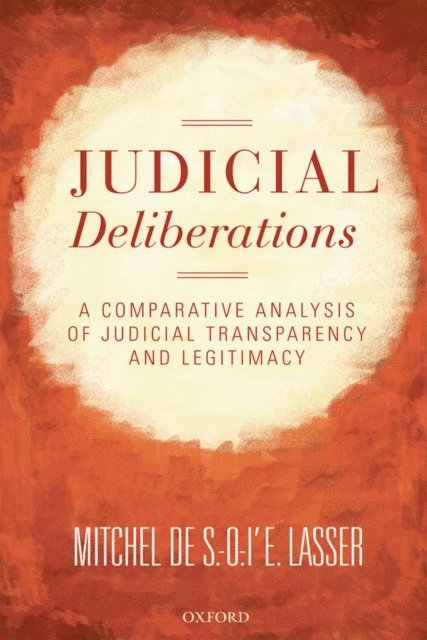
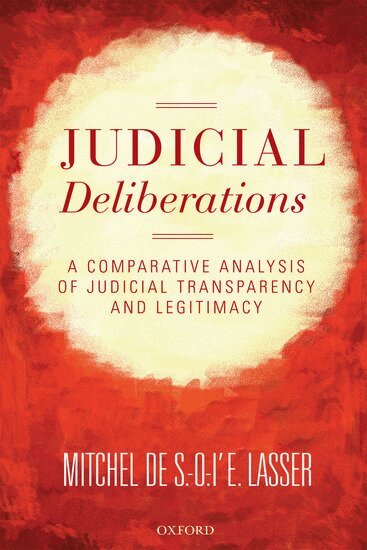
Judicial Deliberations compares how and why the European Court of Justice, the French Cour de cassation and the US Supreme Court offer different approaches for generating judicial accountability and control, judicial debate and deliberation, and ultimately judicial legitimacy. Examining the judicial argumentation of the United States Supreme Court and of the French Cour de cassation, the book first reorders the traditional comparative understanding of the difference between French civil law and American common law judicial decision-making. It then uses this analysis to offer the first detailed comparative examination of the interpretive practice of the European Court of Justice. Lasser demonstrates that the French judicial system rests on a particularly unified institutional and ideological framework founded on explicitly republican notions of meritocracy and managerial expertise. Law-making per se may be limited to the legislature; but significant judicial normative administration is entrusted to State selected, trained, and sanctioned elites who are policed internally through hierarchical institutional structures. The American judicial system, by contrast, deploys a more participatory and democratic approach that reflects a more populist vision. Shunning the unifying, controlling, and hierarchical French structures, the American judicial system instead generates its legitimacy primarily by argumentative means. American judges engage in extensive debates that subject them to public scrutiny and control. The ECJ hovers delicately between the institutional/argumentative and republican/democratic extremes. On the one hand, the ECJ reproduces the hierarchical French discursive structure on which it was originally patterned. On the other, it transposes this structure into a transnational context of fractured political and legal assumptions. This drives the ECJ towards generating legitimacy by adopting a somewhat more transparent argumentative approach.
Inbunden, Engelska, 2009
1 467 kr
Skickas inom 5-8 vardagar
Fundamental rights are exploding across all areas of law in Europe. This rights revolution is transforming European judicial culture and the judge's political role at breakneck speed. Not only have fundamental rights become an integral part of litigation in the domestic and European courts, but their advent has provoked an ongoing revolution in French and European procedural, doctrinal, institutional and conceptual structures. Grounded in comparative law and political science, this book tells the story of the rights revolution. Part of the story is social and intellectual. As the polity has become increasingly complicated both nationally and transnationally, fundamental rights have emerged as a lingua franca within and across European jurisdictions: they offer a pool of common legal terms that address the diversity of interests now litigating in the domestic and European courts. But that is not the entire story. The fundamental rights revolution is also a product of the complex - and often competitive - inter-institutional dynamics that characterize the judicial arena in our ever more globalized legal space. European legal controversies increasingly play out at the jurisdictional intersection of a range of domestic and supranational high courts, which must interact and coordinate as never before. This growing inter-institutional interface has taken on a competitive logic and inflationary force of its own. The result has been a group dynamic that has reinforced the ubiquity and preeminence of fundamental rights throughout the European legal field. Almost every European judicial player now faces powerful pressures to jump on the fundamental rights bandwagon or be left intellectually and institutionally behind. This has prompted a frantic race to master and lead the emergent fundamental rights regime.In telling the story of the rights revolution, the book makes a substantial contribution to understanding the current dynamics of European judiciaries, and the depth of the impact of transnational law on domestic legal culture.
Häftad, Engelska, 2009
604 kr
Skickas inom 7-10 vardagar
Judicial Deliberations compares how and why the European Court of Justice, the French Cour de cassation and the US Supreme Court offer different approaches for generating judicial accountability and control, judicial debate and deliberation, and ultimately judicial legitimacy.Examining the judicial argumentation of the United States Supreme Court and of the French Cour de cassation, the book first reorders the traditional comparative understanding of the difference between French civil law and American common law judicial decision-making. It then uses this analysis to offer the first detailed comparative examination of the interpretive practice of the European Court of Justice.Lasser demonstrates that the French judicial system rests on a particularly unified institutional and ideological framework founded on explicitly republican notions of meritocracy and managerial expertise. Law-making per se may be limited to the legislature; but significant judicial normative administration is entrusted to State selected, trained, and sanctioned elites who are policed internally through hierarchical institutional structures. The American judicial system, by contrast, deploys a more participatory and democratic approach that reflects a more populist vision. Shunning the unifying, controlling, and hierarchical French structures, the American judicial system instead generates its legitimacy primarily by argumentative means. American judges engage in extensive debates that subject them to public scrutiny and control. The ECJ hovers delicately between the institutional/argumentative and republican/democratic extremes. On the one hand, the ECJ reproduces the hierarchical French discursive structure on which it was originally patterned. On the other, it transposes this structure into a transnational context of fractured political and legal assumptions. This drives the ECJ towards generating legitimacy by adopting a somewhat more transparent argumentative approach.