M.J. Holler - Böcker
Visar alla böcker från författaren M.J. Holler. Handla med fri frakt och snabb leverans.
3 produkter
3 produkter
1 584 kr
Skickas inom 10-15 vardagar
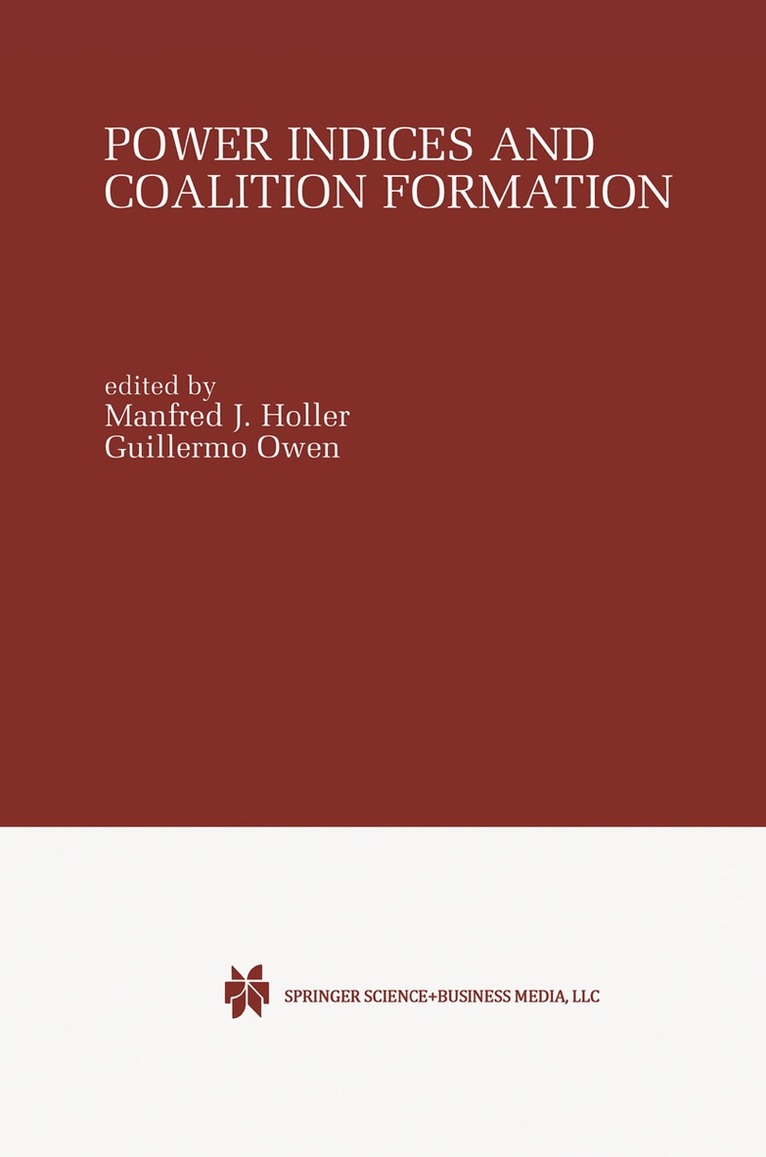
In the last years of the 20th century, publications on power indices and coalition formation have multiplied. The application of these concepts to political institutions, more specifically, to the analysis of the European Union and, as it seems, the election of the President of the United States, is getting more and more popular. There are, however, also theoretical instruments and perspectives that support these applications. Firstly, the probabilistic model of coalition formation which is made operational by the multilinear extension of the characteristic function form of coalition games. This instrument triggered off a re-interpretation of existing power indices and the formulation of new indices. This development is accompanied by an intensive discussion of the concept of power in general - what do we measure when we apply power measures? - and the properties that an adequate measure of power has to satisfy. Various concepts of monotonicity were proposed as litmus test. The discussion shows that the underlying theories of coalition formation play a decisive role.
1 584 kr
Skickas inom 10-15 vardagar
In recent years, publications on power indices and coalition formation have multiplied. Obviously, the application of these concepts to political institutions, more specifically, to the analysis of the European Union and, as it seems, the election of the President of the United States is getting more and more popular. There are, however, also new theoretical instruments and perspectives that support these applications: First of all, the probabilistic model of coalition formation has to be mentioned which is made operational by the multilinear extension of the characteristic function form of coalition games. This instrument triggered off a reinterpretation of existing power indices and the formulation of new indices. This development is accompanied by an intensive discussion of the concept of power in general - what do we measure when we apply power measures? - and the properties that an adequate measure of power has to satisfy. Various concepts of monotonicity were proposed as litmus test. The discussion shows that the underlying theories of coalition formation play a decisive role. New results will be discussed in this volume.Its contributions put flesh and blood on the theoretical innovations and their applications that led to a growing interest in power indices and coalition formation.
Del 17 - International Studies in Economics and Econometrics
Logic of Multiparty Systems
Häftad, Engelska, 2011
538 kr
Skickas inom 10-15 vardagar
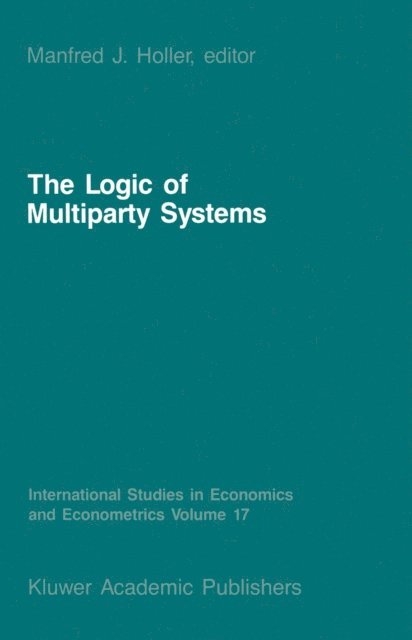
What determines the number of political parties in a democracy? Electoral rules certainly influence the incentives to create and maintain parties. However, a society's political culture can maintain parties despite electoral rules that give them poor prospects of success. Thus, comparing the number of parties and differences in electoral rules across countries cannot clearly test the effect of the electoral rules. A better test would examine a society with a fairly continuous political culture, but a change in electoral rules. Postwar France is such a society. While the basic social order has not changed, there was a drastic change in the electoral system in 1958, which theory implies would reduce the number of parties. Thus we can test the hypothesis that the number of parties fell with the change in electoral system. We can also calculate an " equivalent number of parties· to see how closely France approached a two - party system under the new regime. The first section describes the electoral rules under the Fourth and Fifth Republics. The second section develops a model that indicates how the change in electoral rules should have affected the incentives for multiple parties. The third section tests the hypothesis that the number of parties fell from the Fourth to the Fifth Republic. 1. Electoral Rules In the French Fourth Republic (1945 - 1958) political parties existed largely to serve the direct interests of their members.