Monika Ambrus – författare
Visar alla böcker från författaren Monika Ambrus. Handla med fri frakt och snabb leverans.
6 produkter
Risk and the Regulation of Uncertainty in International Law
Av Wouter Werner, Rosemary Rayfuse m. fl.
E-bok, 2017
1501 kr
Lägg i varukorg
Increasingly, international legal arrangements imagine future worlds or create space for experts to articulate how the future can be conceptualized and managed. With the increased specialization of international law, a series of functional regimes and sub-regimes has emerged, each with their own …
Risk and the Regulation of Uncertainty in International Law
Av Wouter Werner, Rosemary Rayfuse m. fl.
E-bok, 2017
1501 kr
Lägg i varukorg
Increasingly, international legal arrangements imagine future worlds or create space for experts to articulate how the future can be conceptualized and managed. With the increased specialization of international law, a series of functional regimes and sub-regimes has emerged, each with their own …
Risk and the Regulation of Uncertainty in International Law
Av Monika Ambrus, Monika Ambrus m. fl.
Inbunden, 2017
2241 kr
Lägg i varukorg
Increasingly, international legal arrangements imagine future worlds or create space for experts to articulate how the future can be conceptualized and managed. With the increased specialization of international law, a series of functional regimes and sub-regimes has emerged, each with their own …
The Role of 'Experts' in International and European Decision-Making Processes
Advisors, Decision Makers or Irrelevant Actors?
Av Monika Ambrus, Karin Arts m. fl.
Inbunden, 2014
1077 kr
Lägg i varukorg
Experts are increasingly relied on in decision-making processes at international and European levels. Their involvement in those processes, however, is contested. This timely book on the role of 'experts' provides a broad-gauged analysis of the issues raised by their involvement in decision-making …
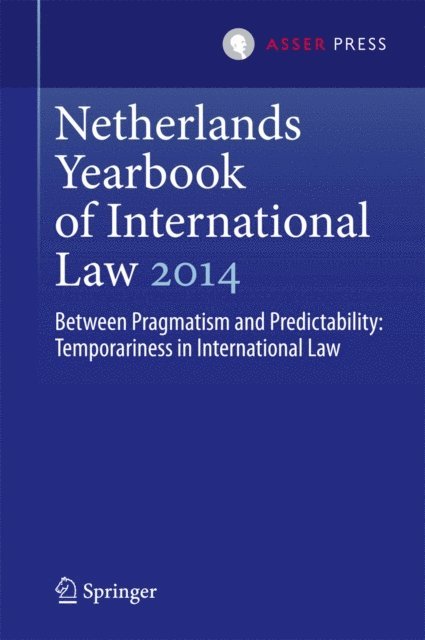
Netherlands Yearbook of International Law 2014
Between Pragmatism and Predictability: Temporariness in International Law
Av Mónika Ambrus, Ramses A. Wessel
Inbunden, 2015
1010 kr
Lägg i varukorg
The Netherlands Yearbook of International Law was first published in 1970. It offers a forum for the publication of scholarly articles of a more general nature in the area of public international law including the law of the european Union.One of the key functions or purposes of international law …
Netherlands Yearbook of International Law 2014
Between Pragmatism and Predictability: Temporariness in International Law
Av Ramses A. Wessel, Monika Ambrus
E-bok, 2015
1342 kr
Lägg i varukorg
The Netherlands Yearbook of International Law was first published in 1970. It offers a forum for the publication of scholarly articles of a more general nature in the area of public international law including the law of the european Union. One of the key functions or purposes of international law …