Mordecai Kurz - Böcker
Visar alla böcker från författaren Mordecai Kurz. Handla med fri frakt och snabb leverans.
5 produkter
5 produkter
1 304 kr
Skickas inom 7-10 vardagar
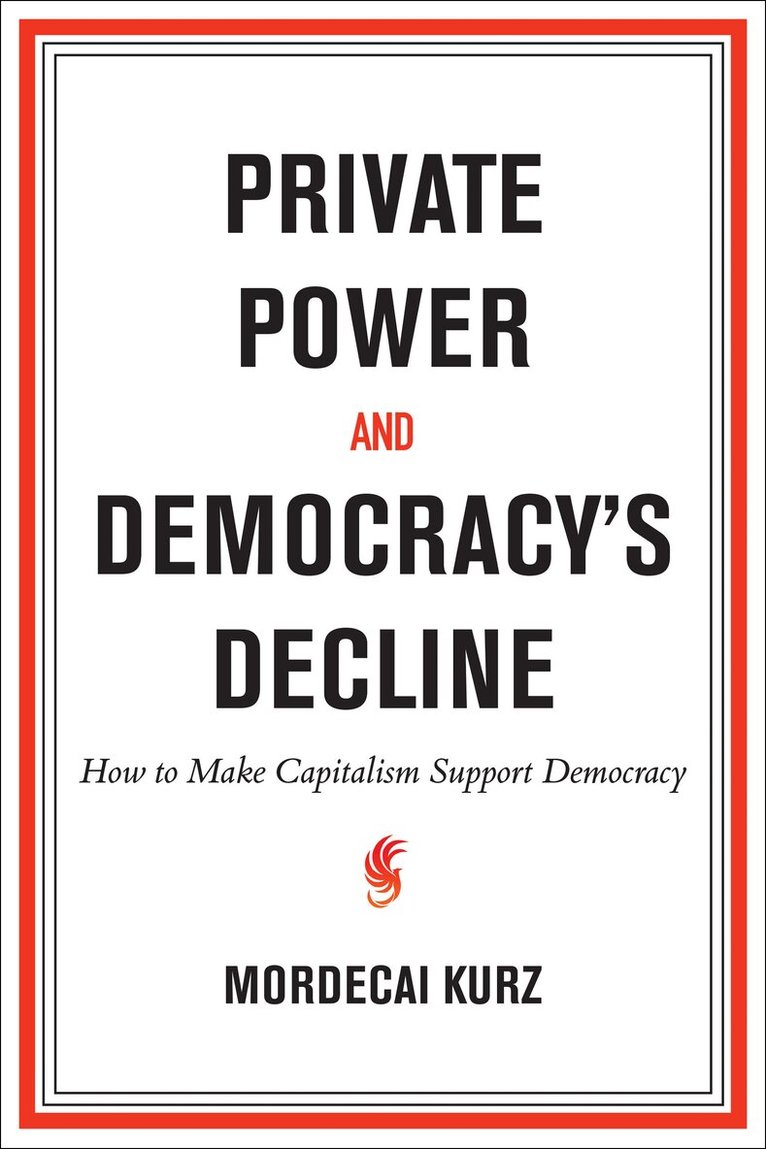
Since the 1980s, the United States has regressed to a level of economic inequality not seen since the Gilded Age in the late nineteenth century. At the same time, technological innovation has transformed society, and a core priority of public policy has been promoting innovation. What is the relationship between economic inequality and technological change?Mordecai Kurz develops a comprehensive integrated theory of the dynamics of market power and income inequality. He shows that technological innovations are not simply sources of growth and progress: they sow the seeds of market power. In a free market economy with intellectual property rights, firms’ control over technology enables them to expand, attain monopoly power, and earn exorbitant profits. Competition among innovators does not eliminate market power because technological competition is different from standard competition; it results in only one or two winners. Kurz provides a pioneering analysis grounded on quantifying technological market power and its effects on inequality, innovation, and economic growth. He outlines what causes market power to rise and fall and details its macroeconomic and distributional consequences.Kurz demonstrates that technological market power tends to rise, increasing inequality of income and wealth. Unchecked inequality threatens the foundations of democracy: public policy is the only counterbalancing force that can restrain corporate power, attain more egalitarian distribution of wealth, and make democracy compatible with capitalism. Presenting a new paradigm for understanding today’s vast inequalities, this book offers detailed proposals to redress them by restricting corporate mergers and acquisitions, reforming patent law, improving the balance of power in the labor market, increasing taxation, promoting upward mobility, and stabilizing the middle class.
331 kr
Skickas inom 7-10 vardagar
Since the 1980s, the United States has regressed to a level of economic inequality not seen since the Gilded Age in the late nineteenth century. At the same time, technological innovation has transformed society, and a core priority of public policy has been promoting innovation. What is the relationship between economic inequality and technological change?Mordecai Kurz develops a comprehensive integrated theory of the dynamics of market power and income inequality. He shows that technological innovations are not simply sources of growth and progress: they sow the seeds of market power. In a free market economy with intellectual property rights, firms’ control over technology enables them to expand, attain monopoly power, and earn exorbitant profits. Competition among innovators does not eliminate market power because technological competition is different from standard competition; it results in only one or two winners. Kurz provides a pioneering analysis grounded on quantifying technological market power and its effects on inequality, innovation, and economic growth. He outlines what causes market power to rise and fall and details its macroeconomic and distributional consequences.Kurz demonstrates that technological market power tends to rise, increasing inequality of income and wealth. Unchecked inequality threatens the foundations of democracy: public policy is the only counterbalancing force that can restrain corporate power, attain more egalitarian distribution of wealth, and make democracy compatible with capitalism. Presenting a new paradigm for understanding today’s vast inequalities, this book offers detailed proposals to redress them by restricting corporate mergers and acquisitions, reforming patent law, improving the balance of power in the labor market, increasing taxation, promoting upward mobility, and stabilizing the middle class.
Private Power and Democracy's Decline
How to Make Capitalism Support Democracy
Inbunden, Engelska, 2026
485 kr
Kommande
1 625 kr
Skickas inom 10-15 vardagar
This volume presents a new theory of expectations called "rational beliefs". Contrary to the standard theory which views the origin of uncertainty as being exogenous to the economic system, the theory of rational beliefs holds that a crucial component of social risk and economic fluctuations is endogenously propagated by variations in the state of beliefs of market participants. One part of the book provides an exposition of the foundation of the theory of rational beliefs. A second part explores the structure of general equilibrium models in which market participants hold rational beliefs. The "Applications" part of the book studies the behaviour of asset prices and rates of return on financial assets. It seeks to demonstrate that endogenous uncertainty provides a uniform paradigm for the study of economic fluctuations.
1 625 kr
Skickas inom 10-15 vardagar
Contrary to the standard theory which views the origin of uncertainty as being exogenous to the economic system, the theory of rational beliefs holds that a crucial component of social risk and economic fluctuations is endogenously propagated by variations in the state of beliefs of market participants.