Morris M. Faierstein - Böcker
Visar alla böcker från författaren Morris M. Faierstein. Handla med fri frakt och snabb leverans.
8 produkter
8 produkter
649 kr
Skickas inom 10-15 vardagar
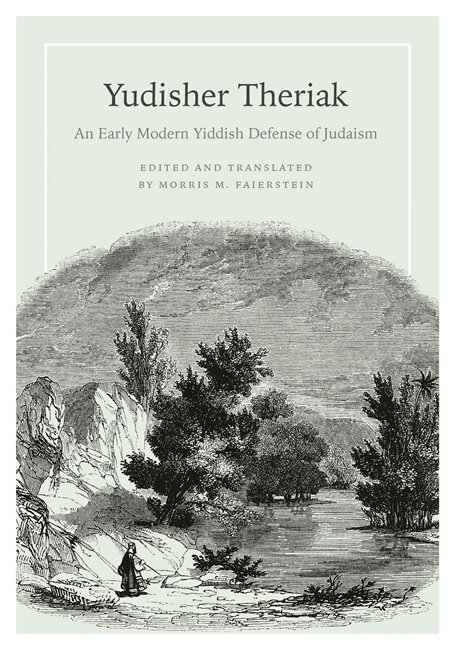
The Yudisher Theriak [Jewish Theriac] by Zalman Zvi of Aufhausen, first published in Hanau, in 1615, was a response to an anti-Jewish work titled Jüdischer abgestreiffter Schlangenbalg [Jewish Shed Snakeskin], written by a Jewish convert to Chistianity, Samuel Friedrich Brenz, and published in Nürnberg and Augsburg in 1614. Brenz’s work was part of a genre of anti-Jewish books and pamphlets written in German and addressed to Christians that purported to reveal how Jews mocked and blasphemed against the Christian religion, cursed their Christian neighbors, and engaged in magic and witchcraft in order to inflict damage to their possessions and livelihoods. The name of Zalman Zvi’s book is a direct allusion to Brenz’s title, but it also hints at a larger purpose. Theriac is a Greek and Latin term that means “the antidote to the bite of a venomous snake.” Perhaps Zvi hoped that his book would also serve as a theriac for the scourge of anti-Judaism, which was prevalent in his generation.The Yudisher Theriak presents an interesting picture of how a learned Jew might respond to the many accusations against Jews and Judaism that became standardized and were repeated from author to author. The Yudisher Theriak makes a passing appearance in most scholarly books and many articles written about Christian-Jewish relations. Its existence is acknowledged and occasionally a fact or idea is cited from it, but its arguments and ideas have not been integrated into the scholarly literature on this subject. One reason that it has not received the attention it deserves is its language. It is written in a form of Early Modern Yiddish, more influenced by German and less familiar than its contemporary eastern European variant. In addition, Zalman Zvi was a learned Jew who interspersed Hebrew phrases, rabbinic terminology, and allusions to rabbinic literature in his work. Morris Faierstein’s goal in this work is not to respond to all the references and allusions in the scholarly literature that the original text touches on, but rather to make the work available in an annotated translation that can be a useful tool in the study of Jewish-Christian relations in the Early Modern period and, more broadly, for Early Modern Jewish historical and cultural studies. The analysis and clarification of the many issues raised in the Yudisher Theriak await further studies. Faierstein has taken the first step by making the work available to an audience wider than the very narrow band of specialists in Early Modern Yiddish literature.Scholars and students of Jewish-Christian relations and Early Modern Jewish historical and cultural studies will appreciate the availability of this previously inaccessible text.
Early Modern Yiddish Bible
From the Mirkevet ha-Mishneh to Blitz and Witzenhausen
Inbunden, Engelska, 2024
1 107 kr
Skickas inom 5-8 vardagar
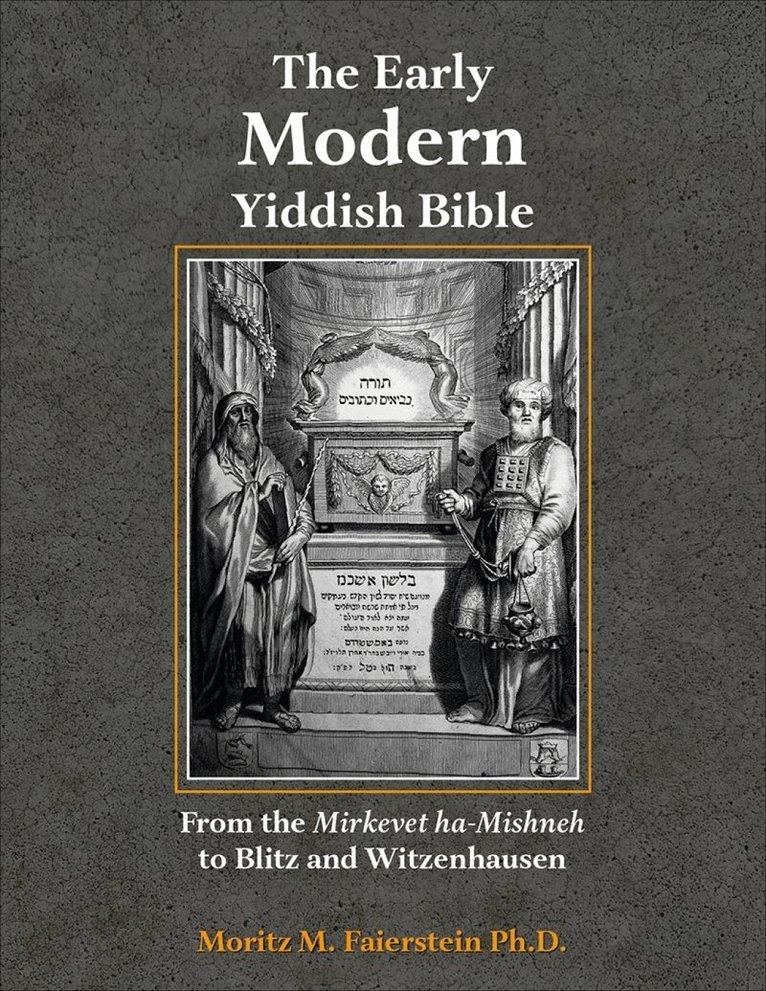
The translation of the Bible into the vernacular is a venerable Jewish tradition, more than two thousand years old. Ashkenazi Jewish culture was a latecomer to the vernacular Bible, and it was only in the sixteenth century that the Yiddish Bible made its appearance in print. Almost one hundred years ago, Wilhelm Staerk and Albert Leitzmann's survey of Early Modern Yiddish Bible translations was the first attempt to define this genre of Early Modern Yiddish literature. In the intervening century there has been relatively little scholarly interest in these texts. The purpose of the present study is to survey the present state of research in this field and place these works in the context of the popular religious culture of Ashkenazi Jewry, which is defined by its use of Yiddish as a means of both oral communication and literary production. The subject of this study is every Yiddish work from the sixteenth and seventeenth centuries that is directly or indirectly related to the Bible. The survey begins with the Mirkevet ha-Mishneh, the first published Yiddish book, which is a biblical concordance, published in Cracow, 1534-36, and concludes with the two competing translations of the entire Bible into Yiddish by Yekutiel Blitz and Joseph Witzenhausen, published in Amsterdam, 1676-86. (These were translations without any accompanying commentaries, and were modeled on Protestant Bibles, like the English King James, or the German Luther Bible.) The study includes not only translations of biblical books, but also adaptations, reworkings, and paraphrases of biblical texts, appearing in diverse literary styles, by a wide variety of authors. King David, for example, is presented in the Shmuel Bukh as a combination of medieval chivalric hero and rabbinic scholar who is careful to observe the strictures of Halakhah. The story of Jonah is retold through a Midrashic lens, and concludes with a kabbalistic parable that analogizes Jonah's journey to that of the soul from conception through life, death, and return to its heavenly source. Some authors take great liberties with the biblical text. The author of the paraphrase of Isaiah only includes what he considers to be prophetic utterances and disregards the rest of the book. Another author decides that the second half of the Torah is too legalistic and not worth retelling, so he ends his commentary after the giving of the Torah on Mount Sinai. As for the Five Scrolls, Lamentations is too depressing so he ignores it. There are also surprising inclusions in these volumes, such as the books of Judith and Susanna from the Apocrypha, and the very colourful medieval version of the Book of Ben Sira, which is considered by modern scholars to be a parody.
1 138 kr
Skickas
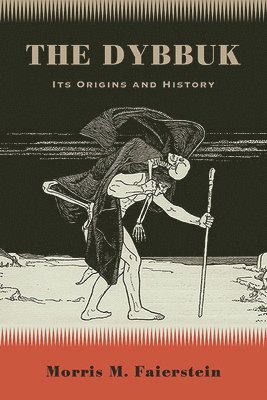
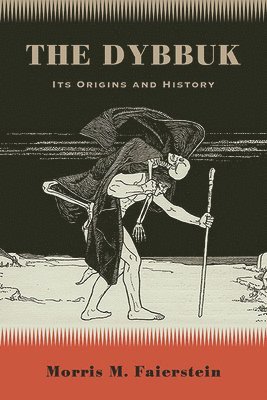
A comprehensive study of the history and evolution of the dybbuk, from kabbalistic tradition to popular folklore.The Dybbuk is the first comprehensive study of the historical and kabbalistic sources of the dybbuk phenomenon, from the first recorded case of dybbuk possession in Safed in 1571 onward. Dybbuk possession differs from possession by demons or Satan. Its origin is in the Kabbalistic concept of gilgul (transmigration) for sins that are so grievous that Gehenna is not sufficient punishment, and the soul must therefore wander until expiation is found. The dybbuk can temporarily find refuge in animals or people and can only be exorcised by a Baal Shem, a great kabbalist or expert in Jewish magic. In addition to describing the history and evolution of this concept, The Dybbuk includes English translations of all dybbuk stories discussed in the book, many translated for the first time.
651 kr
Skickas inom 3-6 vardagar
A comprehensive study of the history and evolution of the dybbuk, from kabbalistic tradition to popular folklore.The Dybbuk is the first comprehensive study of the historical and kabbalistic sources of the dybbuk phenomenon, from the first recorded case of dybbuk possession in Safed in 1571 onward. Dybbuk possession differs from possession by demons or Satan. Its origin is in the Kabbalistic concept of gilgul (transmigration) for sins that are so grievous that Gehenna is not sufficient punishment, and the soul must therefore wander until expiation is found. The dybbuk can temporarily find refuge in animals or people and can only be exorcised by a Baal Shem, a great kabbalist or expert in Jewish magic. In addition to describing the history and evolution of this concept, The Dybbuk includes English translations of all dybbuk stories discussed in the book, many translated for the first time.
236 kr
Skickas inom 5-8 vardagar
402 kr
Skickas inom 5-8 vardagar
3 801 kr
Skickas inom 7-10 vardagar
This book is the first scholarly English translation of the Ze’enah U-Re’enah, a Jewish classic originally published in the beginning of the seventeenth century, and was the first significant anthological commentary on the Torah, Haftorot and five Megillot. The Ze’enah U-Re’enah is a major text that was talked about but has not adequately studied, although it has been published in two hundred and seventy-four editions, including the Yiddish text and partial translation into several languages. Many generations of Jewish men and women have studied the Torah through the Rabbinic and medieval commentaries that the author of the Ze’enah U-Re’enah collected and translated in his work. It shaped their understanding of Jewish traditions and the lives of Biblical heroes and heroines. The Ze’enah U-Re’enah can teach us much about the influence of biblical commentaries, popular Jewish theology, folkways, and religious practices. This translation is based on the earliest editions of the Ze’enah U-Re’enah, and the notes annotate the primary sources utilized by the author.
1 886 kr
Skickas inom 3-6 vardagar
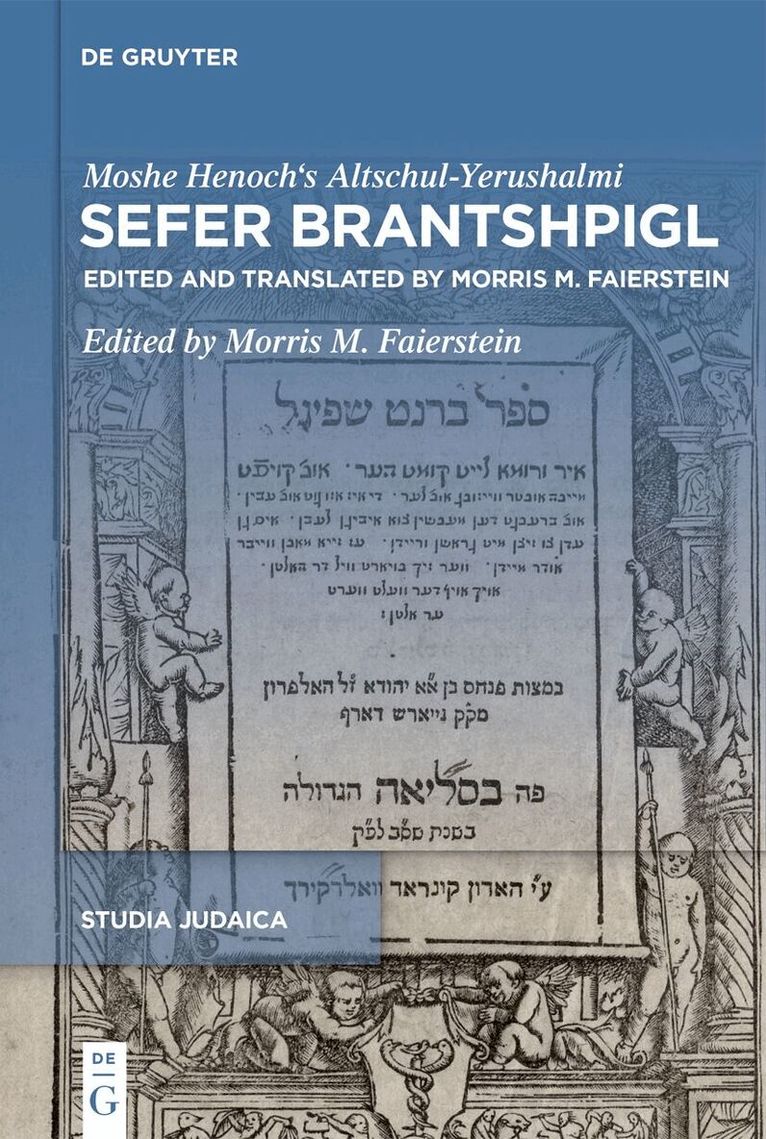
Sefer Brantshpigl is an important Yiddish religious/ethical work first published in Cracow, 1596. It was reprinted six more times into the beginning of the eighteenth century and is an important source for the social and religious life of Central/East European Jewry in the Early Modern period. This volume is the first complete translation of this text into English with annotations and scholarly introduction. The author, Moshe Henochs Altschul-Yerushalmi was a member of what has become to be known as the "secondary intelligentsia." Little is known about his life, other than that he lived in Prague. His son, Henoch Altschul, was the Shamash of the Jewish community of Prague from 1603–1633. He examined all aspects of Jewish social and religious life in seventy-six chapters. Each chapter discusses a specific topic. Not only does he describe what is good and critiques what he finds to be lacking, but he buttresses his arguments with citations from the whole range of rabbinic literature. One aspect that is particularly interesting is his citation of kabbalistic sources in his arguments. He cites kabbalistic sources more than sixty times and even devotes a whole chapter to the kabbalistic night ritual of Tikkun Hazot.