Moshe Haviv - Böcker
Visar alla böcker från författaren Moshe Haviv. Handla med fri frakt och snabb leverans.
7 produkter
7 produkter
1 891 kr
Skickas inom 10-15 vardagar
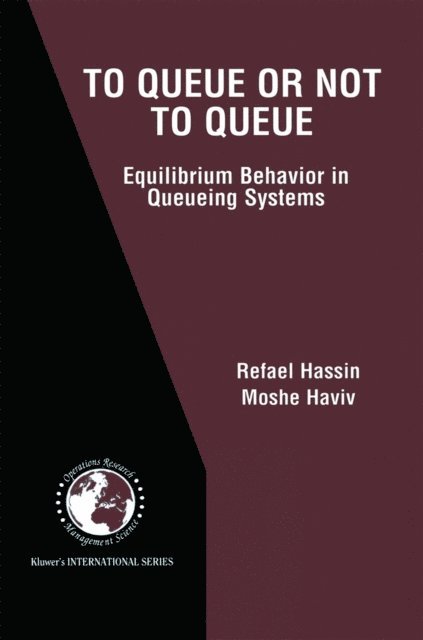
This text focuses on the practical viewpoint of customer behaviour and its effect on the performance of the queueing system. The book's objectives are threefold: It is a comprehensive survey of the literature on equilibrium behavior of customers and servers in queueing systems. The literature is rich and considerable, but lacks continuity. This book should provide continuity and cover some issues that have not been adequately treated. In addition, it will examine the known results of the field, classify them and identify where and how they relate to each other. Finally, it seeks to fill a number of the gaps in the literature with results while explicitly outlining open problems in other areas. With this book, it is the authors' paramount purpose is to motivate further research and to help researchers identify new and interesting open problems.
Del 59 - International Series in Operations Research & Management Science
To Queue or Not to Queue
Equilibrium Behavior in Queueing Systems
Häftad, Engelska, 2012
2 100 kr
Skickas inom 10-15 vardagar
Other goals are to edit the known results in a unified manner, classify them and identify where and how they relate to each other, and fill in some gaps with new results. we have highlighted the results For each topic covered in the book, that, in our opinion, are the most important.
Del 191 - International Series in Operations Research & Management Science
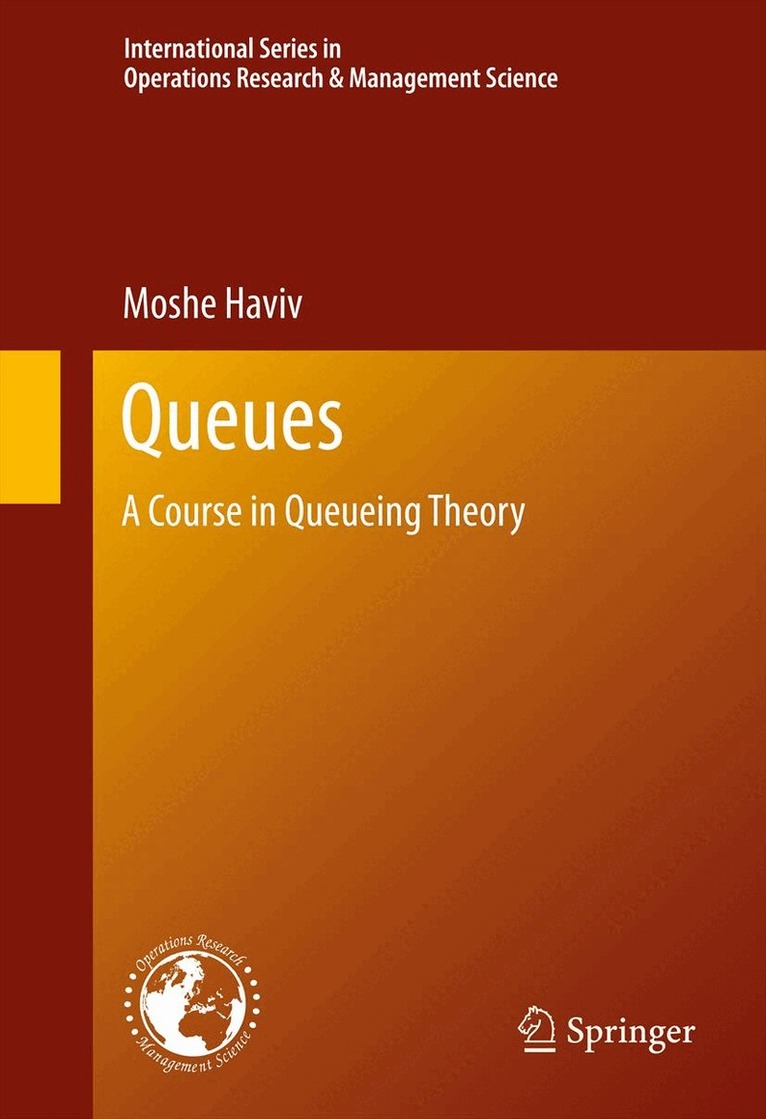
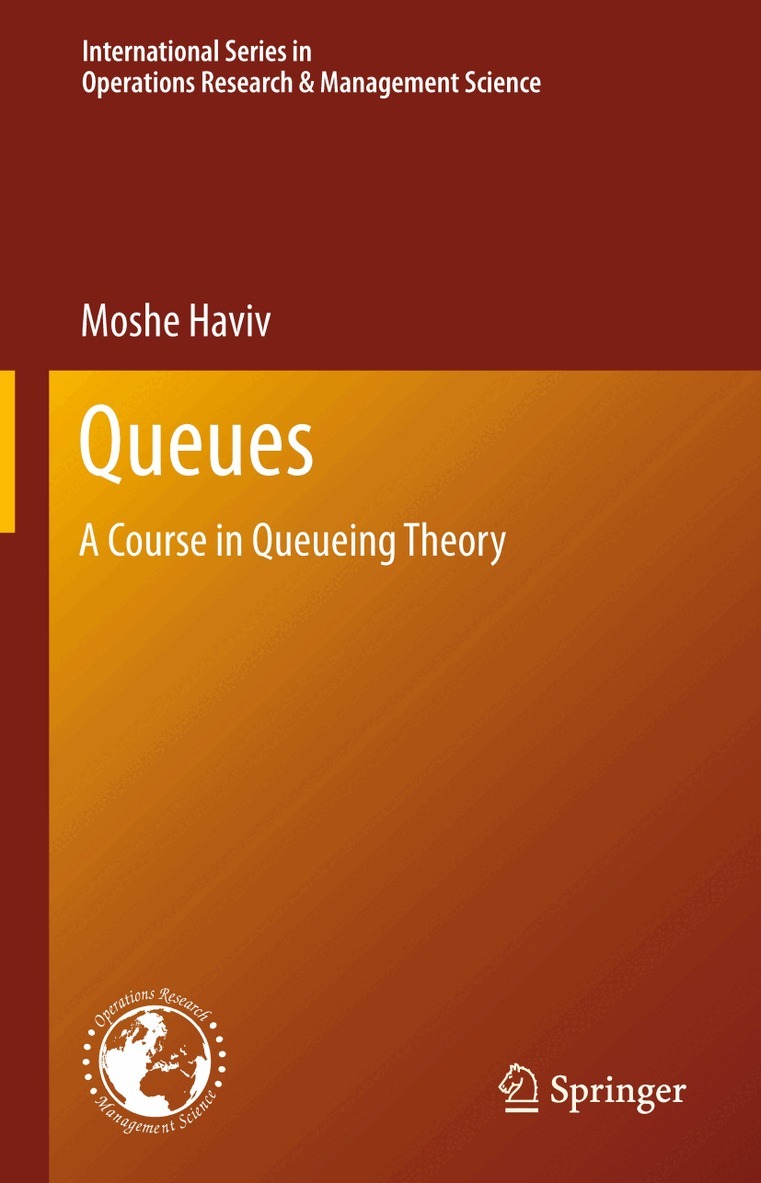
Queues
A Course in Queueing Theory
Inbunden, Engelska, 2013
1 064 kr
Skickas inom 10-15 vardagar
Queueing theory (the mathematical theory of waiting lines in all its configurations) continues to be a standard major area of operations research on the stochastic side. Therefore, universities with an active program in operations research sometimes will have an entire course devoted mainly or entirely to queueing theory, and the course is also taught in computer science, electrical engineering, mathematics, and industrial engineering programs.The basic course in queueing theory is often taught at first year graduate level, though can be taught at senior level undergraduate as well. This text evolved from the author’s preferred syllabus for teaching the course, presenting the material in a more logical order than other texts and so being more effective in teaching the basics of queueing theory.The first three chapters focus on the needed preliminaries, including exposition distributions, Poisson processes and generating functions, renewal theory, and Markov chains, Then, rather than switching to first-come first-served memoryless queues here as most texts do, Haviv discusses the M/G/1 model instead of the M/M/1, and then covers priority queues. Later chapters cover the G/M/1 model, thirteen examples of continuous-time Markov processes, open networks of memoryless queues and closed networks, queueing regimes with insensitive parameters, and then concludes with two-dimensional queueing models which are quasi birth and death processes. Each chapter ends with exercises.
694 kr
Skickas inom 10-15 vardagar
Queueing theory (the mathematical theory of waiting lines in all its configurations) continues to be a standard major area of operations research on the stochastic side. Therefore, universities with an active program in operations research sometimes will have an entire course devoted mainly or entirely to queueing theory, and the course is also taught in computer science, electrical engineering, mathematics, and industrial engineering programs.The basic course in queueing theory is often taught at first year graduate level, though can be taught at senior level undergraduate as well. This text evolved from the author’s preferred syllabus for teaching the course, presenting the material in a more logical order than other texts and so being more effective in teaching the basics of queueing theory.The first three chapters focus on the needed preliminaries, including exposition distributions, Poisson processes and generating functions, renewal theory, and Markov chains, Then, rather than switching to first-come first-served memoryless queues here as most texts do, Haviv discusses the M/G/1 model instead of the M/M/1, and then covers priority queues. Later chapters cover the G/M/1 model, thirteen examples of continuous-time Markov processes, open networks of memoryless queues and closed networks, queueing regimes with insensitive parameters, and then concludes with two-dimensional queueing models which are quasi birth and death processes. Each chapter ends with exercises.
1 062 kr
Skickas inom 5-8 vardagar
This book serves as an introduction to linear algebra for undergraduate students in data science, statistics, computer science, economics, and engineering. The book presents all the essentials in rigorous (proof-based) manner, describes the intuition behind the results, while discussing some applications to data science along the way.The book comes with two parts, one on vectors, the other on matrices. The former consists of four chapters: vector algebra, linear independence and linear subspaces, orthonormal bases and the Gram-Schmidt process, linear functions. The latter comes with eight chapters: matrices and matrix operations, invertible matrices and matrix inversion, projections and regression, determinants, eigensystems and diagonalizability, symmetric matrices, singular value decomposition, and stochastic matrices. The book ends with the solution of exercises which appear throughout its twelve chapters.
1 633 kr
Skickas inom 3-6 vardagar
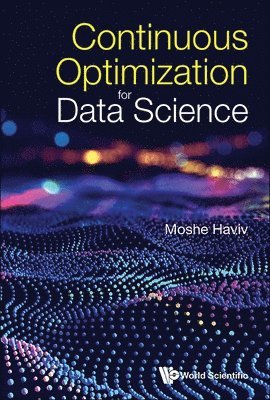
The text is divided into three main parts: unconstrained optimization, constrained optimization, and linear programming. The first part addresses unconstrained optimization in single-variable and multivariable functions, introducing key algorithms such as steepest descent, Newton, and quasi-Newton methods.The second part focuses on constrained optimization, starting with linear equality constraints and extending to more general cases, including inequality constraints. It details optimality conditions, sensitivity analysis, and relevant algorithms for solving these problems.The third part covers linear programming, presenting the formulation of LP problems, the simplex algorithm, and sensitivity analysis. Throughout, the text provides numerous applications to data science, such as linear regression, maximum likelihood estimation, expectation-maximization algorithms, support vector machines, and linear neural networks.
844 kr
Skickas inom 3-6 vardagar
The text is divided into three main parts: unconstrained optimization, constrained optimization, and linear programming. The first part addresses unconstrained optimization in single-variable and multivariable functions, introducing key algorithms such as steepest descent, Newton, and quasi-Newton methods.The second part focuses on constrained optimization, starting with linear equality constraints and extending to more general cases, including inequality constraints. It details optimality conditions, sensitivity analysis, and relevant algorithms for solving these problems.The third part covers linear programming, presenting the formulation of LP problems, the simplex algorithm, and sensitivity analysis. Throughout, the text provides numerous applications to data science, such as linear regression, maximum likelihood estimation, expectation-maximization algorithms, support vector machines, and linear neural networks.