Moshe Y. Vardi – författare
Visar alla böcker från författaren Moshe Y. Vardi. Handla med fri frakt och snabb leverans.
7 produkter
7 produkter
Häftad, Engelska, 2002
566 kr
Skickas inom 10-15 vardagar
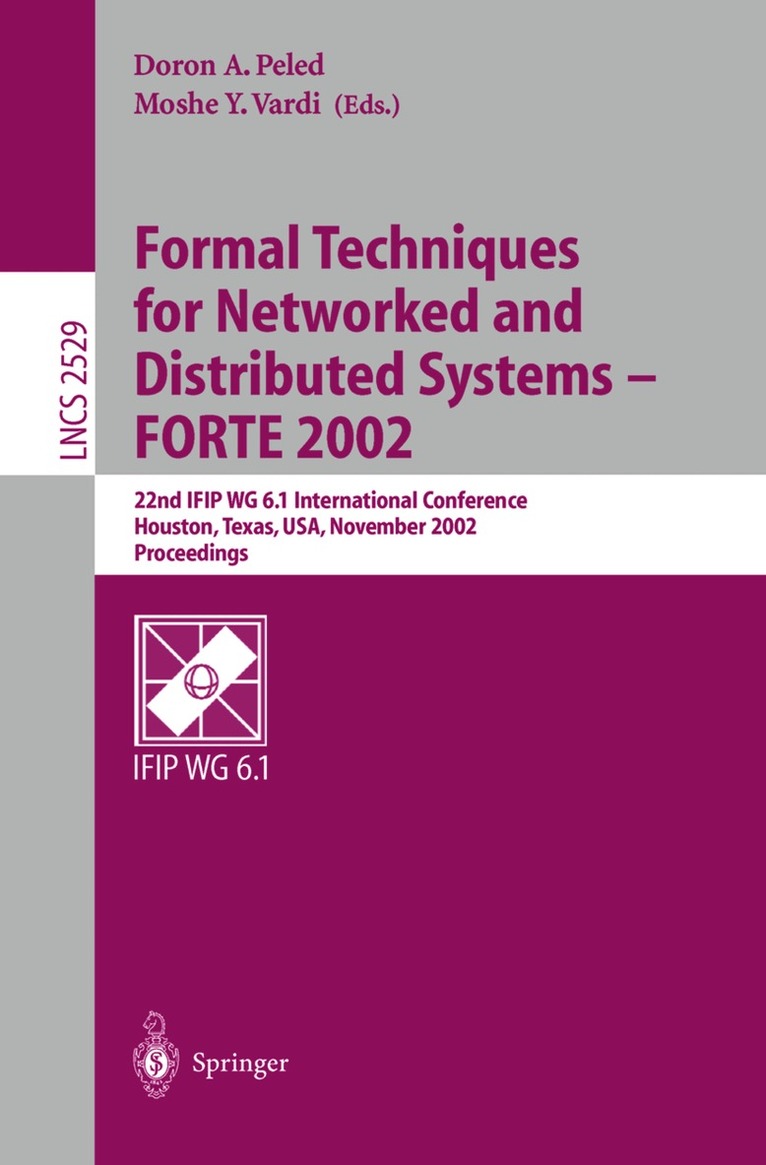
The IFIP TC6 WG 6.1 Joint International Conference on Formal Techniques for Networked and Distributed Systems, FORTE 2002, was held this year at Rice University, Houston, Texas, on November 11–14. This annual conference provides a forum for researchers and practitioners from universities and industry to meet and advance technologies in areas of speci?cation, testing, and veri?cation of distributed systems and communication protocols. The main topics are: – FDT-based system and protocol engineering. – Semantical foundations. – Extensions of FDTs. – Formal approaches to concurrent/distributed object-oriented systems. – Real-time and probability aspects. – Performance modeling and analysis. – Quality of service modeling and analysis. – Veri?cation and validation. – Relations between informal and formal speci?cation. – FDT-based protocol implementation. – Software tools and support environments. – FDT application to distributed systems. – Protocol testing, including conformance testing, interoperability testing, and performance testing. – Test generation, selection, and coverage. – Practical experience and case studies. – Corporate strategic and ?nancial consequences of using formal methods. A total of 61 papers were submitted to FORTE 2002, and reviewed by m- bers of the program committee and additional reviewers. The program committee selected 22 regular papers, two tool papers, and two posters for presentation at the conference. The program also included three tutorials and ?ve invited talks.
Inbunden, Engelska, 2007
1 013 kr
Skickas inom 10-15 vardagar
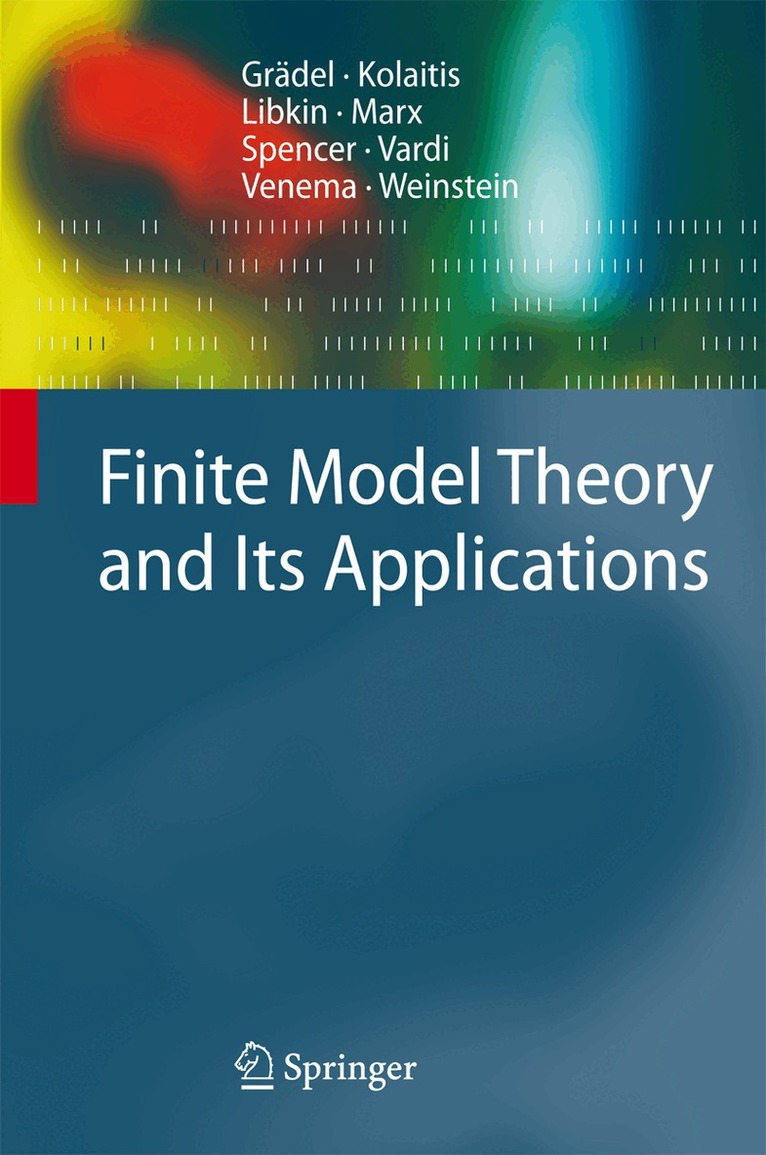
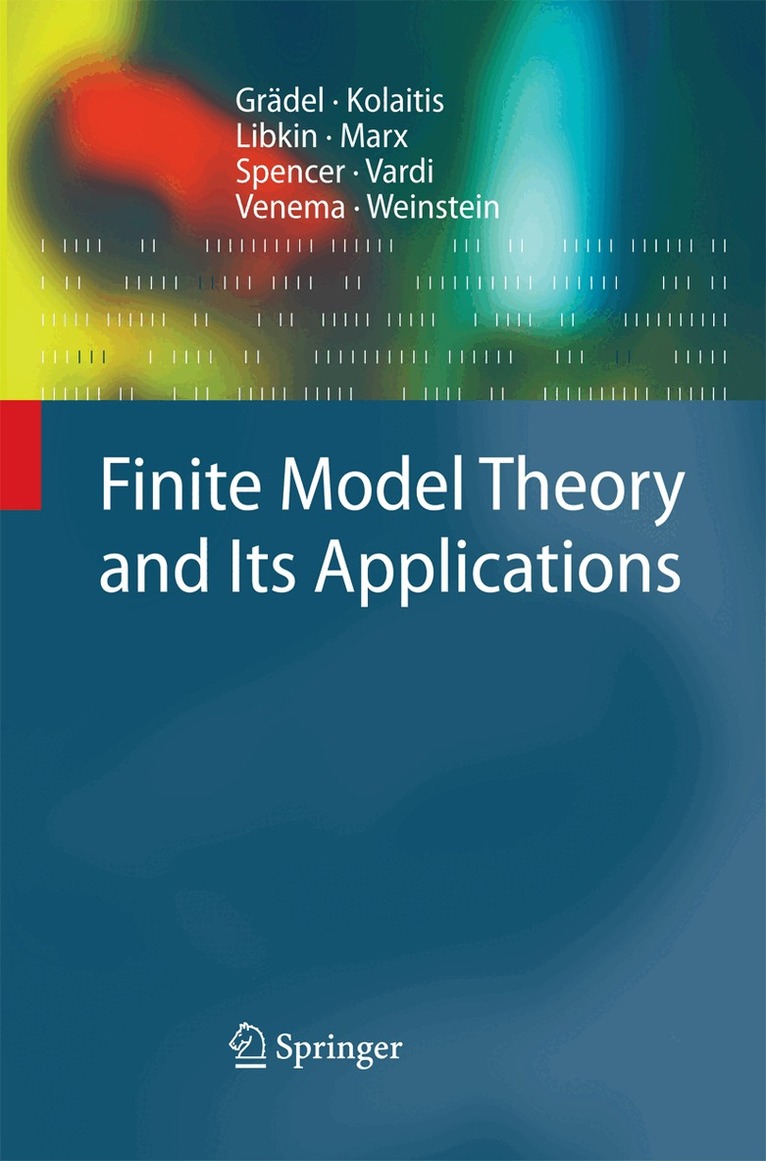
Finite model theory,as understoodhere, is an areaof mathematicallogic that has developed in close connection with applications to computer science, in particular the theory of computational complexity and database theory. One of the fundamental insights of mathematical logic is that our understanding of mathematical phenomena is enriched by elevating the languages we use to describe mathematical structures to objects of explicit study. If mathematics is the science of patterns, then the media through which we discern patterns, as well as the structures in which we discern them, command our attention. It isthis aspect oflogicwhichis mostprominentin model theory,“thebranchof mathematical logic which deals with the relation between a formal language and its interpretations”. No wonder, then, that mathematical logic, and ?nite model theory in particular, should ?nd manifold applications in computer science: from specifying programs to querying databases, computer science is rife with phenomena whose understanding requires close attention to the interaction between language and structure. This volume gives a broadoverviewof some central themes of ?nite model theory: expressive power, descriptive complexity, and zero–one laws, together with selected applications to database theory and arti?cial intelligence, es- cially constraint databases and constraint satisfaction problems. The ?nal chapter provides a concise modern introduction to modal logic,which emp- sizes the continuity in spirit and technique with ?nite model theory.
E-bok
PDF, Engelska, 2003734 kr
Läs direkt efter köp
The IFIP TC6 WG 6.1 Joint International Conference on Formal Techniques for Networked and Distributed Systems, FORTE 2002, was held this year at Rice University, Houston, Texas, on November 11–14. This annual conference provides a forum for researchers and practitioners from universities and industry to meet and advance technologies in areas of speci?cation, testing, and veri?cation of distributed systems and communication protocols. The main topics are: – FDT-based system and protocol engineering. – Semantical foundations. – Extensions of FDTs. – Formal approaches to concurrent/distributed object-oriented systems. – Real-time and probability aspects. – Performance modeling and analysis. – Quality of service modeling and analysis. – Veri?cation and validation. – Relations between informal and formal speci?cation. – FDT-based protocol implementation. – Software tools and support environments. – FDT application to distributed systems. – Protocol testing, including conformance testing, interoperability testing, and performance testing. – Test generation, selection, and coverage. – Practical experience and case studies. – Corporate strategic and ?nancial consequences of using formal methods. A total of 61 papers were submitted to FORTE 2002, and reviewed by m- bers of the program committee and additional reviewers. The program committee selected 22 regular papers, two tool papers, and two posters for presentation at the conference. The program also included three tutorials and ?ve invited talks.
Häftad, Engelska, 1995
566 kr
Skickas inom 10-15 vardagar
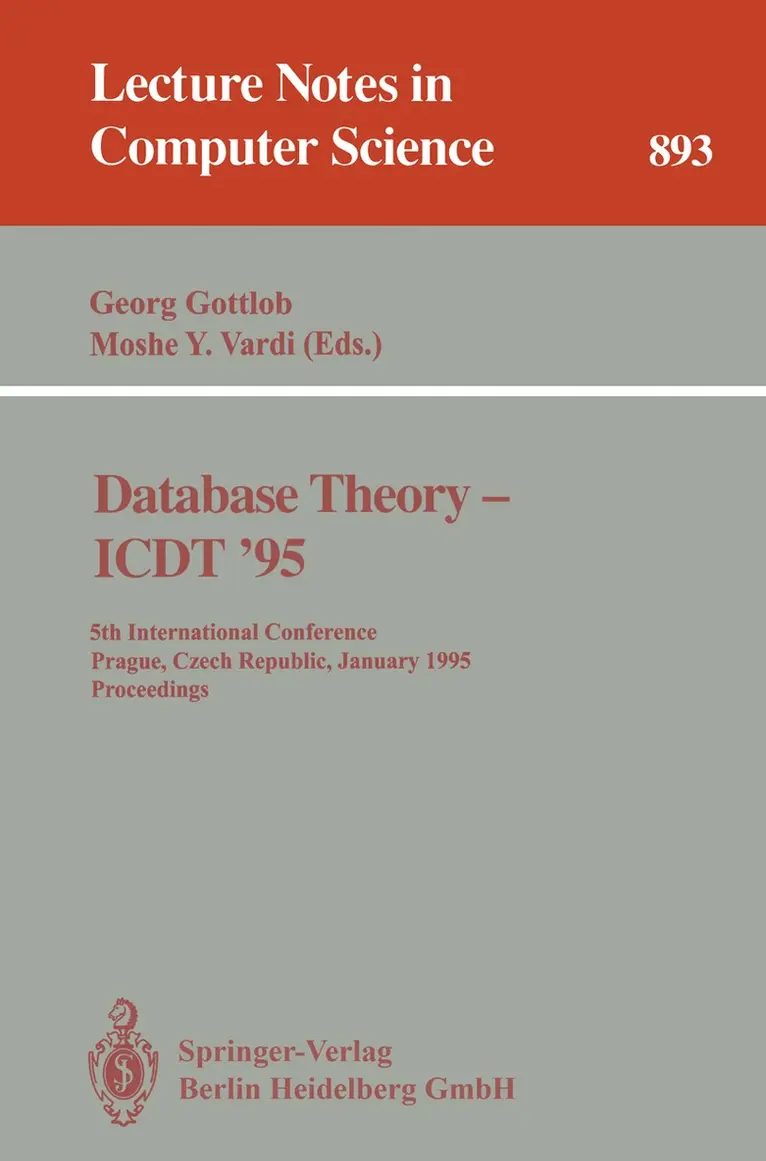
This volume presents the proceedings of the 1995 International Conference on Database Theory, ICDT '95, held in Prague in January 1995.Besides two full invited papers and the abstracts of two tutorials, the book includes the revised full versions of 29 technical contributions selected from a total of 116 submissions. The papers address all current aspects of database theory; they are organized in sections on optimization, nonmonotonic semantics, query languages, concurrency control, advanced models, probabilistic methods, constraints and dependencies, and Datalog analysis.
Häftad, Engelska, 1998
1 123 kr
Skickas inom 10-15 vardagar
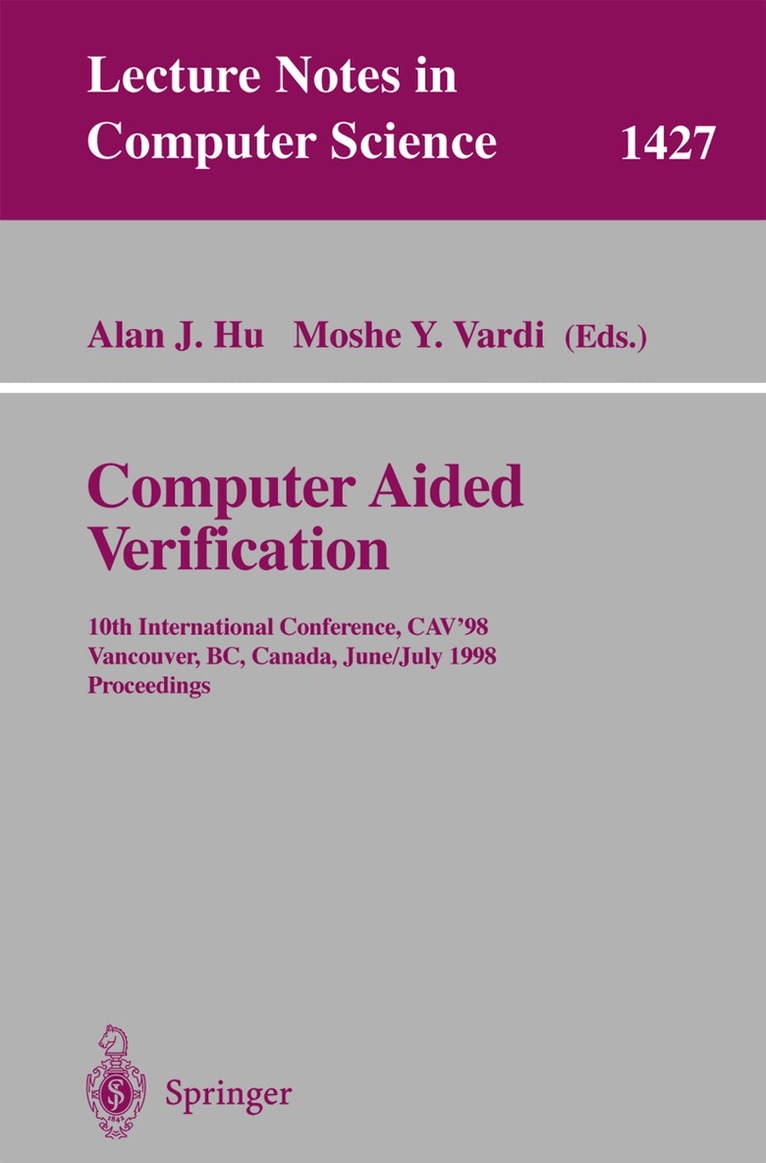
This book consitutes the refereed proceedings of the 10th International Conference on Computer Aided Verification, CAV'98, held in Vancouver, BC, Canada, in June/July 1998. The 33 revised full papers and 10 tool papers presented were carefully selected from a total of 117 submissions. Also included are 11 invited contributions. Among the topics covered are modeling and specification formalisms; verification techniques like state-space exploration, model checking, synthesis, and automated deduction; various verification techniques; applications and case studies, and verification in practice.
E-bok
PDF, Engelska, 20071 069 kr
Läs direkt efter köp
Finite model theory,as understoodhere, is an areaof mathematicallogic that has developed in close connection with applications to computer science, in particular the theory of computational complexity and database theory. One of the fundamental insights of mathematical logic is that our understanding of mathematical phenomena is enriched by elevating the languages we use to describe mathematical structures to objects of explicit study. If mathematics is the science of patterns, then the media through which we discern patterns, as well as the structures in which we discern them, command our attention. It isthis aspect oflogicwhichis mostprominentin model theory,“thebranchof mathematical logic which deals with the relation between a formal language and its interpretations”. No wonder, then, that mathematical logic, and ?nite model theory in particular, should ?nd manifold applications in computer science: from specifying programs to querying databases, computer science is rife with phenomena whose understanding requires close attention to the interaction between language and structure. This volume gives a broadoverviewof some central themes of ?nite model theory: expressive power, descriptive complexity, and zero–one laws, together with selected applications to database theory and arti?cial intelligence, es- cially constraint databases and constraint satisfaction problems. The ?nal chapter provides a concise modern introduction to modal logic,which emp- sizes the continuity in spirit and technique with ?nite model theory.
Häftad, Engelska, 2014
845 kr
Skickas inom 10-15 vardagar
Finite model theory,as understoodhere, is an areaof mathematicallogic that has developed in close connection with applications to computer science, in particular the theory of computational complexity and database theory. One of the fundamental insights of mathematical logic is that our understanding of mathematical phenomena is enriched by elevating the languages we use to describe mathematical structures to objects of explicit study. If mathematics is the science of patterns, then the media through which we discern patterns, as well as the structures in which we discern them, command our attention. It isthis aspect oflogicwhichis mostprominentin model theory,“thebranchof mathematical logic which deals with the relation between a formal language and its interpretations”. No wonder, then, that mathematical logic, and ?nite model theory in particular, should ?nd manifold applications in computer science: from specifying programs to querying databases, computer science is rife with phenomena whose understanding requires close attention to the interaction between language and structure. This volume gives a broadoverviewof some central themes of ?nite model theory: expressive power, descriptive complexity, and zero–one laws, together with selected applications to database theory and arti?cial intelligence, es- cially constraint databases and constraint satisfaction problems. The ?nal chapter provides a concise modern introduction to modal logic,which emp- sizes the continuity in spirit and technique with ?nite model theory.