Scott Weinstein – författare
Visar alla böcker från författaren Scott Weinstein. Handla med fri frakt och snabb leverans.
4 produkter
4 produkter
Häftad, Engelska, 1990
494 kr
Skickas inom 3-6 vardagar
Inbunden, Engelska, 2007
1 003 kr
Skickas inom 10-15 vardagar
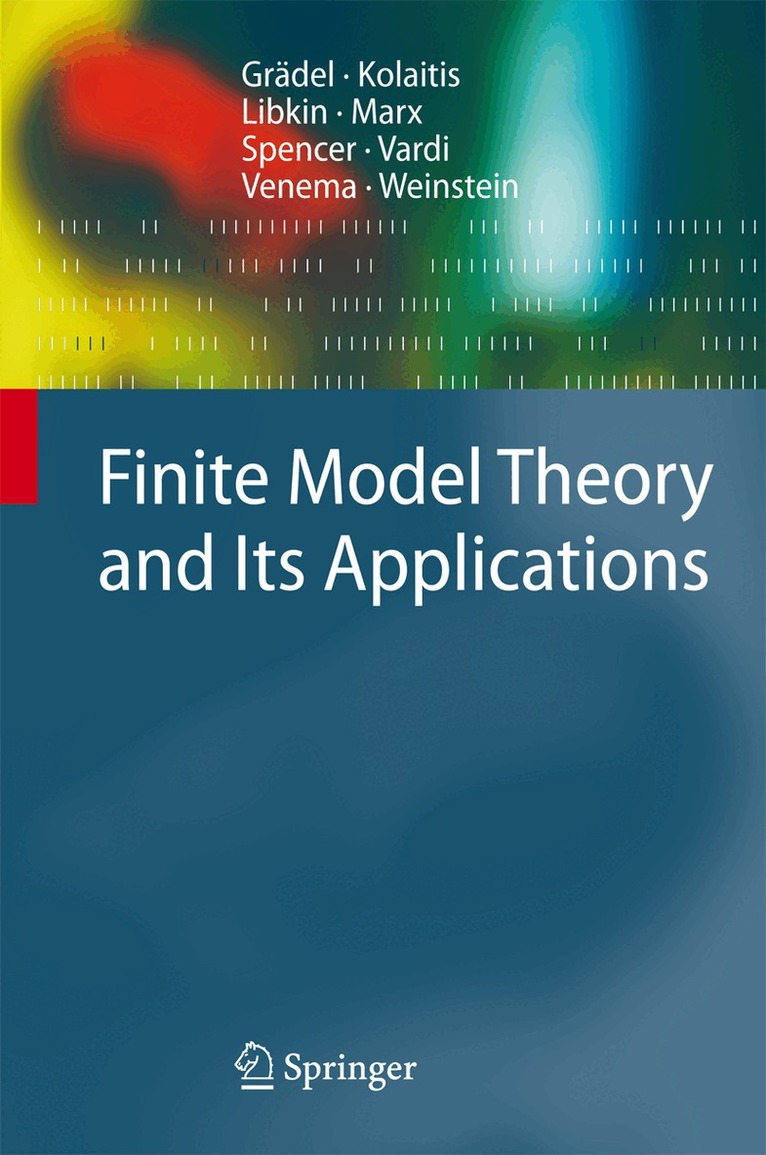
This book gives a broad overview of core topics of finite model theory: expressive power, descriptive complexity, and zero-one laws, together with selected applications to database theory and artificial intelligence, especially constraint databases and constraint satisfaction problems. The final chapter provides a concise modern introduction to modal logic, which emphasizes the continuity in spirit and technique with finite model theory. This underlying spirit involves the use of various fragments of, and hierarchies within, first order, second order, fixed point, and infinitary logics to gain insight into phenomena in complexity theory and combinatorics. Students of logic and computer science will find here the tools necessary to embark on research in finite model theory, and all readers will experience the excitement of a vibrant area of application of logic to computer science.
E-bok
PDF, Engelska, 20071 069 kr
Läs direkt efter köp
Finite model theory,as understoodhere, is an areaof mathematicallogic that has developed in close connection with applications to computer science, in particular the theory of computational complexity and database theory. One of the fundamental insights of mathematical logic is that our understanding of mathematical phenomena is enriched by elevating the languages we use to describe mathematical structures to objects of explicit study. If mathematics is the science of patterns, then the media through which we discern patterns, as well as the structures in which we discern them, command our attention. It isthis aspect oflogicwhichis mostprominentin model theory,“thebranchof mathematical logic which deals with the relation between a formal language and its interpretations”. No wonder, then, that mathematical logic, and ?nite model theory in particular, should ?nd manifold applications in computer science: from specifying programs to querying databases, computer science is rife with phenomena whose understanding requires close attention to the interaction between language and structure. This volume gives a broadoverviewof some central themes of ?nite model theory: expressive power, descriptive complexity, and zero–one laws, together with selected applications to database theory and arti?cial intelligence, es- cially constraint databases and constraint satisfaction problems. The ?nal chapter provides a concise modern introduction to modal logic,which emp- sizes the continuity in spirit and technique with ?nite model theory.
Häftad, Engelska, 2014
837 kr
Skickas inom 10-15 vardagar
Finite model theory,as understoodhere, is an areaof mathematicallogic that has developed in close connection with applications to computer science, in particular the theory of computational complexity and database theory. One of the fundamental insights of mathematical logic is that our understanding of mathematical phenomena is enriched by elevating the languages we use to describe mathematical structures to objects of explicit study. If mathematics is the science of patterns, then the media through which we discern patterns, as well as the structures in which we discern them, command our attention. It isthis aspect oflogicwhichis mostprominentin model theory,“thebranchof mathematical logic which deals with the relation between a formal language and its interpretations”. No wonder, then, that mathematical logic, and ?nite model theory in particular, should ?nd manifold applications in computer science: from specifying programs to querying databases, computer science is rife with phenomena whose understanding requires close attention to the interaction between language and structure. This volume gives a broadoverviewof some central themes of ?nite model theory: expressive power, descriptive complexity, and zero–one laws, together with selected applications to database theory and arti?cial intelligence, es- cially constraint databases and constraint satisfaction problems. The ?nal chapter provides a concise modern introduction to modal logic,which emp- sizes the continuity in spirit and technique with ?nite model theory.