M.R. Smallman-Raynor - Böcker
Visar alla böcker från författaren M.R. Smallman-Raynor. Handla med fri frakt och snabb leverans.
2 produkter
2 produkter
3 290 kr
Skickas inom 5-8 vardagar
The last four decades of human history have seen the emergence of an unprecedented number of 'new' infectious diseases: the familiar roll call includes AIDS, Ebola, H5N1 influenza, hantavirus, hepatitis E, Lassa fever, legionnaires' and Lyme diseases, Marburg fever, Rift Valley fever, SARS, and West Nile. The outbreaks range in scale from global pandemics that have brought death and misery to millions, through to self-limiting outbreaks of mainly local impact. Some outbreaks have erupted explosively but have already faded away; some grumble along or continue to devastate as now persistent features in the medical lexicon; in others, a huge potential threat hangs uncertainly and worryingly in the air. Some outbreaks are merely local, others are worldwide.This book looks at the epidemiological and geographical conditions which underpin disease emergence. What are the processes which lead to emergence? Why now in human history? Where do such diseases emerge and how do they spread or fail to spread around the globe? What is the armoury of surveillance and control measures that may curb the impact of such diseases? But, uniquely, it sets these questions on the modern period of disease emergence in an historical context. First, it uses the historical record to set recent events against a much broader temporal canvas, finding emergence to be a constant theme in disease history rather than one confined to recent decades. It concludes that it is the quantitative pace of emergence, rather than its intrinsic nature, that separates the present period from earlier centuries. Second, it looks at the spatial and ecological setting of emergence, using hundreds of specially-drawn maps to chart the source areas of new diseases and the pathways of their spread. The book is divided into three main sections: Part 1 looks at early disease emergence, Part 2 at the processes of disease emergence, and Part 3 at the future for emergent diseases.
5 578 kr
Skickas inom 5-8 vardagar
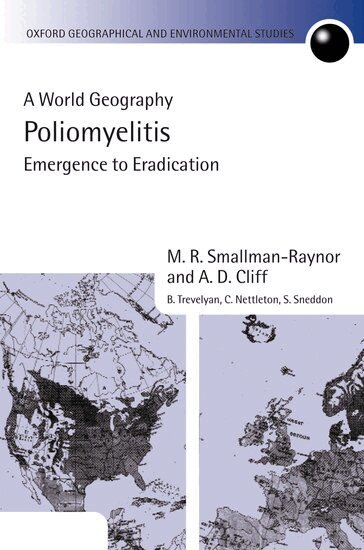
For parents, few infections scored higher than poliomyelitis on the 'dread' factor from the early years of the twentieth century as each successive wave of the disease outdid its predecessor in the number of children it crippled and killed. But, from the 1950s, this picture abruptly changed when preventive vaccines were developed which have brought the disease to the edge of global eradication. Part I, Epidemic Emergence, 1881-1920, looks at the transition from endemic to epidemic poliomyelitis in Europe and the United States. Part II, Global Expansion, 1921-55, covers the pre-vaccination period of epidemic poliomyelitis at world, continental and island scales. Part III, Global Retreat, 1955-88, focuses upon the control of poliomyelitis by mass vaccination campaigns. Part IV, Global Eradication, concludes the book by focusing upon the road to eradication, to which the Forty-first World Health Assembly committed in 1988.And so, at the beginning of a new millennium, poliomyelitis looks set to be the first disease since smallpox in 1979 to be eradicated by direct human intervention, with the interruption of wild poliovirus transmission expected in 2005. The evolution of poliomyelitis to global epidemiological significance from the 1920s marks it out as one of the world's major emergent infections of the twentieth century. What causes diseases to wax and wane in time and space is a theme of contemporary scientific interest as we seek to understand the appearance of new conditions such as Ebola fever, Legionnaires' disease, and HIV, and this book contributes to our comprehension of likely causes.