
Murray Weidenbaum – författare
Visar alla böcker från författaren Murray Weidenbaum. Handla med fri frakt och snabb leverans.
6 produkter
6 produkter
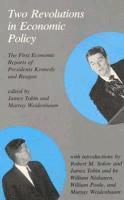
Two Revolutions in Economic Policy
The First Economic Reports of Presidents Kennedy and Reagan
Häftad, Engelska, 1988
341 kr
Tillfälligt slut
1 574 kr
Skickas inom 10-15 vardagar
One-Armed Economist represents a personal, if eclectic, approach to public policy. Weidenbaum avoids doctrinaire positions, be they Keynesian or monetarist or supply side or libertarian. This distillation of Weidenbaum's wide range of writings on public policy issues over the last four decades draws on his practical experience in government and business as well as his academic research over that extended period.The volume covers six major clusters of policy issues: economic policy, government programs, business decision-making, government regulation, the defense sector, and the international economy. There are chapters on how to achieve a cleaner environment, how to fundamentally overhaul the tax and health care systems, and a defense of Reaganomics. The work examines how public sector activities impact the performance of the national economy. Its coverage includes the role of government as a buyer, a seller, a provider of credit, and a source of subsidy and support. Drawing heavily on his experience as economist for a major military contractor, Weidenbaum shows that the defense industry is the most heavily regulated sector of the American economy and discusses ways to modernize the arcane and wasteful process of procuring weapon systems.He also draws on his work on the hidden costs of regulation on the consumer, showing how to improve the regulatory process so as to achieve national objectives while minimizing the burdens of compliance. The last section is devoted to the international economy, with chapters on the role of the overseas enterprises. One-Armed Economist is a lucid analysis of major public policy issues of our time. As such it will be of special interest to organizations involved in public policy, think tanks, and government policymaking groups, as well as readers interested in fresh perspectives on a broad range of policy issues.

Reagan and the Economy
Nine Intimate Perspectives (Miller Center Reagan Oral History, Vol 4)
Häftad, Engelska, 1995
612 kr
Tillfälligt slut
To find more information about Rowman & Littlefield titles please visit us at www.rowmanlittlefield.com.
470 kr
Skickas inom 10-15 vardagar
One-Armed Economist represents a personal, if eclectic, approach to public policy. Weidenbaum avoids doctrinaire positions, be they Keynesian or monetarist or supply side or libertarian. This distillation of Weidenbaum's wide range of writings on public policy issues over the last four decades draws on his practical experience in government and business as well as his academic research over that extended period.The volume covers six major clusters of policy issues: economic policy, government programs, business decision-making, government regulation, the defense sector, and the international economy. There are chapters on how to achieve a cleaner environment, how to fundamentally overhaul the tax and health care systems, and a defense of Reaganomics. The work examines how public sector activities impact the performance of the national economy. Its coverage includes the role of government as a buyer, a seller, a provider of credit, and a source of subsidy and support. Drawing heavily on his experience as economist for a major military contractor, Weidenbaum shows that the defense industry is the most heavily regulated sector of the American economy and discusses ways to modernize the arcane and wasteful process of procuring weapon systems.He also draws on his work on the hidden costs of regulation on the consumer, showing how to improve the regulatory process so as to achieve national objectives while minimizing the burdens of compliance. The last section is devoted to the international economy, with chapters on the role of the overseas enterprises. One-Armed Economist is a lucid analysis of major public policy issues of our time. As such it will be of special interest to organizations involved in public policy, think tanks, and government policymaking groups, as well as readers interested in fresh perspectives on a broad range of policy issues.
1 099 kr
Tillfälligt slut
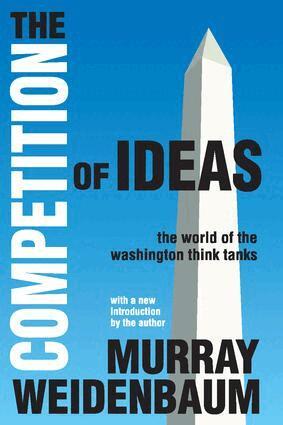
Murray Weidenbaum has been a visiting scholar at the American Enterprise Institute and the Center for Strategic and International Studies, a speaker at meetings at the Brookings Institution, the Cato Institute, and the Heritage Foundation and has also written for their publications, and served as a reviewer of ongoing studies. In The Competition of Ideas, Weidenbaum examines the political economy of these vital institutions, drawing heavily on several decades of involvement in their activities. He is uniquely able to see their accomplishments as well as their shortcomings.Because of the importance of the activities of their organizations, and their tax-exempt status, think tanks are held to a high standard. Weidenbaum shows that sometimes think tanks are more tank than think—major think tanks are often predictable in the positions they take on public issues and are far better at analyzing the shortcomings of other elements of society than of their own operations. The overarching issue of quality control, Weidenbaum holds, deserves more attention than it has attained in the think tank world.This book presents a careful, balanced account of where think tanks have been and where they are now headed. Given the high levels of professionalism in many think tanks, a fundamental change in the attitude of their management is important. The compelling need is less for the wielder of policy than for the lucid synthesizer of relevant research and analysis. Likewise, society needs sensitivity to the long-term concerns of the citizenry more urgently than rapid response to the opportunities of the moment. Future competition, particularly among the major think tanks, could well be centered, not on achieving greater visibility, but on developing responses to economic, environmental, and national security problems that are likely to be adopted and carried out.
715 kr
Skickas inom 10-15 vardagar
Murray Weidenbaum has been a visiting scholar at the American Enterprise Institute and the Center for Strategic and International Studies, a speaker at meetings at the Brookings Institution, the Cato Institute, and the Heritage Foundation and has also written for their publications, and served as a reviewer of ongoing studies. In The Competition of Ideas, Weidenbaum examines the political economy of these vital institutions, drawing heavily on several decades of involvement in their activities. He is uniquely able to see their accomplishments as well as their shortcomings.Because of the importance of the activities of their organizations, and their tax-exempt status, think tanks are held to a high standard. Weidenbaum shows that sometimes think tanks are more tank than think—major think tanks are often predictable in the positions they take on public issues and are far better at analyzing the shortcomings of other elements of society than of their own operations. The overarching issue of quality control, Weidenbaum holds, deserves more attention than it has attained in the think tank world.This book presents a careful, balanced account of where think tanks have been and where they are now headed. Given the high levels of professionalism in many think tanks, a fundamental change in the attitude of their management is important. The compelling need is less for the wielder of policy than for the lucid synthesizer of relevant research and analysis. Likewise, society needs sensitivity to the long-term concerns of the citizenry more urgently than rapid response to the opportunities of the moment. Future competition, particularly among the major think tanks, could well be centered, not on achieving greater visibility, but on developing responses to economic, environmental, and national security problems that are likely to be adopted and carried out.