N. Capaldi - Böcker
Visar alla böcker från författaren N. Capaldi. Handla med fri frakt och snabb leverans.
4 produkter
4 produkter
1 974 kr
Skickas inom 5-8 vardagar
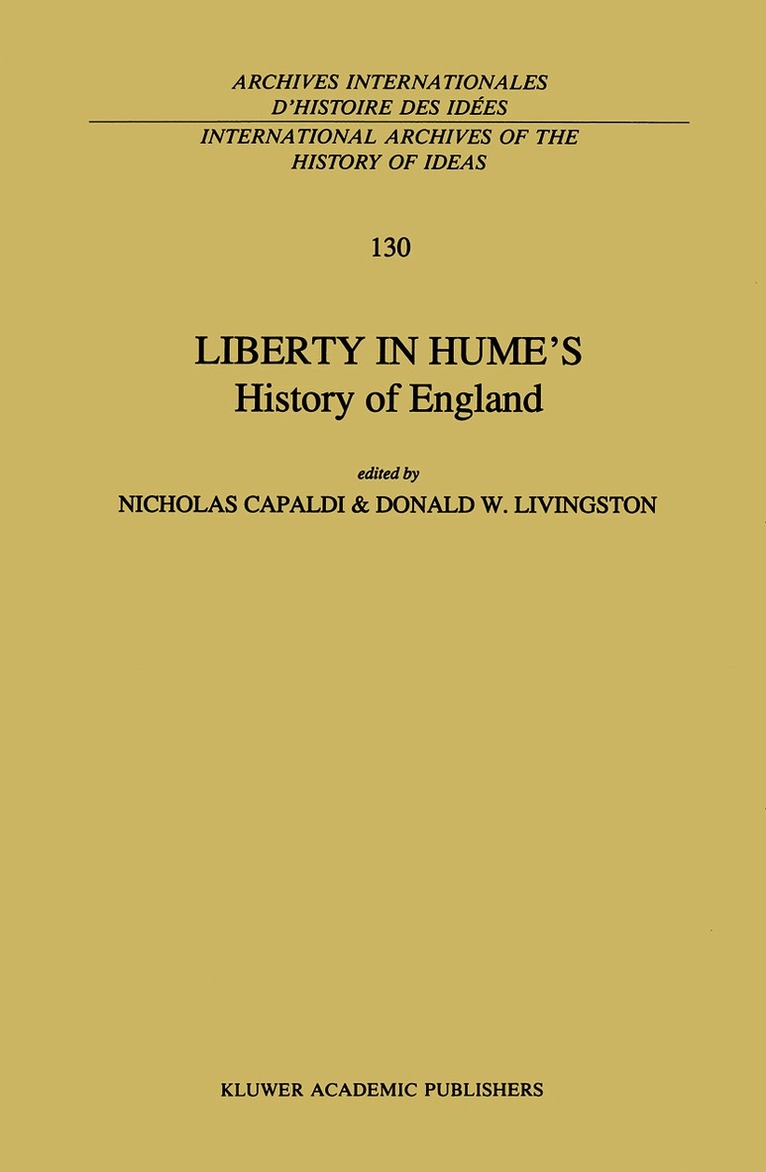
LIBERTY IN HUME'S HISTORY OF ENGLAND In his own lifetime, Hume was feted by his admirers as a great historian, and even his enemies conceded that he was a controversial historian with whom one had to reckon. On the other hand, Hume failed to achieve positive recognition for his philosophical views. It was Hume's History of England that played an influential role in public policy debate during the eighteenth century in both Great Britain and in the United States. Hume's Hist01Y of England passed through seven editions and was beginning to be perceived as a classic before Hume's death. Voltaire, as an historian, considered it "perhaps the best ever written in any lan guage. " Gibbon greatly admired Hume's work and said, of a letter written by Hume in 1776 praising the Decline and Fall of the Roman Empire, that a compliment from Hume "overpaid the labor of ten years. " After Hume's death on August 20, 1776, the History became a factor in the revolutionary events that began to unfold. Louis XVI was a close student of Hume's History, and his valet records that, upon having learned that the Convention had voted the death penalty, the King asked for the volume in Hume's History covering the trial and execution of Charles I to read in the days that remained. But if Louis XVI found the consolations of philosophical history in the Stuart volumes, Thomas Jefferson saw in them a cause for alarm.
Del 4 - Philosophical Studies in Contemporary Culture
Enlightenment Project in the Analytic Conversation
Inbunden, Engelska, 1998
2 111 kr
Skickas inom 10-15 vardagar
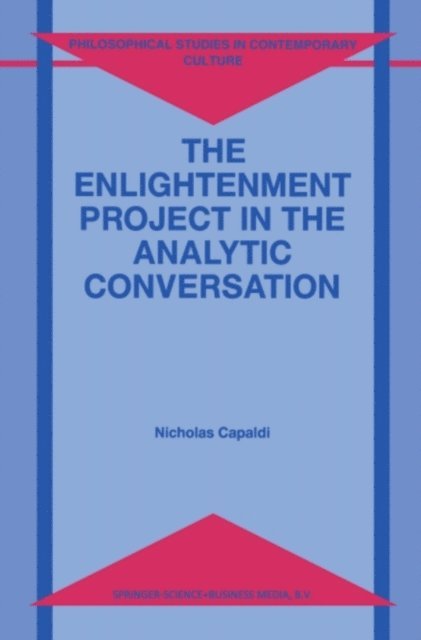
Analytic philosophy has been a dominant intellectual movement in the 20th century and a reflection of the cultural pre-eminence of scientism. In response to analytic philosophy's peculiar reticence (and inability) to discuss itself, this book provides a comprehensive history and critique. The central element in the analytic conversation has been the Enlightenment Project: the appeal to an autonomous human reason, freed of any higher authority and channeling itself through science as its privileged tool. This centrality is demonstrated by systematically examining its presence and development in the philosophy of science, metaphysics, epistemology, language, psychology, social science, ethics, political philosophy, and the history of philosophy. This journey highlights the internal logical disintegration of that project. Post-modern relativism is its natural offspring and not a viable alternative.The Enlightenment Project's conception of physical science is defective; this defective conception of physical science renders the analytic conception of social science, philosophical psychology, and epistemology defective; and that defective conception of the human condition leads to defective conceptions of both moral and political philosophy, specifically the idea of social engineering or social technology. Throughout the book, an alternative conception of philosophy is presented as a way out of the abyss of analysis, an alternative that reconnects philosophy with the mainstream of Western civilization and initiates the process of providing a coherent cultural narrative. This book should be of particular interest to any reader concerned about the lack of a coherent cultural narrative.
2 111 kr
Skickas inom 10-15 vardagar
Analytic philosophy has been a dominant intellectual movement in the 20th century and a reflection of the cultural pre-eminence of scientism. In response to analytic philosophy's peculiar reticence (and inability) to discuss itself, this book provides its first comprehensive history and critique. The central element in the analytic conversation has been the Enlightenment Project: the appeal to an autonomous human reason, freed of any higher authority and channeling itself through science as its privileged tool. This centrality is demonstrated by systematically examining its presence and development in the philosophy of science, metaphysics, epistemology, language, psychology, social science, ethics, political philosophy, and the history of philosophy. This journey highlights the internal logical disintegration of that project. Post-modern relativism is its natural offspring and not a viable alternative.The Enlightenment Project's conception of physical science is defective; this defective conception of physical science renders the analytic conception of social science, philosophical psychology, and epistemology defective; and that defective conception of the human condition leads to defective conceptions of both moral and political philosophy, specifically the idea of social engineering or social technology. Throughout the book, an alternative conception of philosophy is presented as a way out of the abyss of analysis, an alternative that reconnects philosophy with the mainstream of Western civilization and initiates the process of providing a coherent cultural narrative. This book will be of particular interest to any sophisticated reader concerned about the lack of a coherent cultural narrative.
2 111 kr
Skickas inom 10-15 vardagar
LIBERTY IN HUME'S HISTORY OF ENGLAND In his own lifetime, Hume was feted by his admirers as a great historian, and even his enemies conceded that he was a controversial historian with whom one had to reckon. On the other hand, Hume failed to achieve positive recognition for his philosophical views. It was Hume's History of England that played an influential role in public policy debate during the eighteenth century in both Great Britain and in the United States. Hume's Hist01Y of England passed through seven editions and was beginning to be perceived as a classic before Hume's death. Voltaire, as an historian, considered it "perhaps the best ever written in any lan guage. " Gibbon greatly admired Hume's work and said, of a letter written by Hume in 1776 praising the Decline and Fall of the Roman Empire, that a compliment from Hume "overpaid the labor of ten years. " After Hume's death on August 20, 1776, the History became a factor in the revolutionary events that began to unfold. Louis XVI was a close student of Hume's History, and his valet records that, upon having learned that the Convention had voted the death penalty, the King asked for the volume in Hume's History covering the trial and execution of Charles I to read in the days that remained. But if Louis XVI found the consolations of philosophical history in the Stuart volumes, Thomas Jefferson saw in them a cause for alarm.