
Nancy S. Struever – författare
Visar alla böcker från författaren Nancy S. Struever. Handla med fri frakt och snabb leverans.
7 produkter
7 produkter
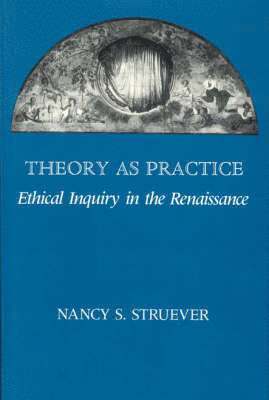
Inbunden, Engelska, 1992
566 kr
Skickas inom 5-8 vardagar
There is a tendency in modern scholarship to describe the Renaissance Humanists merely as readers—as interpreters happily absorbed within the bounds of their chosen classical texts. In Theory as Practice, Nancy Struever contests this accepted notion; by focusing on ethical inquiry, she presents the Humanists as engaged in subtle, innovative moral work.Struever argues that the accomplishment of five major Renaissance figures—Petrarch, Nicolaus Cusanus, Lorenzo Valla, Machiavelli, and Montaigne—was to consider theory as practice and thus engage the ethics of inquiry. She notes three stages of investigation, the first represented by Petrarch, who "relocated" ethical inquiry from a theoretical realm to a familiar practice responsive to daily experience. Next, Struever describes how Cusanus and Valla assume Petrarch's relocation, yet confect ethics into discursive disciplines. Finally, while both Machiavelli and Montaigne produced strong revisions of discipline, they considered the problems of addressing the non-inquirer as well. Struever urges modern readers to employ both rhetorical and philosophical analysis to reveal these Humanists' aggressive tactics of presentation as well as their novel disciplinary reorientation. By doing so, she suggests, we discover how Renaissance ethical inquiry illuminates, and is illuminated by, the modern ethical theory of such philosophers as Peirce, Wittgenstein, Bernard Williams, and Quine.
Häftad, Engelska, 2015
625 kr
Skickas inom 3-6 vardagar
At any time, basic assumptions about language have a direct effect on the writing of history. The structure of language is related to the structure of knowledge and thus to the definition of historical reality, while linguistic competence gives insights into the relation of ideas and action. Within the framework of these ideas, and drawing on recent work in linguistic theory, including that of the French structuralists. Professor Struever studies the major shift in attitudes toward language and history which the Renaissance represents. One of the essential innovations of Renaissance Humanism is the substitution of rhetoric for dialectic as the dominant language discipline; rhetoric gives the Humanists their cohesion as a lay intellectual elite, as well as the force and direction of their thought. The author accepts the current trend in classical studies, the rehabilitation of the Sophists which finds its source in Nietzsche and includes the work of Rostagni, Untersteiner, and Buccellato, to reinstate rhetoric as the historical vehicle of Sophistic insight. Originally published in 1970.The Princeton Legacy Library uses the latest print-on-demand technology to again make available previously out-of-print books from the distinguished backlist of Princeton University Press. These editions preserve the original texts of these important books while presenting them in durable paperback and hardcover editions. The goal of the Princeton Legacy Library is to vastly increase access to the rich scholarly heritage found in the thousands of books published by Princeton University Press since its founding in 1905.
Inbunden, Engelska, 2016
1 459 kr
Skickas inom 3-6 vardagar
At any time, basic assumptions about language have a direct effect on the writing of history. The structure of language is related to the structure of knowledge and thus to the definition of historical reality, while linguistic competence gives insights into the relation of ideas and action. Within the framework of these ideas, and drawing on recent work in linguistic theory, including that of the French structuralists. Professor Struever studies the major shift in attitudes toward language and history which the Renaissance represents. One of the essential innovations of Renaissance Humanism is the substitution of rhetoric for dialectic as the dominant language discipline; rhetoric gives the Humanists their cohesion as a lay intellectual elite, as well as the force and direction of their thought. The author accepts the current trend in classical studies, the rehabilitation of the Sophists which finds its source in Nietzsche and includes the work of Rostagni, Untersteiner, and Buccellato, to reinstate rhetoric as the historical vehicle of Sophistic insight. Originally published in 1970.The Princeton Legacy Library uses the latest print-on-demand technology to again make available previously out-of-print books from the distinguished backlist of Princeton University Press. These editions preserve the original texts of these important books while presenting them in durable paperback and hardcover editions. The goal of the Princeton Legacy Library is to vastly increase access to the rich scholarly heritage found in the thousands of books published by Princeton University Press since its founding in 1905.
Inbunden, Engelska, 2009
2 603 kr
Skickas inom 5-8 vardagar
In the articles collected here Nancy Struever explores the basic assumption that rhetoric is not simply a bag of persuasive tricks, but functions, necessarily, as a mode of inquiry investigating not simply the mechanics of production and reception of discourse, but the psychological factors of reason and passion engaged by the assertion, modification, and contest of beliefs and dispositions of the civil communities. The first section looks both at contemporary historians employing rhetorical constructs and tactics and at contemporary accounts of the employment of rhetorical pedagogical material and theoretical texts in medieval and Renaissance cultural practices. The second set of articles considers change and continuity in the rhetorical exploitation's of genre forms in cultural programs, focuses on the strong reorientation of Classical forms of moral inquiry, on the ingenious use of the proverb, of etymology, of the exemplum, as well as on the changes in strategies in the theater, the novel, and art criticism. The final section deals with the strong historical interconnections of rhetoric with other disciplines: the motives and investigative tactics of medicine and rhetoric in the Renaissance and Early Modernity, and the shared interests and interwoven careers of rhetoric and law.
Häftad, Engelska, 2016
893 kr
Skickas inom 10-15 vardagar
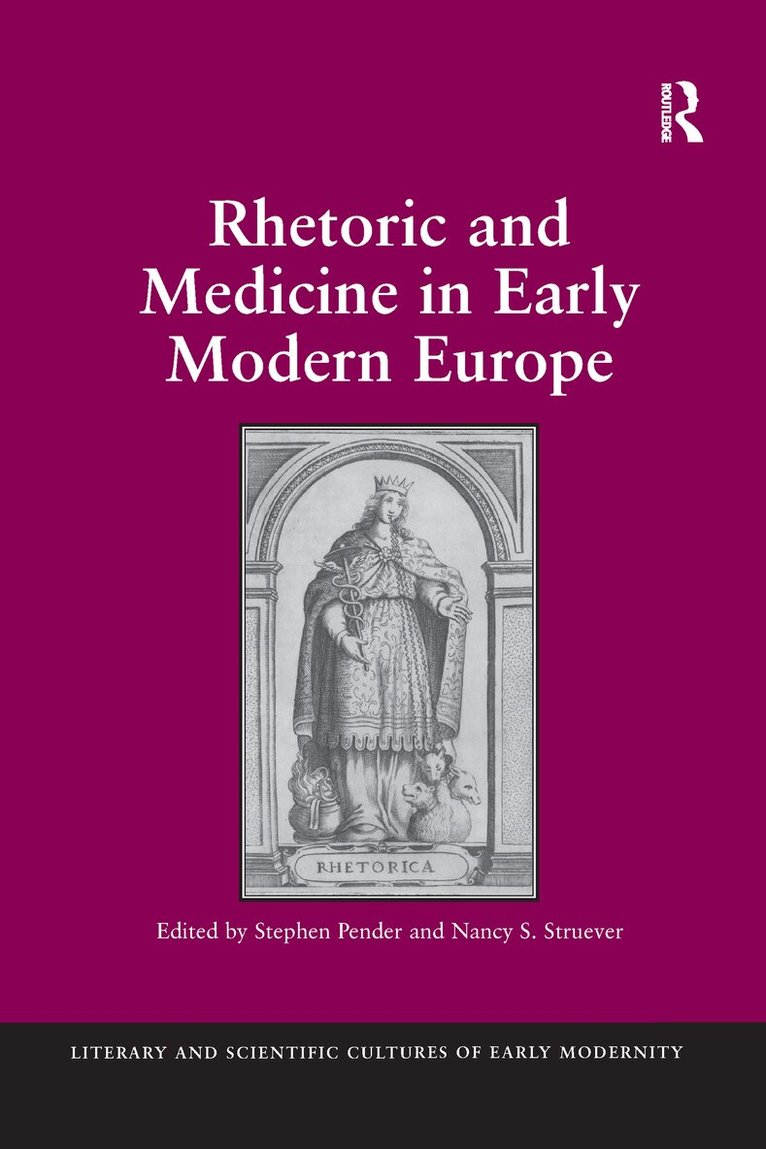
Through close analysis of texts, cultural and civic communities, and intellectual history, the papers in this collection, for the first time, propose a dynamic relationship between rhetoric and medicine as discourses and disciplines of cure in early modern Europe. Although the range of theoretical approaches and methodologies represented here is diverse, the essays collectively explore the theories and practices, innovations and interventions, that underwrite the shared concerns of medicine, moral philosophy, and rhetoric: care and consolation, reading, policy, and rectitude, signinference, selfhood, and autonomy-all developed and refined at the intersection of areas of inquiry usually thought distinct. From Italy to England, from the sixteenth through to the mid-eighteenth century, early modern moral philosophers and essayists, rhetoricians and physicians investigated the passions and persuasion, vulnerability and volubility, theoretical intervention and practical therapy in the dramas, narratives, and disciplines of public and private cure. The essays are relevant to a wide range of readers, including cultural, literary, and intellectual historians, historians of medicine and philosophy, and scholars of rhetoric.
Häftad, Engelska, 2019
846 kr
Skickas inom 10-15 vardagar
In the articles collected here Nancy Struever explores the basic assumption that rhetoric is not simply a bag of persuasive tricks, but functions, necessarily, as a mode of inquiry investigating not simply the mechanics of production and reception of discourse, but the psychological factors of reason and passion engaged by the assertion, modification, and contest of beliefs and dispositions of the civil communities. The first section looks both at contemporary historians employing rhetorical constructs and tactics and at contemporary accounts of the employment of rhetorical pedagogical material and theoretical texts in medieval and Renaissance cultural practices. The second set of articles considers change and continuity in the rhetorical exploitation's of genre forms in cultural programs, focuses on the strong reorientation of Classical forms of moral inquiry, on the ingenious use of the proverb, of etymology, of the exemplum, as well as on the changes in strategies in the theater, the novel, and art criticism. The final section deals with the strong historical interconnections of rhetoric with other disciplines: the motives and investigative tactics of medicine and rhetoric in the Renaissance and Early Modernity, and the shared interests and interwoven careers of rhetoric and law.
Inbunden, Engelska, 2012
2 695 kr
Skickas inom 10-15 vardagar
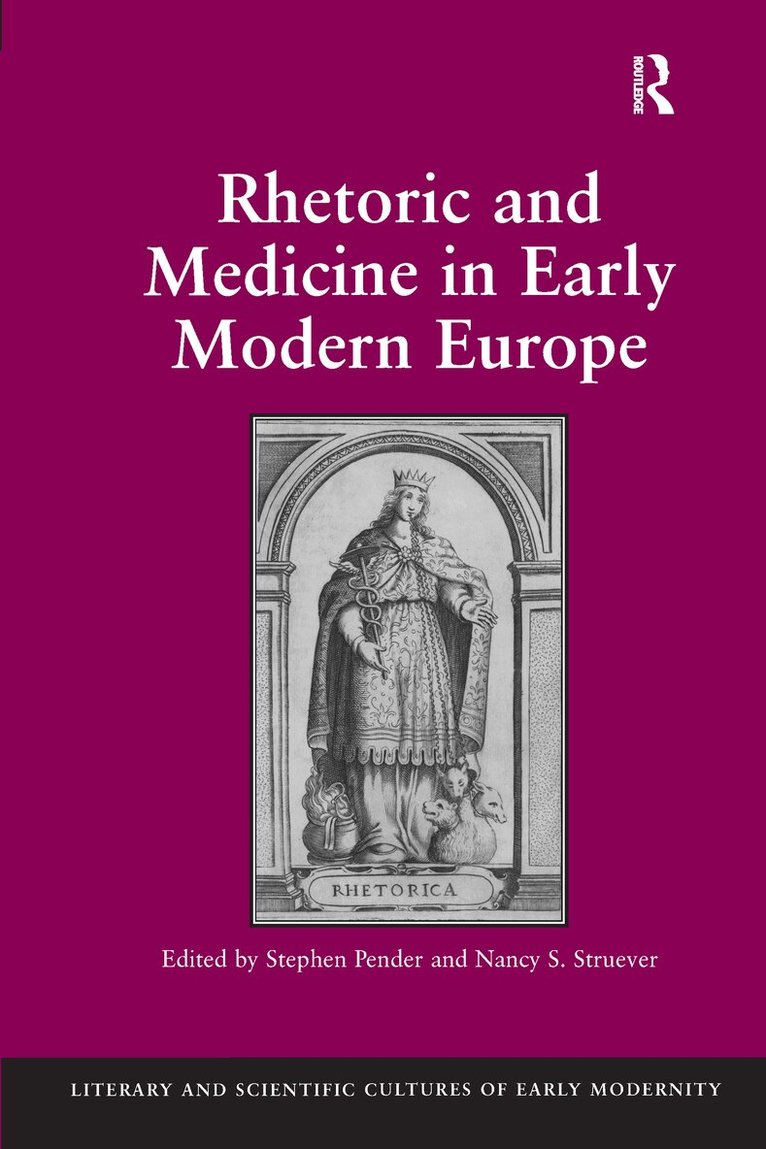
Through close analysis of texts, cultural and civic communities, and intellectual history, the papers in this collection, for the first time, propose a dynamic relationship between rhetoric and medicine as discourses and disciplines of cure in early modern Europe. Although the range of theoretical approaches and methodologies represented here is diverse, the essays collectively explore the theories and practices, innovations and interventions, that underwrite the shared concerns of medicine, moral philosophy, and rhetoric: care and consolation, reading, policy, and rectitude, signinference, selfhood, and autonomy-all developed and refined at the intersection of areas of inquiry usually thought distinct. From Italy to England, from the sixteenth through to the mid-eighteenth century, early modern moral philosophers and essayists, rhetoricians and physicians investigated the passions and persuasion, vulnerability and volubility, theoretical intervention and practical therapy in the dramas, narratives, and disciplines of public and private cure. The essays are relevant to a wide range of readers, including cultural, literary, and intellectual historians, historians of medicine and philosophy, and scholars of rhetoric.