Naomi W. Cohen – författare
Visar alla böcker från författaren Naomi W. Cohen. Handla med fri frakt och snabb leverans.
5 produkter
Jews in Christian America
The Pursuit of Religious Equality
Inbunden, 1992
2047 kr
Lägg i varukorg
This book examines how American Jews from colonial times to the present have contended with living in a fundamentally Christian state. Separation of church and state has become a veritable creed in the American Jewish community, and the focus of the work is the way in which Jewish actions have …
Jews in Christian America
The Pursuit of Religious Equality
E-bok, 1992
1100 kr
Lägg i varukorg
Separation of church and state has become a veritable creed in the American Jewish community. Focusing on the way in which Jewish actions have contributed to the development of separation, this book examines how American Jews have contended with living in a fundamentally Christian state. In the …
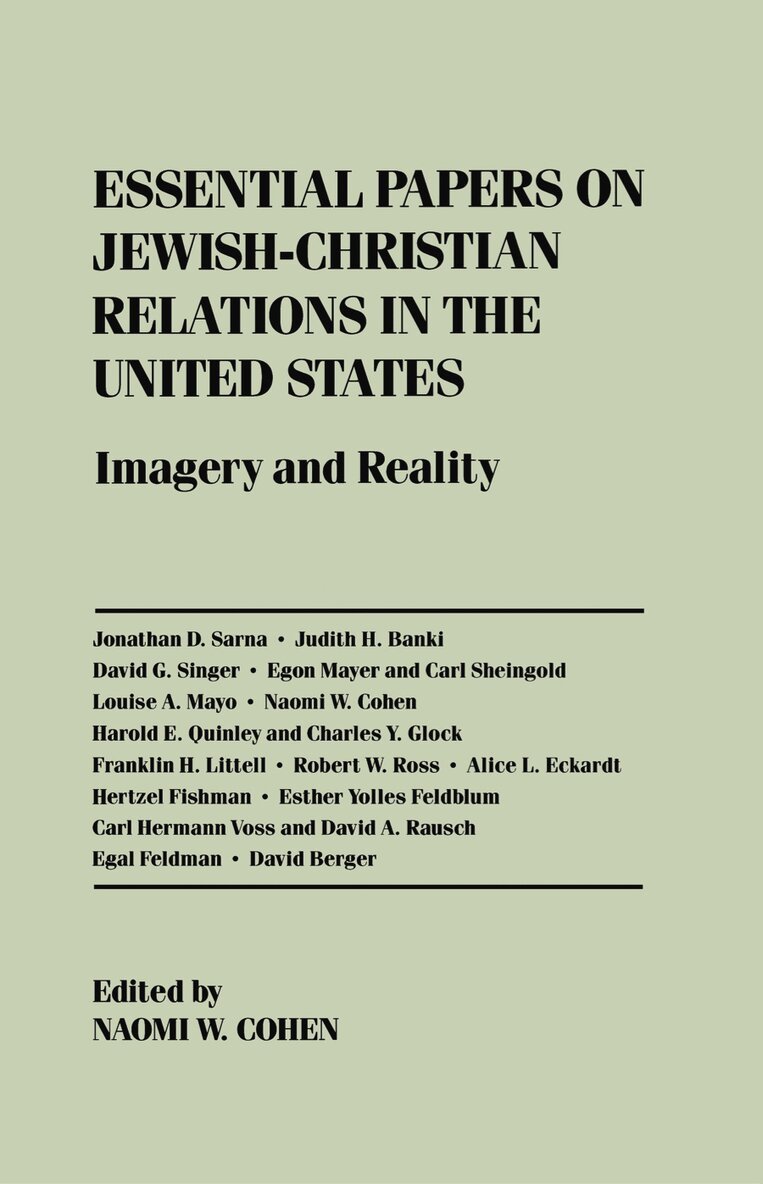
Essential Papers on Jewish-Christian Relations in the United States
Imagery and Reality
Inbunden, 1991
1007 kr
Lägg i varukorg
These papers address the central question of how classical Christian images of Jews have been acted out or muted in interreligious encounters in the USA. The book is organized according to the salient issues that divide Jews from the Christian majority, with sections on anti-Semitism.
Essential Papers on Jewish-Christian Relations in the United States
Imagery and Reality
Av Naomi W. Cohen, Naomi W. Cohen m. fl.
Häftad, 1991
387 kr
Lägg i varukorg
These papers address the central question of how classical Christian images of Jews have been acted out or muted in interreligious encounters in the USA. The book is organized according to the salient issues that divide Jews from the Christian majority, with sections on anti-Semitism.
What the Rabbis Said
The Public Discourse of 19th Century American Rabbis
Inbunden, 2008
894 kr
Lägg i varukorg
What the Rabbis Said examines a relatively unexplored facet of the rich social history of nineteenth-century American Jews. Based on sources that have heretofore been largely neglected, it traces the sermons and other public statements of rabbis, both Traditionalists and Reformers, on a host of …