Natalie Isser - Böcker
Visar alla böcker från författaren Natalie Isser. Handla med fri frakt och snabb leverans.
3 produkter
3 produkter
1 247 kr
Tillfälligt slut
From governments that enact population-limiting legislation or commit wholesale neonaticide, to families who purposely allow a weak, infirm, or unfavorably gendered infant to perish rather than expend limited resources, neonaticide, infanticide, and filicide, are practiced on every continent and by every level of cultural complexity.Taking an objective and diagnostic approach, Child Homicide: Parents Who Kill examines the crime of neonaticide from all angles including historical, cultural, psychological, and legal. Expanding on the first edition, published as Endangered Children: Neonaticide, Infanticide, and Filicide, this edition details child homicide in its many forms such as shaken baby syndrome and Munchausen-by-Proxy as well as the differing circumstances involved in infanticide and filicide. Unlike many books on the subject, it investigates the behavior of the father--deemed responsible in roughly 75 percent of these cases--whether aggressive, complicit, or merely absent, and his ultimate culpability under the law.The authors study the influence of today's media, and how its lightning-fast dissemination of these shocking and often complicated stories affect public opinion, copycat crime, and legal bias. This book explains legal defenses including insanity, differential post partum diagnosis such as post-partum psychosis, and discusses new policies, more appropriate, therapeutic punishments, and preventive measures.Child Homicide: Parents Who Kill places this phenomenon in its historical, cultural, and human context and makes us realize that this is not just someone else's nightmare.
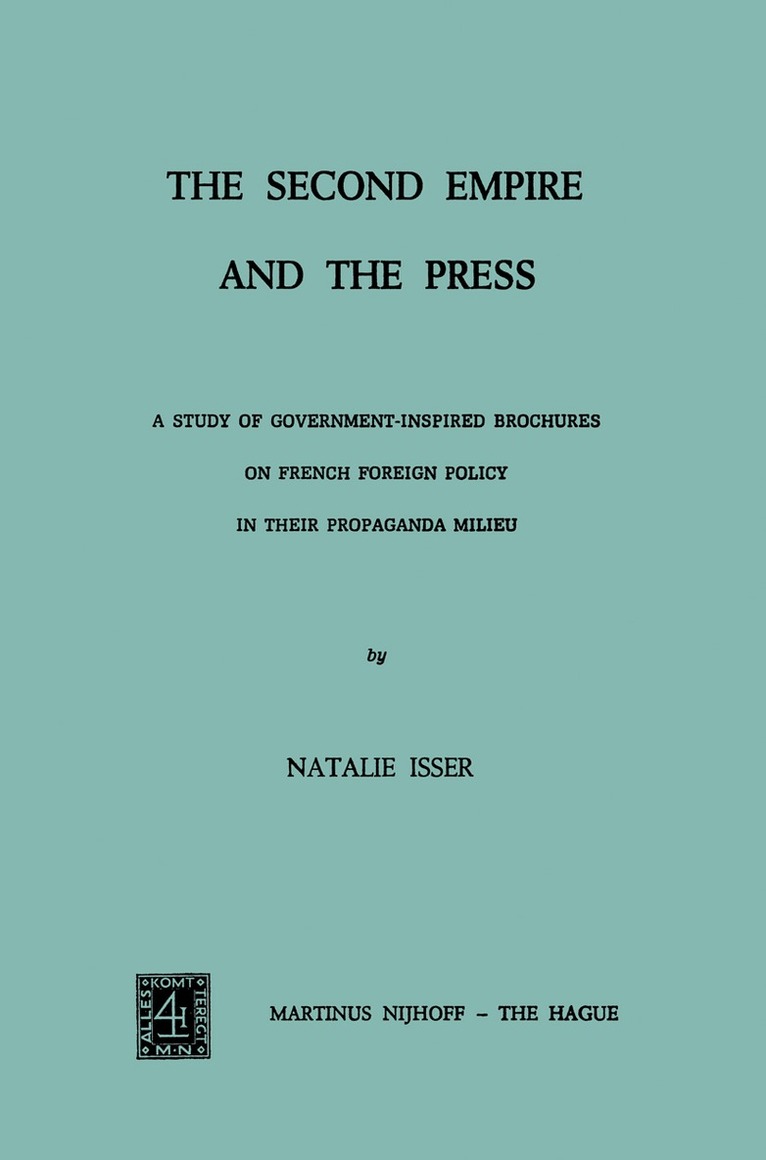
Second Empire and the Press
A Study of Government-Inspired Brochures on French Foreign Policy in their Propaganda Milieu
Häftad, Engelska, 1974
552 kr
Skickas inom 10-15 vardagar
Public opinion had roots in the nineteenth century with the develop ment of industrialization. What is this public? It is the mass of individuals who comprise a society or a nation; this mass in turn is divided into many groups, which have their own interests, prejudices, and beliefs. A govern ment, whether democratic or not, is well aware of the power of public opinion and is anxious to measure and shape it. All three branches of government may direct and educate public thinking, using the instru ments of propaganda. Propaganda is any idea and action designed to influence the views and actions of others. Today's means of propaganda are books, newspapers, radio, movies, television, public schools, and lastly the rostrum. Molders of opinion believe that words, sounds, and pictures accomplish little unless they are carefully organized and inte grated into a well-conceived plan. Once this is accomplished, the ideas 1 conveyed by the words will become part of the people themselves. Special techniques, such as the employment of fear and the play on prejudices, have been used quite succesfully by modern states to impose their own dogmas and policies. Because the social scientist has been aware of the study of public opinion, he may have concluded that it was a modern innovation; but governments have always been concerned with public opinion, though not always understanding it, and have attempted to influence it.
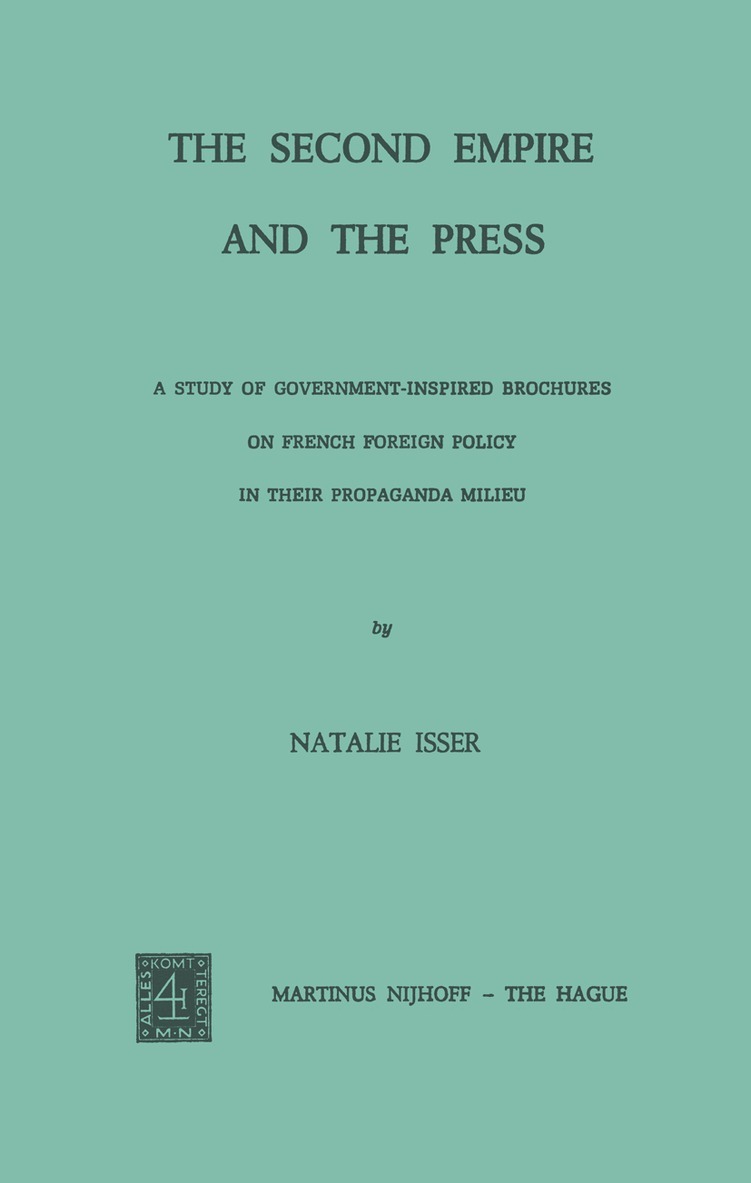
Second Empire and the Press
A Study of Government-Inspired Brochures on French Foreign Policy in Their Propaganda Milieu
Häftad, Engelska, 1974
552 kr
Skickas inom 10-15 vardagar
Public opinion had roots in the nineteenth century with the develop ment of industrialization. What is this public? It is the mass of individuals who comprise a society or a nation; this mass in turn is divided into many groups, which have their own interests, prejudices, and beliefs. A govern ment, whether democratic or not, is well aware of the power of public opinion and is anxious to measure and shape it. All three branches of government may direct and educate public thinking, using the instru ments of propaganda. Propaganda is any idea and action designed to influence the views and actions of others. Today's means of propaganda are books, newspapers, radio, movies, television, public schools, and lastly the rostrum. Molders of opinion believe that words, sounds, and pictures accomplish little unless they are carefully organized and inte grated into a well-conceived plan. Once this is accomplished, the ideas 1 conveyed by the words will become part of the people themselves. Special techniques, such as the employment of fear and the play on prejudices, have been used quite succesfully by modern states to impose their own dogmas and policies. Because the social scientist has been aware of the study of public opinion, he may have concluded that it was a modern innovation; but governments have always been concerned with public opinion, though not always understanding it, and have attempted to influence it.