Nathalie Clayer – författare
Visar alla böcker från författaren Nathalie Clayer. Handla med fri frakt och snabb leverans.
8 produkter
Kemalism
Transnational Politics in the Post Ottoman World
Av Nathalie Clayer, Fabio Giomi m. fl.
Inbunden, 2018
1748 kr
Lägg i varukorg
The founder of modern Turkey, Mustafa Kemal Ataturk, came to power in 1923 with a radical and wide-ranging programme of reforms, known collectively as Kemalism. This philosophy – which included adopting a western alphabet and securing a secular state apparatus - has since the early 1930s, when the …
Conflicting Loyalties in the Balkans
The Great Powers, the Ottoman Empire and Nation-building
Av Hannes Grandits, Nathalie Clayer m. fl.
Inbunden, 2011
2044 kr
Lägg i varukorg
The collapse of the Ottoman Empire resulted in the birth of new nation states in the Balkans in the late nineteenth and early twentieth centuries. 'Conflicting Loyalties in the Balkans' explores the effects of the Ottoman reform era upon Balkan societies in order to shed much-needed light on the …
Europe's Balkan Muslims
A New History
Av Nathalie Clayer, Xavier Bougarel m. fl.
Inbunden, 2017
608 kr
Lägg i varukorg
There are roughly eight million Muslims in south-east Europe, among them Albanians, Bosniaks, Turks and Roma -- descendants of converts or settlers in the Ottoman period. This new history of the social, political and religious transformations that this population experienced in the nineteenth and …
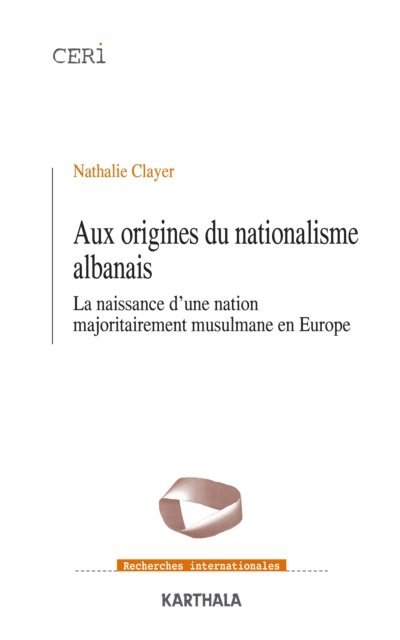
Aux origines du nationalisme albanais
La naissance d''une nation majoritairement musulmane en Europe
E-bok, 2006
553 kr
Lägg i varukorg
A l''heure où la "question albanaise" et le statut du Kosovo demeurent d''actualité, mais aussi où les rapports entre islam et Europe sont débattus au sujet de l''adhésion éventuelle de la Turquie à l''Union européenne, il n''est pas inutile de revenir sur la formation de la nation albanaise, la …
Les musulmans de l’Europe du Sud-Est
Des empires aux Etats balkaniques
Av Nathalie Clayer, Xavier Bougarel
E-bok, 2013
393 kr
Lägg i varukorg
L’Europe du Sud-Est, qui s’étend de la Croatie à la Grèce et de l’Albanie à la Bulgarie, compte environ huit millions d’habitants de culture musulmane. Albanais, Bosniaques, Turcs, Roms, ils sont les descendants de populations converties à l’islam ou installées là pendant la période ottomane. Dans …
Aux origines du nationalisme albanais
La naissance d''une nation majoritairement musulmane en Europe
E-bok, 2018
428 kr
Lägg i varukorg
La « question albanaise » et le statut du Kosovo restent d’une brûlante actualité. En outre les rapports entre l’islam et l’Europe sont en débat, et la Turquie, héritière de l’Empire ottoman, frappe à la porte de cette dernière. Dans ce contexte, il est utile de revenir sur la formation de la …
Une histoire en travelling de l'Albanie (1920-1939)
Avec, au-delà et en-deçà de l''État
E-bok, 2022
485 kr
Lägg i varukorg
L’État-nation a nationalisé les historiographies. La construction étatique doit-elle pour autant être rejetée en tant qu’objet d’étude ? Non, bien sûr, mais il faut assurément l’aborder autrement. C’est ce que suggère déjà une nouvelle historiographie qui, avec le développement de l’histoire …
L'autorité religieuse et ses limites en terres d'islam
Approches historiques et anthropologiques
Av Nathalie Clayer, Alexandre Papas
Inbunden, 2013
2476 kr
Lägg i varukorg
Reprenant à nouveaux frais la question de l'autorité religieuse, ce livre présente différents cas d'étude en Asie centrale, à travers l'Empire ottoman, dans les Balkans et en Turquie. Sont examinés les rapports complexes qu'entretiennent, avec le pouvoir politique, cheikhs soufis, oulémas, sheikh …