Neal E. Miller - Böcker
Visar alla böcker från författaren Neal E. Miller. Handla med fri frakt och snabb leverans.
6 produkter
6 produkter
652 kr
Skickas inom 10-15 vardagar
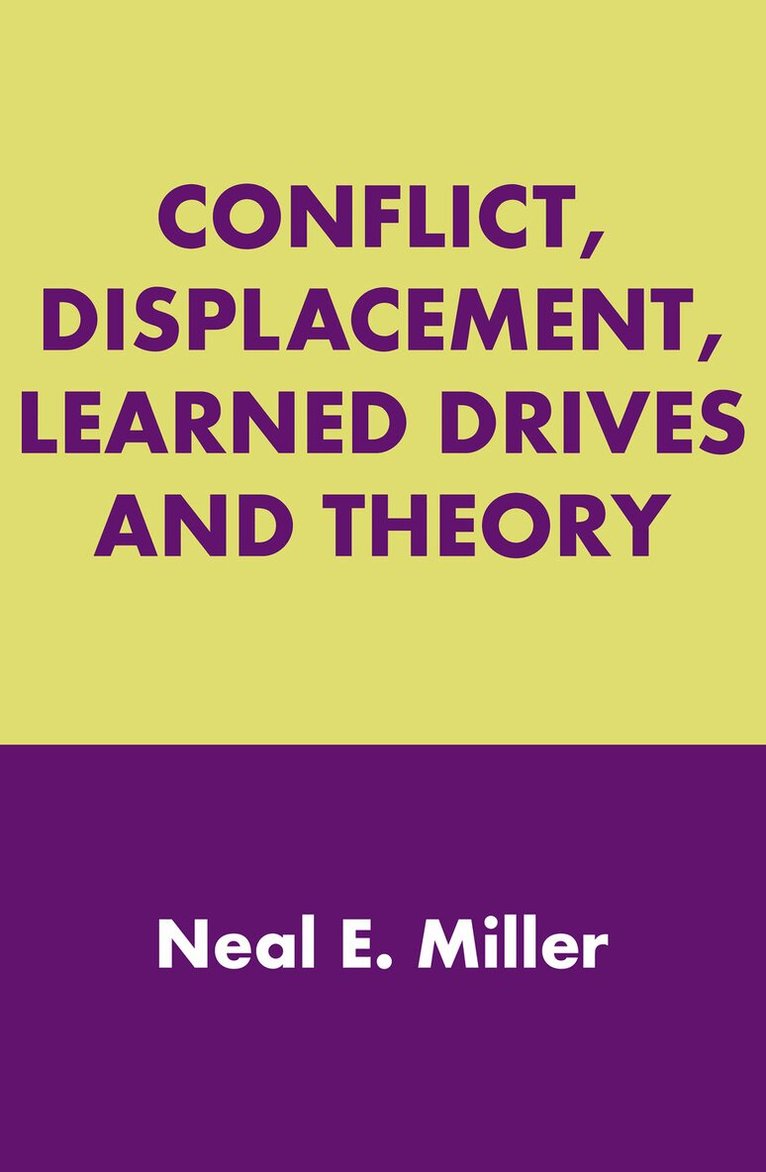
Neal E. Miller's pioneering work in experimental psychology has earned him worldwide respect. This first of a two-volume collection of his work brings together twenty-one of Miller's most important and representative essays on conflict, displacement, learned drives, and theory. They were selected for both their current relevance and their historical significance.The theoretical and experimental analysis of conflict behavior in Part I grew out of an interest in applying the laws of learning that Pavlov discovered in the laboratory to certain phenomena that Freud discovered in the clinic. This led naturally to a similar analysis of displacement in Part II and also to the studies of fear as a learnable drives in Part III.In contrast with the ease of establishing learned fear on the basis of pain, the studies in Part IV show that it is much more difficult, and perhaps impossible, to establish learned appetitive drives on the basis of hunger or thirst. In the first experiments on drugs, Part V attempted to test the applicability of some of the principles discovered by Pavlov in experiments on classical conditioning to the trial-and-error learning situation studied by Thorndike and now frequently called operant conditioning. Later studies of drugs are closely related to the work on fear and conflict and, hence, are grouped nearby.The first of the theoretical chapters in Part VI summarizes the work on conflict behavior as well as many of my other theoretical ideas, including a cybernetic analysis of behavior. Another chapter is the result of an assignment to represent behavioral sciences, from physiology through anthropology.
705 kr
Skickas inom 10-15 vardagar
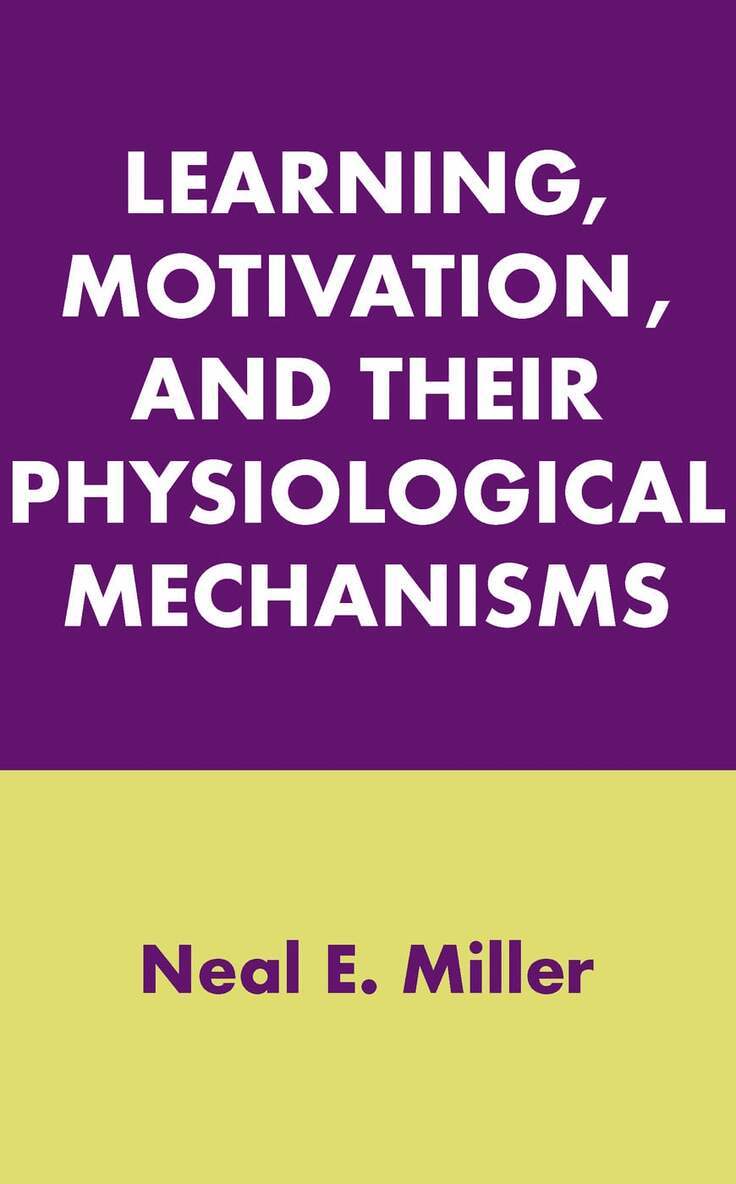
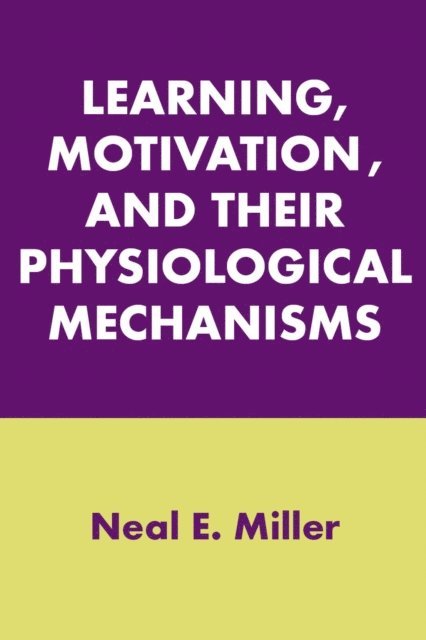
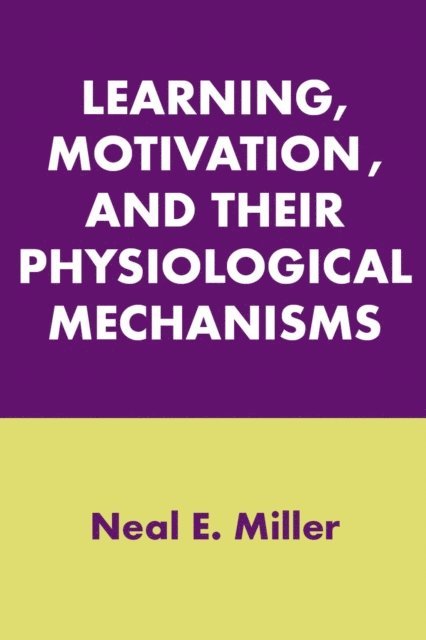
Neal E. Miller's pioneering work in experimental psychology has earned him worldwide respect. This second in a two-volume collection of his work brings together forty-three of Miller's most important and representative essays on learning, motivation, and their physiological mechanisms. They were selected on the basis of their current relevance and their historical significance at the time they were published. In order to emphasize the main themes, essays on a given topic have been grouped together.Learning, Motivation, and Their Physiological Mechanisms begins when the author first discovered the thrill of designing and executing experiments to get clear-cut answers concerning the behavior of children and of rats. The first study was one of the earliest ones on the behavioral effects of the recently synthesized male hormone, testosterone. The second was one of the earliest studies demonstrating the value of using a variety of behavioral techniques to investigate the motivational effects of a physiological intervention. The next studies investigated the satisfying and rewarding effects of food or water in the stomach versus in the mouth and the thirst-inducing and reducing effects of hyper- and hypotonic solutions, respectively, injected into the brain. The last study describes a technique devised for extending the analysis of the mechanism of hunger to the effects of humoral factors in the blood.The study is completed with an examination of trial-and-error learning that was motivated by direct electrical stimulation of the brain and rewarded by the termination of such stimulation. Other studies show that the stimulation via such electrodes not only elicits eating, but also has the principal motivational characteristics of normal hunger. The conclusion deals with a series of experiments that overthrows strong traditional beliefs by proving that glandular and visceral responses mediated by the autonomic nervous system are subject to instrumental learning, which can be made quite specific.
4 926 kr
Skickas inom 10-15 vardagar
This is Volume XIII of eighteen in a collection of the Sociology of Behaviour and Psychology. Imitation has long been an important concept, as well in social theory as in social practices. In their endeavour to explain how societies are organized and held together, allow cultures are transmitted from one generation to the next, social scientists have made wide use of the concept of imitation. As a key idea in theory and practice it has been the subject of much systematic discussion. Originally published in 1945, In this volume the authors have made a fresh attack upon the problem with a set of concepts which seem peculiarly relevant to it. If imitative tendencies are not instinctive they must be learned, the argument runs. discussion of how such learning takes place.
671 kr
Skickas inom 10-15 vardagar
This is Volume XIII of eighteen in a collection of the Sociology of Behaviour and Psychology. Imitation has long been an important concept, as well in social theory as in social practices. In their endeavour to explain how societies are organized and held together, allow cultures are transmitted from one generation to the next, social scientists have made wide use of the concept of imitation. As a key idea in theory and practice it has been the subject of much systematic discussion. Originally published in 1945, In this volume the authors have made a fresh attack upon the problem with a set of concepts which seem peculiarly relevant to it. If imitative tendencies are not instinctive they must be learned, the argument runs. discussion of how such learning takes place.
2 029 kr
Skickas inom 10-15 vardagar
Neal E. Miller's pioneering work in experimental psychology has earned him worldwide respect. This first of a two-volume collection of his work brings together twenty-one of Miller's most important and representative essays on conflict, displacement, learned drives, and theory. They were selected for both their current relevance and their historical significance.The theoretical and experimental analysis of conflict behavior in Part I grew out of an interest in applying the laws of learning that Pavlov discovered in the laboratory to certain phenomena that Freud discovered in the clinic. This led naturally to a similar analysis of displacement in Part II and also to the studies of fear as a learnable drives in Part III.In contrast with the ease of establishing learned fear on the basis of pain, the studies in Part IV show that it is much more difficult, and perhaps impossible, to establish learned appetitive drives on the basis of hunger or thirst. In the first experiments on drugs, Part V attempted to test the applicability of some of the principles discovered by Pavlov in experiments on classical conditioning to the trial-and-error learning situation studied by Thorndike and now frequently called operant conditioning. Later studies of drugs are closely related to the work on fear and conflict and, hence, are grouped nearby.The first of the theoretical chapters in Part VI summarizes the work on conflict behavior as well as many of my other theoretical ideas, including a cybernetic analysis of behavior. Another chapter is the result of an assignment to represent behavioral sciences, from physiology through anthropology.
2 029 kr
Skickas inom 10-15 vardagar
Neal E. Miller's pioneering work in experimental psychology has earned him worldwide respect. This second in a two-volume collection of his work brings together forty-three of Miller's most important and representative essays on learning, motivation, and their physiological mechanisms. They were selected on the basis of their current relevance and their historical significance at the time they were published. In order to emphasize the main themes, essays on a given topic have been grouped together.Learning, Motivation, and Their Physiological Mechanisms begins when the author first discovered the thrill of designing and executing experiments to get clear-cut answers concerning the behavior of children and of rats. The first study was one of the earliest ones on the behavioral effects of the recently synthesized male hormone, testosterone. The second was one of the earliest studies demonstrating the value of using a variety of behavioral techniques to investigate the motivational effects of a physiological intervention. The next studies investigated the satisfying and rewarding effects of food or water in the stomach versus in the mouth and the thirst-inducing and reducing effects of hyper- and hypotonic solutions, respectively, injected into the brain. The last study describes a technique devised for extending the analysis of the mechanism of hunger to the effects of humoral factors in the blood.The study is completed with an examination of trial-and-error learning that was motivated by direct electrical stimulation of the brain and rewarded by the termination of such stimulation. Other studies show that the stimulation via such electrodes not only elicits eating, but also has the principal motivational characteristics of normal hunger. The conclusion deals with a series of experiments that overthrows strong traditional beliefs by proving that glandular and visceral responses mediated by the autonomic nervous system are subject to instrumental learning, which can be made quite specific.