Neil Immerman – författare
Visar alla böcker från författaren Neil Immerman. Handla med fri frakt och snabb leverans.
4 produkter
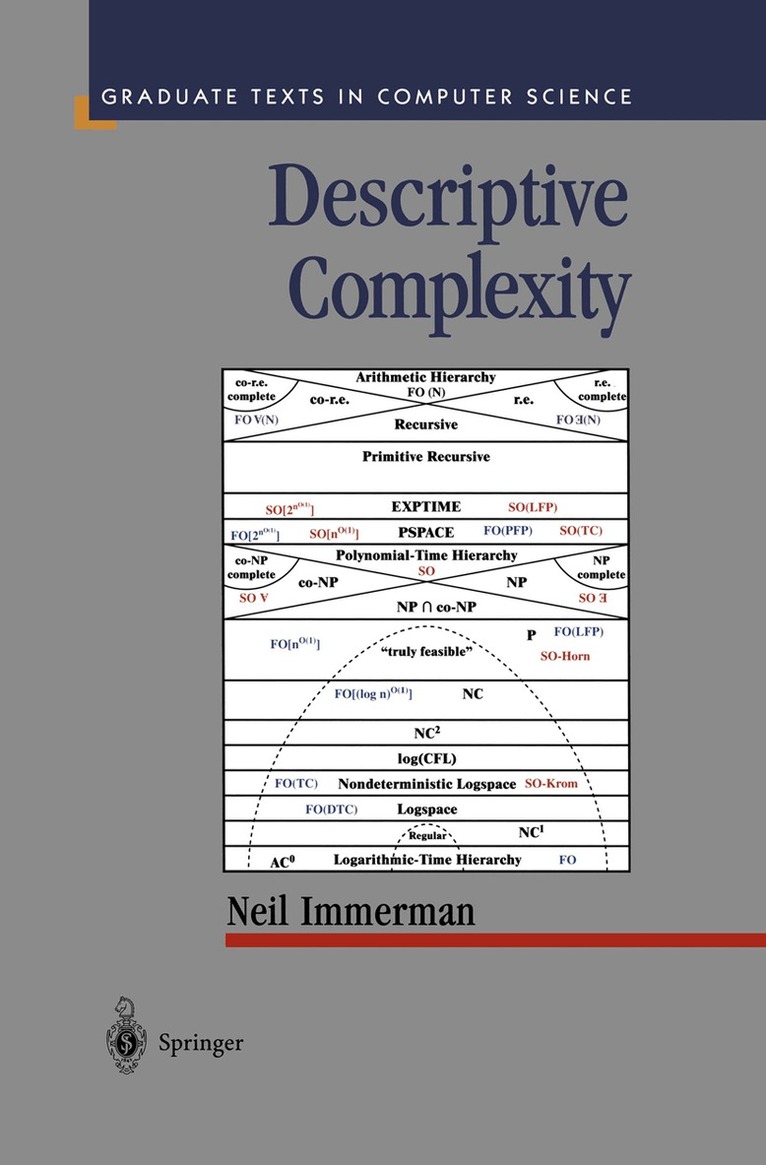
Descriptive Complexity
Inbunden, 1998
1312 kr
Lägg i varukorg
A basic issue in computer science is the complexity of problems. Computational complexity measures how much time or memory is needed as a function of the input problem size. Descriptive complexity is concerned with problems which may be described in first-order logic. By virtue of the close …
Descriptive Complexity and Finite Models
Av Neil Immerman, Phokion G. Kolaitis
Inbunden, 1997
973 kr
Lägg i varukorg
'We hope that this small volume will suggest directions of synergy and contact for future researchers to build upon, creating connections and making discoveries that will help explain some of the many mysteries of computation' - from the Preface. Finite model theory can be succinctly described as …
Descriptive Complexity
E-bok, 2012
1214 kr
Lägg i varukorg
A basic issue in computer science is the complexity of problems. Computational complexity measures how much time or memory is needed as a function of the input problem size. Descriptive complexity is concerned with problems which may be described in first-order logic. By virtue of the close …
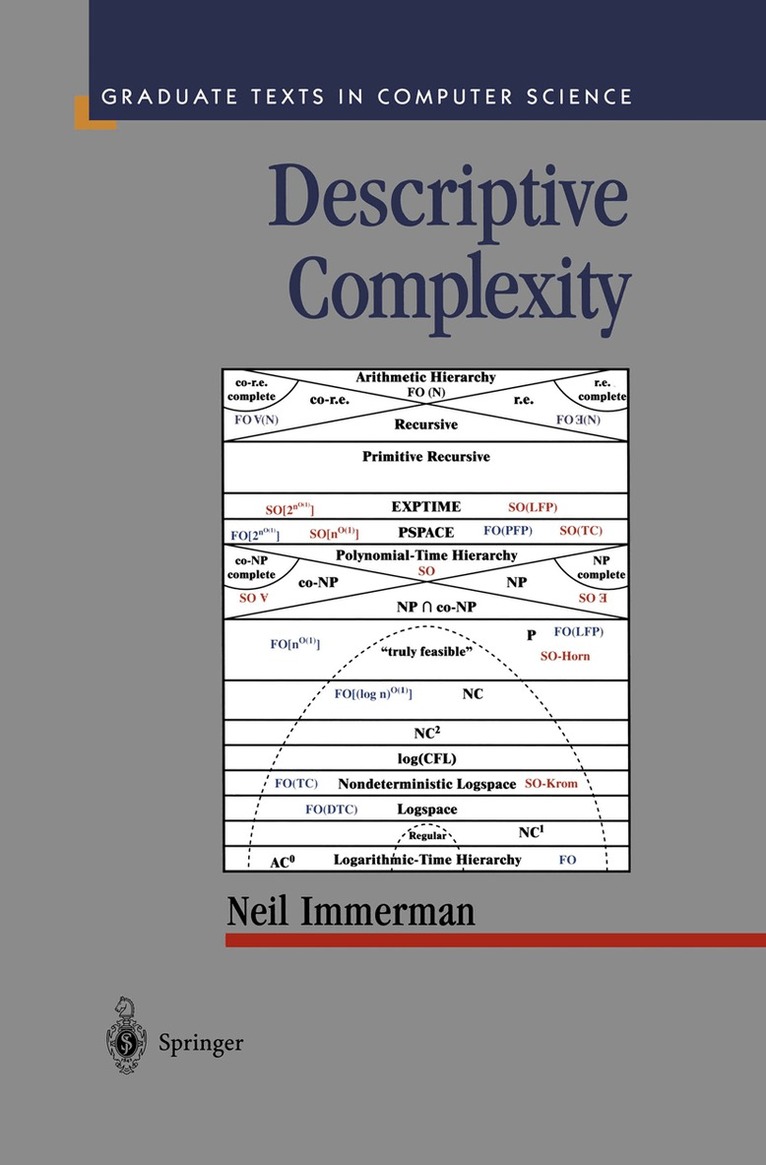
Descriptive Complexity
Häftad, 2012
931 kr
Lägg i varukorg
A basic issue in computer science is the complexity of problems. Computational complexity measures how much time or memory is needed as a function of the input problem size. Descriptive complexity is concerned with problems which may be described in first-order logic. By virtue of the close …