Neil J. A. Sloane – författare
Visar alla böcker från författaren Neil J. A. Sloane. Handla med fri frakt och snabb leverans.
6 produkter
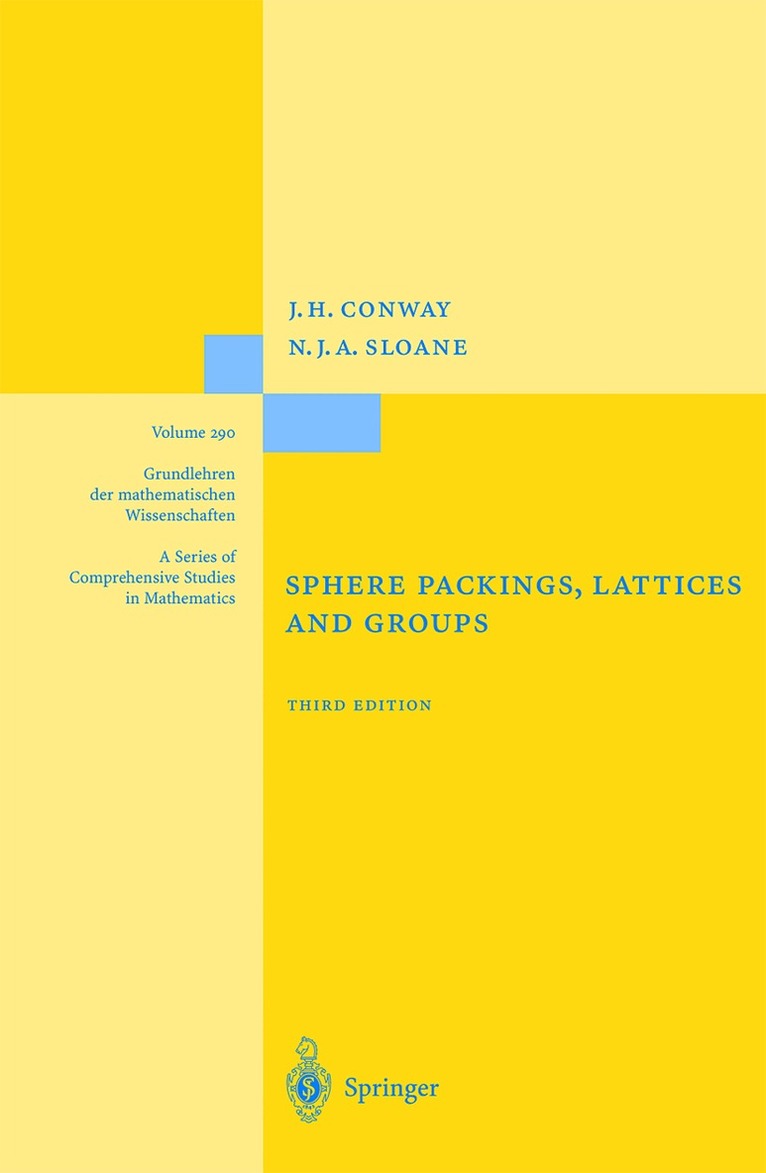
Sphere Packings, Lattices and Groups
Av John Conway, Neil J. A. Sloane
Inbunden, 1998
986 kr
Lägg i varukorg
We now apply the algorithm above to find the 121 orbits of norm -2 vectors from the (known) nann 0 vectors, and then apply it again to find the 665 orbits of nann -4 vectors from the vectors of nann 0 and -2. The neighbors of a strictly 24 dimensional odd unimodular lattice can be found as follows. …
Sphere Packings, Lattices and Groups
Av John Conway, Neil J. A. Sloane
Häftad, 2010
714 kr
Lägg i varukorg
We now apply the algorithm above to find the 121 orbits of norm -2 vectors from the (known) nann 0 vectors, and then apply it again to find the 665 orbits of nann -4 vectors from the vectors of nann 0 and -2. The neighbors of a strictly 24 dimensional odd unimodular lattice can be found as follows. …
Sphere Packings, Lattices and Groups
Av Neil J. A. Sloane, John Conway
E-bok, 2013
929 kr
Lägg i varukorg
We now apply the algorithm above to find the 121 orbits of norm -2 vectors from the (known) nann 0 vectors, and then apply it again to find the 665 orbits of nann -4 vectors from the vectors of nann 0 and -2. The neighbors of a strictly 24 dimensional odd unimodular lattice can be found as follows. …
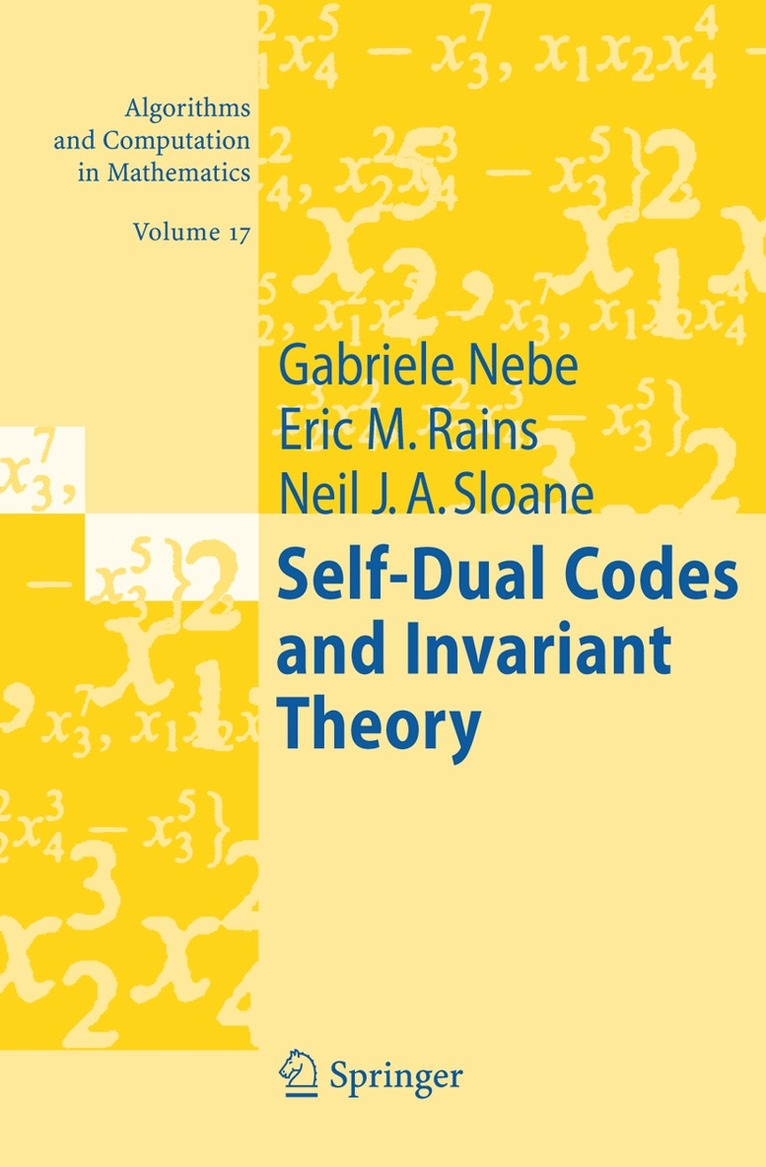
Self-Dual Codes and Invariant Theory
Av Gabriele Nebe, Eric M. Rains m. fl.
Inbunden, 2006
1857 kr
Lägg i varukorg
One of the most remarkable and beautiful theorems in coding theory is Gleason's 1970 theorem about the weight enumerators of self-dual codes and their connections with invariant theory. In the past 35 years there have been hundreds of papers written about generalizations and applications of this …
Self-Dual Codes and Invariant Theory
Av Neil J. A. Sloane, Eric M. Rains m. fl.
E-bok, 2006
2437 kr
Lägg i varukorg
One of the most remarkable and beautiful theorems in coding theory is Gleason''s 1970 theorem about the weight enumerators of self-dual codes and their connections with invariant theory. In the past 35 years there have been hundreds of papers written about generalizations and applications of this …
Self-Dual Codes and Invariant Theory
Av Gabriele Nebe, Eric M. Rains m. fl.
Häftad, 2010
1857 kr
Lägg i varukorg
One of the most remarkable and beautiful theorems in coding theory is Gleason's 1970 theorem about the weight enumerators of self-dual codes and their connections with invariant theory. In the past 35 years there have been hundreds of papers written about generalizations and applications of this …