Nicholas Marston - Böcker
Visar alla böcker från författaren Nicholas Marston. Handla med fri frakt och snabb leverans.
4 produkter
4 produkter
2 528 kr
Skickas inom 5-8 vardagar
In his thorough analytical study of Beethoven's Piano Sonata in E, Op. 109, Nicholas Marston suggests a unique way of understanding this important work. The book provides an exhaustive study of its sources and an analytical approach to the structure of the sonata itself. The source study is based on a complete transcritpion of all the surviving manuscript sources for the work; the book includes a large majority of the sketches, and parts of the autograph score.The introductory chapter reivews Heinrich Schenker's work on Op. 109. In Chapter 2 Beethoven's letters, conversation books, sketchbooks and other sources are used to build up a detailed picture of the progess of his work on the sonata. The middle chapters form the core of the analytical study in which the sketches for each part of the three movements are analysed in detail, and the relevance of the sketches to the final version is explored. The final chapter extends the notion of 'sketch' beyond Op. 109 and summarizes the results of the study. No stone is left unturned: even Beethoven's previously misunderstood notation of final barlines in the autograph score is shown to be of structural significance.The book is important in several respects. The attitude adopted towards the sketches is postive , approaching them as valid compositional acts and not wrong turnings en route to a perfect final version. As an analytical study the book provides perhaps the most extended Schenkerian analysis of a Beethoven sonata yet published, and offers a rare Schenkerian analysis of a variation movement. It may equally be read as a extension or critique of Schenkerian thinking: it goes beyond Schenker both in its espousal of unconventional 'background' strucures and in its suggestion of a single structural plan for the entire three-movement work.
202 kr
Skickas inom 7-10 vardagar
Schumann's Fantasie, Op. 17 is one of the finest examples of Romantic piano music. In a rounded picture of this major keyboard work, Nicholas Marston traces the fascinating history of its composition, drawing on many of Schumann's letters to Clara Wieck and to his publisher. Examining the few surviving sketches: to whom was the work really dedicated? Was the celebrated opening movement perhaps intended as an independent composition? Schumann's own critical writings provide vital insights into his ideas on genre and the relationship between the Fantasie and the many generic and descriptive titles which the composer gave the work before publication. Dr Marston also considers the role of allusion and quotation in the work, preparing the way for an analytical study of each of the movements. The book concludes with an overview of the reception and performance of the Fantasie from 1839 onwards. Every aspect of the work is covered, providing the performer, the listener or the student with an understanding not only of the Fantasie, but of Schumann himself as a composer.
2 153 kr
Skickas inom 10-15 vardagar
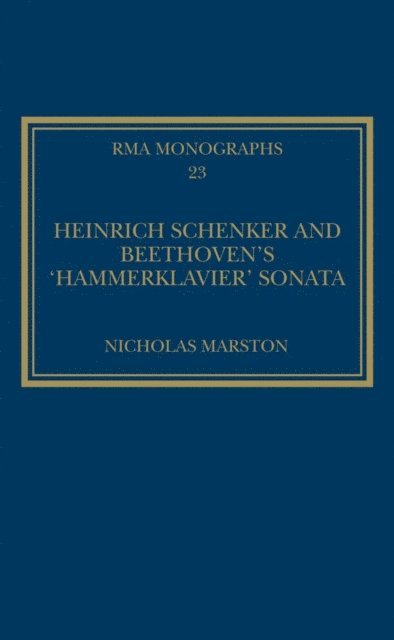
In 1912 Heinrich Schenker contracted with the Viennese publisher Universal Edition to provide an 'elucidatory edition' (Erläuterungsausgabe) of Beethoven's last five piano sonatas. Each publication would comprise a score, newly edited by Schenker and using the composer's autograph manuscript as principal source, together with a substantial commentary combining analytical, text-critical and performance-related matter. Four of the five editions appeared between 1913 and 1921, but that of the 'Hammerklavier' Sonata, op. 106, was never published. It has generally been assumed that this was simply because Schenker was unable to locate the autograph manuscript, which remains missing to this day. But as Nicholas Marston shows in a detailed history of the Erläuterungsausgabe project, other factors were involved also, including financial considerations, Schenker's health concerns, and his broader theoretical ambitions. Moreover, despite the missing autograph he nevertheless developed a voice-leading analysis of the complete sonata during the years 1924-1926, a crucial period in the development of his mature theory of tonal music. Marston's book provides the first in-depth study of this rich analysis, which is reproduced in full in high-quality digital images. The book draws on hundreds of letters and documents from Schenker's Nachlaß; it both adds to our biographical knowledge of Schenker and illuminates for the first time the response of this giant of music theory to one of the most significant masterworks in all music.
584 kr
Skickas inom 10-15 vardagar
In 1912 Heinrich Schenker contracted with the Viennese publisher Universal Edition to provide an 'elucidatory edition' (Erläuterungsausgabe) of Beethoven's last five piano sonatas. Each publication would comprise a score, newly edited by Schenker and using the composer's autograph manuscript as principal source, together with a substantial commentary combining analytical, text-critical and performance-related matter. Four of the five editions appeared between 1913 and 1921, but that of the 'Hammerklavier' Sonata, op. 106, was never published. It has generally been assumed that this was simply because Schenker was unable to locate the autograph manuscript, which remains missing to this day. But as Nicholas Marston shows in a detailed history of the Erläuterungsausgabe project, other factors were involved also, including financial considerations, Schenker's health concerns, and his broader theoretical ambitions. Moreover, despite the missing autograph he nevertheless developed a voice-leading analysis of the complete sonata during the years 1924-1926, a crucial period in the development of his mature theory of tonal music. Marston's book provides the first in-depth study of this rich analysis, which is reproduced in full in high-quality digital images. The book draws on hundreds of letters and documents from Schenker's Nachlaß; it both adds to our biographical knowledge of Schenker and illuminates for the first time the response of this giant of music theory to one of the most significant masterworks in all music.