Nick Goss – författare
Visar alla böcker från författaren Nick Goss. Handla med fri frakt och snabb leverans.
2 produkter
2 produkter
316 kr
Skickas
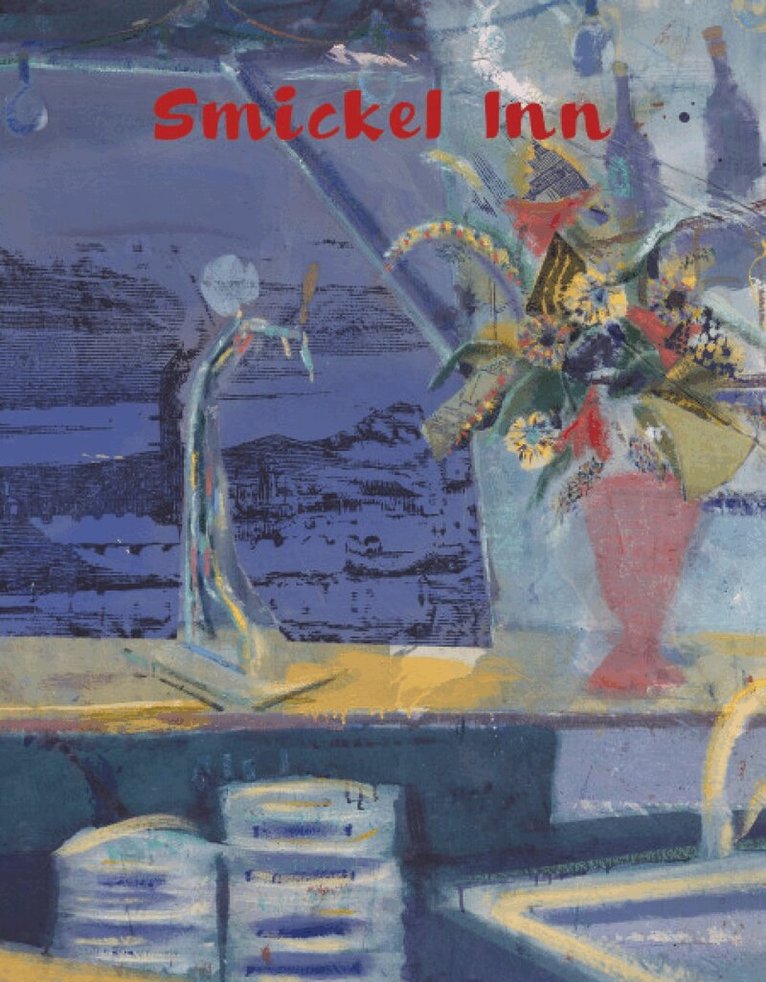
_Smickel Inn_ is a publication of works by London-based Anglo-Dutch artist Nick Goss, produced by Ingleby, Edinburgh, and co-published with Matthew Brown, Los Angeles, and Anomie Publishing, London. Along with around sixty plates and illustrations, the publication features an essay by writer, journalist and critic Hettie Judah, and an in-conversation between Goss, fellow painter Michael Armitage and writer Thomas Marks. ‘Smickel Inn is a real place in an unreal place,’ writes Judah, ‘a snack bar on an outer extremity of the port of Rotterdam.’ It’s a venue that is popular with port workers and sailors—a clientele of regular and transitory people often involved in sea freight or oil shipping, though their lives, personalities and stories are largely played out in Goss’s mixed-media paintings through the bar’s interior décor: an old vase with fresh flowers, a stack of glass ashtrays, a well-worn piano with a pile of books on top, an eclectic selection of picture frames with faded scenes and a clock that might only be right twice a day.Filtered through Goss’s imagination, Smickel Inn carries its history with it, much of it decorating the countertop; it’s a venue that charms with its informality—a place that knows itself, and its disparate customers. In real life, the bar has a cinematic view of the port and the North Sea, translated here, through Goss’s creative process of painting and silk-screening, into a scene from an engraving of seventeenth-century Sicily. Fragments from different places and eras infiltrate his images, creating a patina of palimpsests, visual echoes, perhaps, of memories of travellers coming through the port. The body of work takes us around the wider Dutch coastline and beyond—we see passengers on foot disembarking a ferry, have a backseat view of a car ride around the village of Stavenisse, and join a night-time campfire on the beach at Scheveningen, among other more mysterious, if not abstruse, locations and scenarios. Observation from contemporary life mingles with visual culture spanning centuries and continents in Goss’s oeuvre, creating lyrical yet strangely haunting and melancholic paintings, trapped in time somewhere between personal experience and collective memory.Nick Goss is an Anglo-Dutch painter, born in Bristol in 1981\. He studied first at the Slade School of Art (2002–06) and then at the Royal Academy Schools, London (2006–09). He has exhibited widely in Europe and America, including solo exhibitions with Josh Lilley, London, Matthew Brown, Los Angeles, Simon Preston, New York, and Contemporary Fine Arts, Berlin. His first institutional survey, Morley’s Mirror, was presented in 2019 at Pallant House, Chichester, UK. _Smickel Inn_ is published to coincide with Goss’s first exhibition at Ingleby, Edinburgh, in the autumn of 2023.
551 kr
Kommande
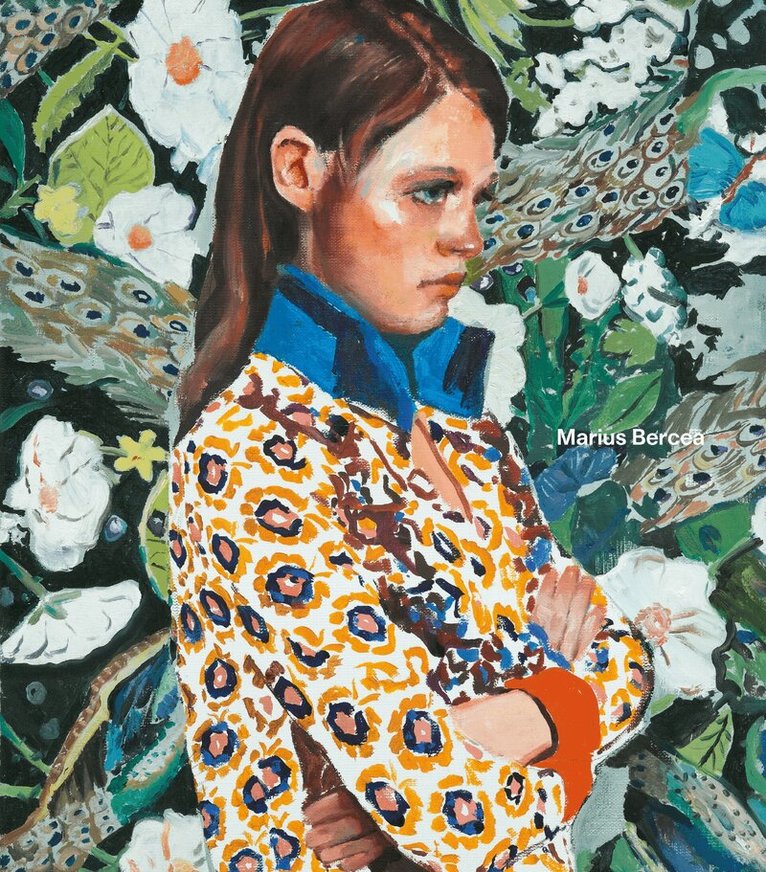
This significant new monograph on Romanian painter Marius Bercea (b. 1979) presents a selection of his work from 2020 to 2025, offering an in-depth view of his recent practice through both critical and personal perspectives. The publication features a new essay by curator and critic Diana Marincu, a conversation with the British painter Nick Goss, chaired by Thomas Marks, an interview with art historian and curator Liviana Dan, and a foreword by Matt Price. The book is published by Anomie Publishing, London, with the support of Jecza Gallery and UniCredit Bank Romania.Bercea is widely recognised as a leading figure of the Cluj School of Painting – a group of artists who emerged in Cluj-Napoca following the 1989 Romanian Revolution. Drawing on his experiences growing up in Communist Romania and his encounters with American culture, particularly during his many visits to Los Angeles, Bercea creates paintings that navigate the intersections of personal and collective memory, history and cultural identity. In recent years, Bercea has focused his portraiture on a generation of young Romanians, specifically those born around 1989, exploring their unique sense of historical memory and their collaged experience of liberal democracy and the free market. In her essay, Diana Marincu examines recurring figures and motifs in Bercea’s recent work. She considers how his painted spaces often function like the scene of a film or the stage of a live performance, populated by characters who seem to await the finished script. Marincu traces the interplay of nostalgia, temporality and imagination in Bercea’s compositions, considering how his paintings negotiate the tension between personal experience and collective history.In a conversation with friend and fellow artist Nick Goss, chaired by Thomas Marks, Bercea discusses his studio practice, techniques and the literary and art-historical references that inform his work. They consider Bercea’s engagement with American modernism, the interplay of interior and exterior spaces and the careful attention paid to the details of his subjects and environments. The dialogue emphasises how memory, storytelling and cinematic imagination converge in Bercea’s paintings. They also discuss their respective art educations and upbringings and how they inform their practices and the overlap between personal and cultural memory. Bercea’s interview with Liviana Dan foregrounds the artist’s intellectual and emotional engagement with painting and its history, tracing the influence of masters from Poussin and Titian to Cézanne and Gerhard Richter. They discuss his approach to portraiture, domestic interiors, colour and geometry, as well as the ways in which his biography and personal life intersect with his artmaking.