Nir Avieli - Böcker
Visar alla böcker från författaren Nir Avieli. Handla med fri frakt och snabb leverans.
5 produkter
5 produkter
275 kr
Skickas inom 10-15 vardagar
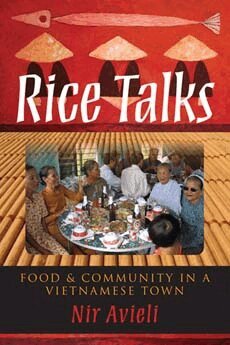
Rice Talks explores the importance of cooking and eating in the everyday social life of Hoi An, a properous market town in central Vietnam known for its exceptionally elaborate and sophisticated local cuisine. In a vivid and highly personal account, Nir Avieli takes the reader from the private setting of the extended family meal into the public realm of the festive, extraordinary, and unique. He shows how foodways relate to class relations, gender roles, religious practices, cosmology, ethnicity, and even local and national politics. This evocative study departs from conventional anthropological research on food by stressing the rich meanings, generative capacities, and potential subversion embedded in foodways and eating.

Del 67 - California Studies in Food and Culture
Food and Power
A Culinary Ethnography of Israel
Inbunden, Engelska, 2017
1 513 kr
Skickas inom 3-6 vardagar
Drawing on ethnography conducted in Israel since the late 1990s, Food and Power considers how power is produced, reproduced, negotiated, and subverted in the contemporary Israeli culinary sphere. Nir Avieli explores issues such as the definition of Israeli cuisine, the ownership of hummus, the privatization of communal Kibbutz dining rooms, and food at a military prison for Palestinian detainees to show how cooking and eating create ambivalence concerning questions of strength and weakness and how power and victimization are mixed into a sense of self-justification that maintains internal cohesion among Israeli Jews.
Del 67 - California Studies in Food and Culture
Food and Power
A Culinary Ethnography of Israel
Häftad, Engelska, 2017
251 kr
Skickas inom 7-10 vardagar
Drawing on ethnography conducted in Israel since the late 1990s, Food and Power considers how power is produced, reproduced, negotiated, and subverted in the contemporary Israeli culinary sphere. Nir Avieli explores issues such as the definition of Israeli cuisine, the ownership of hummus, the privatization of communal Kibbutz dining rooms, and food at a military prison for Palestinian detainees to show how cooking and eating create ambivalence concerning questions of strength and weakness and how power and victimization are mixed into a sense of self-justification that maintains internal cohesion among Israeli Jews.
2 098 kr
Skickas inom 10-15 vardagar
This book, the first of its kind, critically analyzes the conjunctions of 21st century food, faith and society. It aims to provide a fresh approach that theorizes the culinary sphere in its association with morality, identity, justice and the sublime.In a changing climate of food fads, diet plans, gastropolitics and fusion tastes, this edited volume interrogates, analyzes and critiques various situations in which food, the state, civil society, gender, race, and faith intersect and even transmute. Informed by emergent post-secularist views of religion(s) and novel approaches to twenty-first century forms of mobility and fixity, the book's primary aim is to ponder through ethnography the manifold meanings of food, eating and commensality as dynamic social and religious practices. The main goal of Eating Religiously: Food and Faith in the 21st Century is to present cutting-edge anthropological research that examines the causes, effects, meanings and repercussions of theoretical and real-world relationships between culinary practices and religion, identity politics and national pride.The chapters in this book were originally published as a special issue of Food, Culture, and Society.
579 kr
Skickas inom 10-15 vardagar
This book, the first of its kind, critically analyzes the conjunctions of 21st century food, faith and society. It aims to provide a fresh approach that theorizes the culinary sphere in its association with morality, identity, justice and the sublime.In a changing climate of food fads, diet plans, gastropolitics and fusion tastes, this edited volume interrogates, analyzes and critiques various situations in which food, the state, civil society, gender, race, and faith intersect and even transmute. Informed by emergent post-secularist views of religion(s) and novel approaches to twenty-first century forms of mobility and fixity, the book's primary aim is to ponder through ethnography the manifold meanings of food, eating and commensality as dynamic social and religious practices. The main goal of Eating Religiously: Food and Faith in the 21st Century is to present cutting-edge anthropological research that examines the causes, effects, meanings and repercussions of theoretical and real-world relationships between culinary practices and religion, identity politics and national pride.The chapters in this book were originally published as a special issue of Food, Culture, and Society.