
Nirmala Prakash – författare
Visar alla böcker från författaren Nirmala Prakash. Handla med fri frakt och snabb leverans.
4 produkter
4 produkter
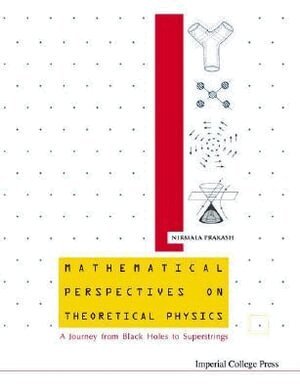
Mathematical Perspectives On Theoretical Physics: A Journey From Black Holes To Superstrings
Inbunden, Engelska, 2003
2 875 kr
Tillfälligt slut
This book presents the basics of mathematics that are needed for learning the physics of today. It describes briefly the theories of groups and operators, finite- and infinite-dimensional algebras, concepts of symmetry and supersymmetry, and then delineates their relations to theories of relativity and black holes, classical and quantum physics, electroweak fields and Yang-Mills. It concludes with a chapter on (the complex theory of) strings and superstrings and their link to black holes — an idea that fascinates both the physicist and the mathematician.
Mathematical Perspectives On Theoretical Physics: A Journey From Black Holes To Superstrings
Häftad, Engelska, 2003
1 118 kr
Tillfälligt slut
This book presents the basics of mathematics that are needed for learning the physics of today. It describes briefly the theories of groups and operators, finite- and infinite-dimensional algebras, concepts of symmetry and supersymmetry, and then delineates their relations to theories of relativity and black holes, classical and quantum physics, electroweak fields and Yang-Mills. It concludes with a chapter on (the complex theory of) strings and superstrings and their link to black holes — an idea that fascinates both the physicist and the mathematician.
1 617 kr
Tillfälligt slut
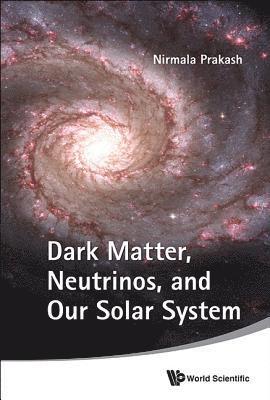
Dark Matter, Neutrinos, and Our Solar System is a unique enterprise that should be viewed as an important contribution to our understanding of dark matter, neutrinos and the solar system. It describes these issues in terms of links, between cosmology, particle and nuclear physics, as well as between cosmology, atmospheric and terrestrial physics. It studies the constituents of dark matter (classified as hot warm and cold) first in terms of their individual structures (baryonic and non-baryonic, massive and non-massive, interacting and non-interacting) and second, in terms of facilities available to detect these structures (large and small). Neutrinos (an important component of dark matter) are treated as a separate entity. A detailed study of these elusive (sub-atomic) particles is done, from the year 1913 when they were found as byproducts of beta decay — until the discovery in 2007 which confirmed that neutrino flavors were not more than three (as speculated by some).The last chapter of the book details the real-time stories about the “regions” that were not explored thus far, for lack of advanced technology. Their untold fascinating stories (which span up to 2010) are illustrated here datewise in full.The book concludes with the latest news that the Large Hadron Collider team at CERN has finally succeeded in producing 7 trillion electronic Volts of energy by creating head-on-collisions of protons and more protons (in search of God-particle). The energy produced was three times more than previous records.
1 118 kr
Skickas inom 5-8 vardagar
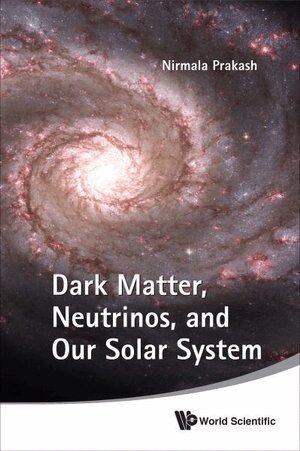
Dark Matter, Neutrinos, and Our Solar System is a unique enterprise that should be viewed as an important contribution to our understanding of dark matter, neutrinos and the solar system. It describes these issues in terms of links, between cosmology, particle and nuclear physics, as well as between cosmology, atmospheric and terrestrial physics. It studies the constituents of dark matter (classified as hot warm and cold) first in terms of their individual structures (baryonic and non-baryonic, massive and non-massive, interacting and non-interacting) and second, in terms of facilities available to detect these structures (large and small). Neutrinos (an important component of dark matter) are treated as a separate entity. A detailed study of these elusive (sub-atomic) particles is done, from the year 1913 when they were found as byproducts of beta decay — until the discovery in 2007 which confirmed that neutrino flavors were not more than three (as speculated by some).The last chapter of the book details the real-time stories about the “regions” that were not explored thus far, for lack of advanced technology. Their untold fascinating stories (which span up to 2010) are illustrated here datewise in full.The book concludes with the latest news that the Large Hadron Collider team at CERN has finally succeeded in producing 7 trillion electronic Volts of energy by creating head-on-collisions of protons and more protons (in search of God-particle). The energy produced was three times more than previous records.