Norman Sieroka - Böcker
Visar alla böcker från författaren Norman Sieroka. Handla med fri frakt och snabb leverans.
5 produkter
5 produkter
1 304 kr
Kommande
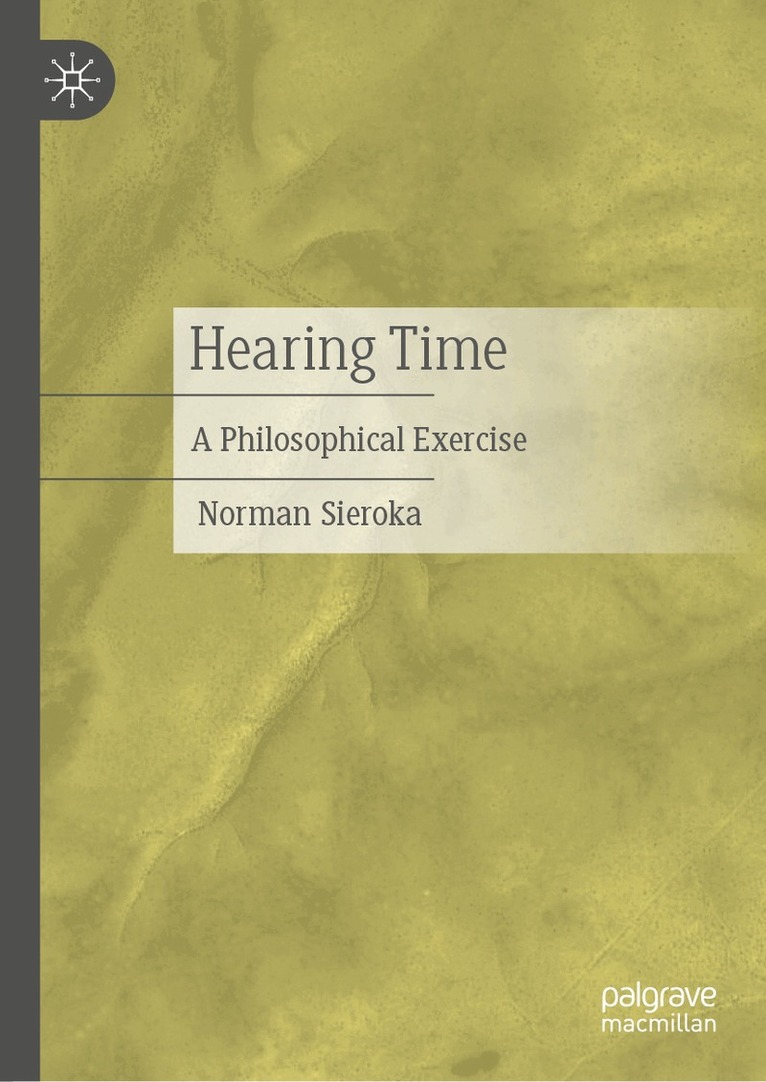
This book explores temporal orders, how reality is organised in time, and the coordination of events and experiences.Recognising that everything humans experience occurs within time, this book describes how misunderstandings and even painful consequences arise when time is viewed as an object or resource. Anxiety from a perceived scarcity of time and the pressure of time’s perceived acceleration are among the relatively harmless variants. But psychopathologies such as bipolar disorder or autism have also been described in terms of distortions in time perception.The book contends that time should be understood as a dimension of events and it is shown how events become meaningful through repetition and variation. The close connection between time, hearing and music is explored in order to explain these general structural characteristics of temporal reality.The book is not merely a philosophical discourse but also an invitation to experience time anew. It is a book for all those who not only want to read about the conceptual foundations of time, but also want to be motivated to use time wisely. Serenity and prudence, but also irony, are shown to be powerful means to gain autonomy, understood as a specific kind of temporal balance or harmony.Hearing Time is essential reading for all scholars of metaphysics and aesthetics, especially those focussing on the philosophy of time and the role of time in the experience of art.
454 kr
Skickas inom 3-6 vardagar
124 kr
Skickas inom 3-6 vardagar
147 kr
Skickas inom 3-6 vardagar
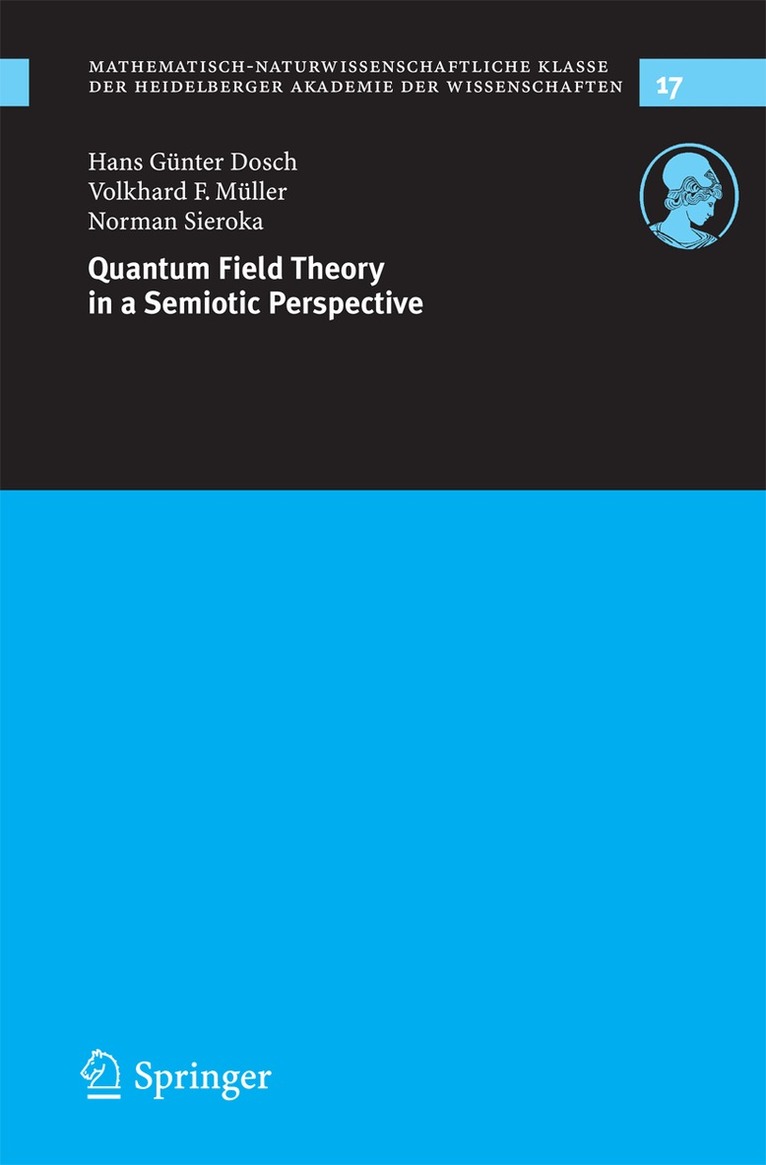
Del 17 - Schriften der Mathematisch-naturwissenschaftlichen Klasse
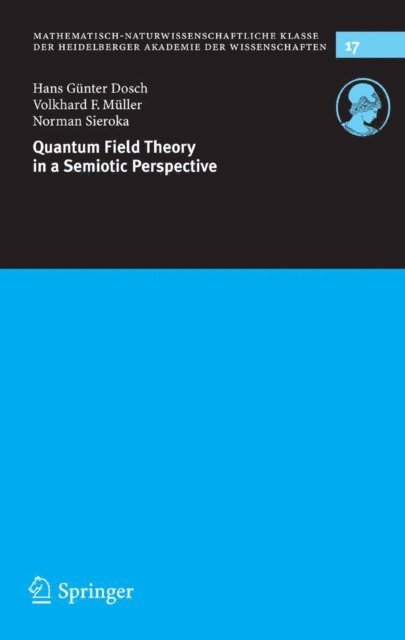
Quantum Field Theory in a Semiotic Perspective
Häftad, Engelska, 2005
536 kr
Skickas inom 10-15 vardagar
In this essay we discuss epistemological implications of relativistic quantum field theory. The empirical domain of such a theory is formed by phenomena ascribed to subnuclear particles, sometimes still called elementary particles. This latter more traditional design at ionrejects the lasting desire of physicists to eventually second and isolate irreducible constituents of matter. Going down to the atomic level, electrons appear to play such a role, whereas the nuclei of atoms can be considered as compound systems of protons and neutrons, i. e. of two species of particles. This view makes sense, since the respective number of these two types of constituents essentially identifies an atomic nucleus. Extracted from a nucleus, however, the 'free' neutron is an unstable particle: it decays spontaneously into a proton, an electron and an anti-neutrino. In the past fifty years or so basically the bombardment of matter by protons or by electrons in specially devised experiments has revealed a large variety of further subnuclear objects. Successive generations of accelerators and refined collision devices provided higher and higher collision energies.All theses- nuclear objects are termed 'particles' in the physics community, nearly all of these objects are unstable and decay spontaneously into other ones. The respective lifetimes of the distinct types, however, differ widely, ranging from 3 - 25 relatively long(10 sec) to extremely short(10 sec). Because of this huge disparity in lifetime the notion of a particle deserves particular attention, a point laid stress on in our consideration. The study of the physical behaviour of these subnuclear particles led to distinguish three types of interactions: the strong, the electromagnetic and the weak interaction. As the names suggest these interactions differ in their respective strength.