Olga Touloumi - Böcker
Visar alla böcker från författaren Olga Touloumi. Handla med fri frakt och snabb leverans.
4 produkter
4 produkter
2 166 kr
Skickas inom 10-15 vardagar
Computer Architectures is a collection of multidisciplinary historical works unearthing sites, concepts, and concerns that catalyzed the cross-contamination of computers and architecture in the mid-20th century.Weaving together intellectual, social, cultural, and material histories, this book paints the landscape that brought computing into the imagination, production, and management of the built environment, whilst foregrounding the impact of architecture in shaping technological development. The book is organized into sections corresponding to the classic von Neumann diagram for computer architecture: program (control unit), storage (memory), input/output and computation (arithmetic/logic unit), each acting as a quasi-material category for parsing debates among architects, engineers, mathematicians, and technologists. Collectively, authors bring forth the striking homologies between a computer program and an architectural program, a wall and an interface, computer memory and storage architectures, structures of mathematics and structures of things. The collection initiates new histories of knowledge and technology production that turn an eye toward disciplinary fusions and their institutional and intellectual drives.Constructing the common ground between design and computing, this collection addresses audiences working at the nexus of design, technology, and society, including historians and practitioners of design and architecture, science and technology scholars, and media studies scholars.
634 kr
Skickas inom 10-15 vardagar
Computer Architectures is a collection of multidisciplinary historical works unearthing sites, concepts, and concerns that catalyzed the cross-contamination of computers and architecture in the mid-20th century.Weaving together intellectual, social, cultural, and material histories, this book paints the landscape that brought computing into the imagination, production, and management of the built environment, whilst foregrounding the impact of architecture in shaping technological development. The book is organized into sections corresponding to the classic von Neumann diagram for computer architecture: program (control unit), storage (memory), input/output and computation (arithmetic/logic unit), each acting as a quasi-material category for parsing debates among architects, engineers, mathematicians, and technologists. Collectively, authors bring forth the striking homologies between a computer program and an architectural program, a wall and an interface, computer memory and storage architectures, structures of mathematics and structures of things. The collection initiates new histories of knowledge and technology production that turn an eye toward disciplinary fusions and their institutional and intellectual drives.Constructing the common ground between design and computing, this collection addresses audiences working at the nexus of design, technology, and society, including historians and practitioners of design and architecture, science and technology scholars, and media studies scholars.
1 521 kr
Skickas inom 7-10 vardagar
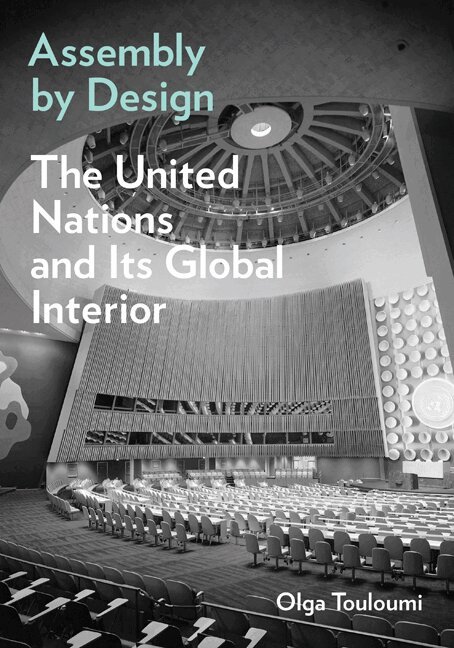
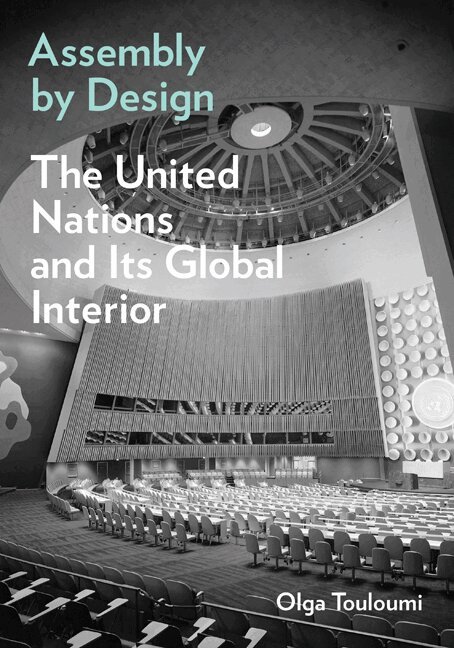
How the United Nations headquarters became the architectural instrument and broadcast medium of global diplomacyFor almost seven years after World War II, a small group of architects took on an exciting task: to imagine the spaces of global governance for a new political organization called the United Nations (UN). To create the iconic headquarters of the UN in New York City, these architects experimented with room layouts, media technologies, and design in tribunal courtrooms, assembly halls, and council chambers. The result was the creation of a new type of public space, the global interior. Assembly by Design shows how this space leveraged media to help the UN communicate with the world. With its media infrastructure, symbols, acoustic design, and architecture, the global interior defined political assembly both inside and outside the UN headquarters, serving as the architectural medium to organize multilateral encounters of international publics around the globe. Demonstrating how aesthetics have long held sway over political work, Olga Touloumi posits that the building framed diplomacy on the ground amid a changing political landscape that brought the United States to the forefront of international politics, destabilizing old and establishing new geopolitical alliances. Uncovering previously closed institutional and family archives, Assembly by Design offers new information about the political and aesthetic decisions that turned the UN headquarters into a communications organism. It looks back at a moment of hope, when politicians, architects, and diplomats-believing that assembly was a matter of design-worked together to deliver platforms for global democracy and governance.
372 kr
Skickas inom 7-10 vardagar
How the United Nations headquarters became the architectural instrument and broadcast medium of global diplomacyFor almost seven years after World War II, a small group of architects took on an exciting task: to imagine the spaces of global governance for a new political organization called the United Nations (UN). To create the iconic headquarters of the UN in New York City, these architects experimented with room layouts, media technologies, and design in tribunal courtrooms, assembly halls, and council chambers. The result was the creation of a new type of public space, the global interior. Assembly by Design shows how this space leveraged media to help the UN communicate with the world. With its media infrastructure, symbols, acoustic design, and architecture, the global interior defined political assembly both inside and outside the UN headquarters, serving as the architectural medium to organize multilateral encounters of international publics around the globe. Demonstrating how aesthetics have long held sway over political work, Olga Touloumi posits that the building framed diplomacy on the ground amid a changing political landscape that brought the United States to the forefront of international politics, destabilizing old and establishing new geopolitical alliances. Uncovering previously closed institutional and family archives, Assembly by Design offers new information about the political and aesthetic decisions that turned the UN headquarters into a communications organism. It looks back at a moment of hope, when politicians, architects, and diplomats-believing that assembly was a matter of design-worked together to deliver platforms for global democracy and governance.