Omar Everleny Pérez Villanueva - Böcker
Visar alla böcker från författaren Omar Everleny Pérez Villanueva. Handla med fri frakt och snabb leverans.
2 produkter
2 produkter
Del 29 - Series on Latin American Studies
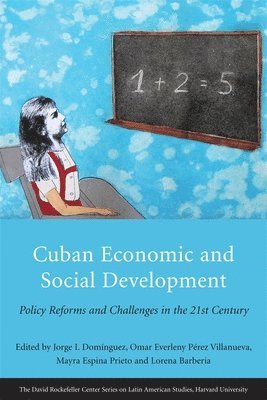
Cuban Economic and Social Development
Policy Reforms and Challenges in the 21st Century
Häftad, Engelska, 2012
204 kr
Skickas inom 7-10 vardagar
The Cuban economy has been transformed over the course of the last decade, and these changes are now likely to accelerate. In this edited volume, prominent Cuban economists and sociologists present a clear analysis of Cuba’s economic and social circumstances and suggest steps for Cuba to reactivate economic growth and improve the welfare of its citizens. These authors focus first on trade, capital inflows, exchange rates, monetary and fiscal policy, and the agricultural sector. In a second section, a multidisciplinary team of sociologists and an economist map how reforms in economic and social policies have produced declines in the social standing of some specific groups and economic mobility for others.A joint collaboration between scholars at Harvard University and in Cuba, this book includes the same editors and many of the same authors of The Cuban Economy at the Start of the Twenty-First Century (edited by Jorge I. Domínguez, Omar Everleny Pérez Villanueva, and Lorena G. Barberia), which is also part of the David Rockefeller Center series.
Del 33 - Series on Latin American Studies
Cuban Economy in a New Era
An Agenda for Change Toward Durable Development
Häftad, Engelska, 2018
243 kr
Skickas inom 7-10 vardagar
Cuba’s economy has grown hardly at all during Raúl Castro’s presidency (beginning in 2006), hit by the economic collapse of its Venezuelan partner and burdened by a legacy of decayed infrastructure, a bankrupt sugar industry, and stagnant agriculture.The Cuban Economy in a New Era diagnoses the ills that afflict Cuba’s economy and examines possible economic policy changes in seven areas: macroeconomic policy, central planning, small and medium private enterprises, nonagricultural cooperatives, financing options for the new private sector, state enterprise management, and relations with international financial institutions. Cuban economists have contributed these seven chapters, and the combined import is further considered in introductory and concluding chapters. The book is the culmination of over a decade of scholarly collaboration with Harvard scholars, anchored in a series of workshops held over several years in Cambridge, Massachusetts, and Havana.