Omar Lizardo - Böcker
Visar alla böcker från författaren Omar Lizardo. Handla med fri frakt och snabb leverans.
8 produkter
8 produkter
910 kr
Skickas inom 7-10 vardagar
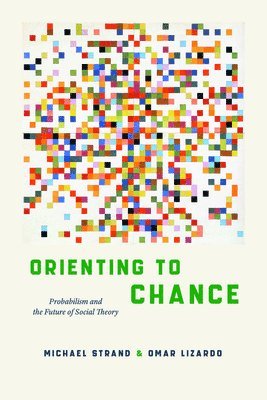
Explores the implications of chance and uncertainty in social theory and offers a new interpretation of the sociological canon. Since the founding of the discipline, sociologists have endeavored to understand the structures of groups, organizations, and societies, and how these entities condition our behavior. While some of the foundational theorists saw these processes as largely deterministic, sociological theory has increasingly insisted on the importance of culture in shaping our position in and responses to social groups. In Orienting to Chance, sociologists Michael Strand and Omar Lizardo aim to show that the social order bears an unmistakable link to chance and urge us to think about how it conditions our actions.Strand and Lizardo provide a sweeping overview of a new social theory framework that they call probabilism. Using examples of probabilism in sociology, particularly in the work of Max Weber, W. E. B. Du Bois, and Pierre Bourdieu, they describe probabilism’s place in multiple fields of science. As the authors argue, their effort at redefinition and recovery helps position sociology as a field of the future, while also keeping it grounded in core issues of action, structure, culture, inequality, and inequity. By sharing these groundbreaking insights and revealing wider theoretical claims about mortality, fate, and technology in the contemporary era, Strand and Lizardo demonstrate how probabilism is an essential intervention for understanding the inevitable role of uncertainty in social life.
282 kr
Skickas inom 7-10 vardagar
Explores the implications of chance and uncertainty in social theory and offers a new interpretation of the sociological canon. Since the founding of the discipline, sociologists have endeavored to understand the structures of groups, organizations, and societies, and how these entities condition our behavior. While some of the foundational theorists saw these processes as largely deterministic, sociological theory has increasingly insisted on the importance of culture in shaping our position in and responses to social groups. In Orienting to Chance, sociologists Michael Strand and Omar Lizardo aim to show that the social order bears an unmistakable link to chance and urge us to think about how it conditions our actions.Strand and Lizardo provide a sweeping overview of a new social theory framework that they call probabilism. Using examples of probabilism in sociology, particularly in the work of Max Weber, W. E. B. Du Bois, and Pierre Bourdieu, they describe probabilism’s place in multiple fields of science. As the authors argue, their effort at redefinition and recovery helps position sociology as a field of the future, while also keeping it grounded in core issues of action, structure, culture, inequality, and inequity. By sharing these groundbreaking insights and revealing wider theoretical claims about mortality, fate, and technology in the contemporary era, Strand and Lizardo demonstrate how probabilism is an essential intervention for understanding the inevitable role of uncertainty in social life.
793 kr
Skickas inom 7-10 vardagar
Social scientists seek to develop systematic ways to understand how people make meaning and how the meanings they make shape them and the world in which they live. But how do we measure such processes? Measuring Culture is an essential point of entry for both those new to the field and those who are deeply immersed in the measurement of meaning. Written collectively by a team of leading qualitative and quantitative sociologists of culture, the book considers three common subjects of measurement—people, objects, and relationships—and then discusses how to pivot effectively between subjects and methods. Measuring Culture takes the reader on a tour of the state of the art in measuring meaning, from discussions of neuroscience to computational social science. It provides both the definitive introduction to the sociological literature on culture as well as a critical set of case studies for methods courses across the social sciences.
211 kr
Skickas inom 7-10 vardagar
Social scientists seek to develop systematic ways to understand how people make meaning and how the meanings they make shape them and the world in which they live. But how do we measure such processes? Measuring Culture is an essential point of entry for both those new to the field and those who are deeply immersed in the measurement of meaning. Written collectively by a team of leading qualitative and quantitative sociologists of culture, the book considers three common subjects of measurement—people, objects, and relationships—and then discusses how to pivot effectively between subjects and methods. Measuring Culture takes the reader on a tour of the state of the art in measuring meaning, from discussions of neuroscience to computational social science. It provides both the definitive introduction to the sociological literature on culture as well as a critical set of case studies for methods courses across the social sciences.
2 693 kr
Skickas inom 10-15 vardagar
Microsociologists seek to capture social life as it is experienced, and in recent decades no one has championed the microsociological approach more fiercely than Randall Collins. The pieces in this exciting volume offer fresh and original insights into key aspects of Collins’ thought, and of microsociology more generally. The introductory essay by Elliot B. Weininger and Omar Lizardo provides a lucid overview of the key premises this perspective. Ethnographic papers by Randol Contreras, using data from New York, and Philippe Bourgois and Laurie Kain Hart, using data from Philadelphia, examine the social logic of violence in street-level narcotics markets. Both draw on heavily on Collins’ microsociological account of the features of social situations that tend to engender violence. In the second section of the book, a study by Paul DiMaggio, Clark Bernier, Charles Heckscher, and David Mimno tackles the question of whether electronically mediated interaction exhibits the ritualization which, according to Collins, is a common feature of face-to-face encounters. Their results suggest that, at least under certain circumstances, digitally mediated interaction may foster social solidarity in a manner similar to face-to-face interaction. A chapter by Simone Polillo picks up from Collins’ work in the sociology of knowledge, examining multiple ways in which social network structures can engender intellectual creativity. The third section of the book contains papers that critically but sympathetically assess key tenets of microsociology. Jonathan H. Turner argues that the radically microsociological perspective developed by Collins will better serve the social scientific project if it is embedded in a more comprehensive paradigm, one that acknowledges the macro- and meso-levels of social and cultural life. A chapter by David Gibson presents empirical analyses of decisions by state leaders concerning whether or not to use force to deal with internal or external foes, suggesting that Collins’ model of interaction ritual can only partially illuminate the dynamics of these highly consequential political moments. Work by Erika Summers-Effler and Justin Van Ness seeks to systematize and broaden the scope of Collins’ theory of interaction, by including in it encounters that depart from the ritual model in important ways. In a final, reflective chapter, Randall Collins himself highlights the promise and future of microsociology. Clearly written, these pieces offer cutting-edge thinking on some of the crucial theoretical and empirical issues in sociology today.
563 kr
Skickas inom 10-15 vardagar
Microsociologists seek to capture social life as it is experienced, and in recent decades no one has championed the microsociological approach more fiercely than Randall Collins. The pieces in this exciting volume offer fresh and original insights into key aspects of Collins’ thought, and of microsociology more generally. The introductory essay by Elliot B. Weininger and Omar Lizardo provides a lucid overview of the key premises this perspective. Ethnographic papers by Randol Contreras, using data from New York, and Philippe Bourgois and Laurie Kain Hart, using data from Philadelphia, examine the social logic of violence in street-level narcotics markets. Both draw on heavily on Collins’ microsociological account of the features of social situations that tend to engender violence. In the second section of the book, a study by Paul DiMaggio, Clark Bernier, Charles Heckscher, and David Mimno tackles the question of whether electronically mediated interaction exhibits the ritualization which, according to Collins, is a common feature of face-to-face encounters. Their results suggest that, at least under certain circumstances, digitally mediated interaction may foster social solidarity in a manner similar to face-to-face interaction. A chapter by Simone Polillo picks up from Collins’ work in the sociology of knowledge, examining multiple ways in which social network structures can engender intellectual creativity. The third section of the book contains papers that critically but sympathetically assess key tenets of microsociology. Jonathan H. Turner argues that the radically microsociological perspective developed by Collins will better serve the social scientific project if it is embedded in a more comprehensive paradigm, one that acknowledges the macro- and meso-levels of social and cultural life. A chapter by David Gibson presents empirical analyses of decisions by state leaders concerning whether or not to use force to deal with internal or external foes, suggesting that Collins’ model of interaction ritual can only partially illuminate the dynamics of these highly consequential political moments. Work by Erika Summers-Effler and Justin Van Ness seeks to systematize and broaden the scope of Collins’ theory of interaction, by including in it encounters that depart from the ritual model in important ways. In a final, reflective chapter, Randall Collins himself highlights the promise and future of microsociology. Clearly written, these pieces offer cutting-edge thinking on some of the crucial theoretical and empirical issues in sociology today.
3 428 kr
Skickas inom 10-15 vardagar
The book pushes against the conventional classical theory pedagogy, which often focused on single theorists and their contributions, and looks at isolating themes capturing the essence of the interest of classical theorists that seem to have relevance to modern research questions and theoretical traditions.
3 428 kr
Skickas inom 10-15 vardagar
The book pushes against the conventional classical theory pedagogy, which often focused on single theorists and their contributions, and looks at isolating themes capturing the essence of the interest of classical theorists that seem to have relevance to modern research questions and theoretical traditions.