P. Kamp - Böcker
Visar alla böcker från författaren P. Kamp. Handla med fri frakt och snabb leverans.
3 produkter
3 produkter
Del 85 - Astrophysics and Space Science Library
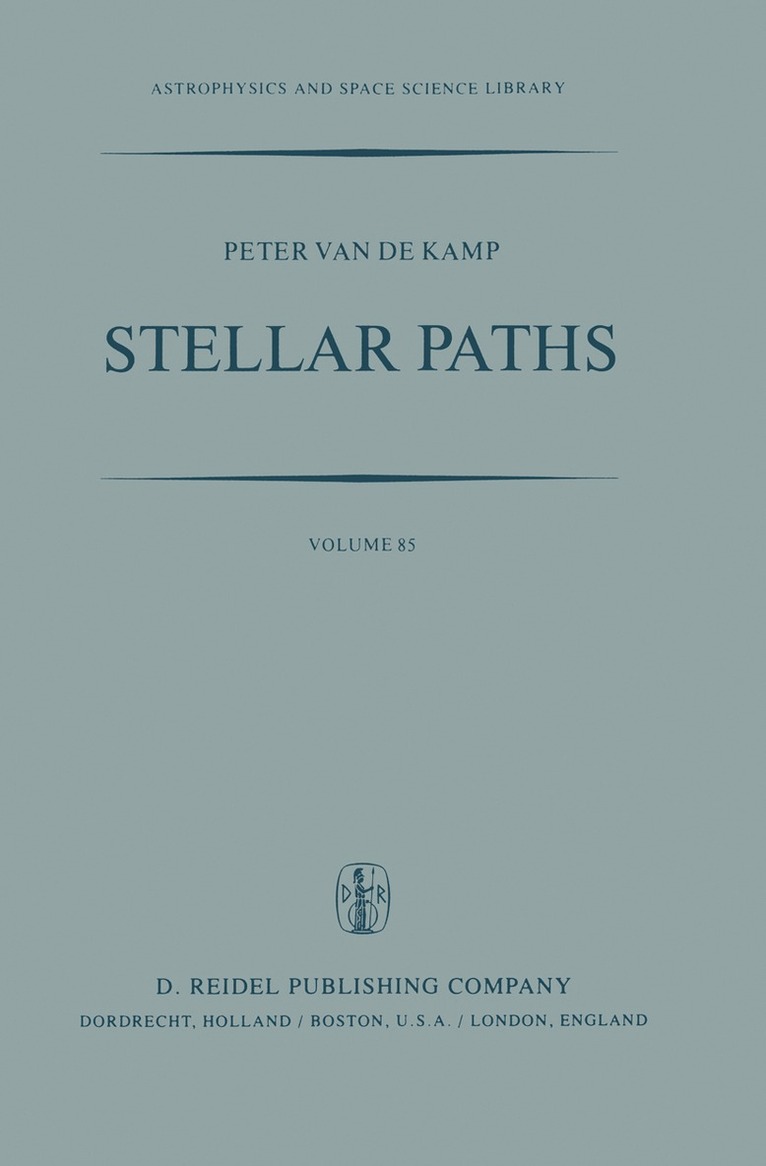
Stellar Paths
Photographic Astrometry with Long-Focus Instruments
Inbunden, Engelska, 1981
1 062 kr
Skickas inom 10-15 vardagar
This is the latest effort in a sequence of presentations begun in 1949 with a series of lectures on long-focus photographic astrometry given by the author as Fulbright professor in Paris at the invitation by the late H. Mineur, at that time Director of the Institut d' Astrophysique. These earlier lectures were published as a series of review articles in Popular Astronomy (1951) and appeared both as Contributions de l'Institut d'Astrophysique, Serie A, No. 81 and as reprint No. 75 of Sproul Observatory. A more elaborate presenta tion was given in 1963 in Stars and Stellar Systems, which was followed by Principles of Astrometry (1967, W. H. Freeman & Co.). During the second half of 1974, again under Fulbright auspices, at the invitation of Pik Sin The, I lectured at the Astronomical Institute in Amster dam, followed by a short course in May-June 1978 at the invitation of E. P. J. van den Heuvel. I gave a more extensive course at the Institut d' As trophysique at the invitation of J. C. Pecker of the College de France and of J. Audouze, Director of the LA.P. Both in Amsterdam and in Paris I had presented occasional astrometric topics at various times. The opportunity to lecture in France and in Holland has facilitated, influenced and improved the organization and contents of the presentations on the subject of long-focus photographic astrometry.
Del 85 - Astrophysics and Space Science Library
Stellar Paths
Photographic Astrometry with Long-Focus Instruments
Häftad, Engelska, 2011
1 062 kr
Skickas inom 10-15 vardagar
This is the latest effort in a sequence of presentations begun in 1949 with a series of lectures on long-focus photographic astrometry given by the author as Fulbright professor in Paris at the invitation by the late H. Mineur, at that time Director of the Institut d' Astrophysique. These earlier lectures were published as a series of review articles in Popular Astronomy (1951) and appeared both as Contributions de l'Institut d'Astrophysique, Serie A, No. 81 and as reprint No. 75 of Sproul Observatory. A more elaborate presenta tion was given in 1963 in Stars and Stellar Systems, which was followed by Principles of Astrometry (1967, W. H. Freeman & Co.). During the second half of 1974, again under Fulbright auspices, at the invitation of Pik Sin The, I lectured at the Astronomical Institute in Amster dam, followed by a short course in May-June 1978 at the invitation of E. P. J. van den Heuvel. I gave a more extensive course at the Institut d' As trophysique at the invitation of J. C. Pecker of the College de France and of J. Audouze, Director of the LA.P. Both in Amsterdam and in Paris I had presented occasional astrometric topics at various times. The opportunity to lecture in France and in Holland has facilitated, influenced and improved the organization and contents of the presentations on the subject of long-focus photographic astrometry.
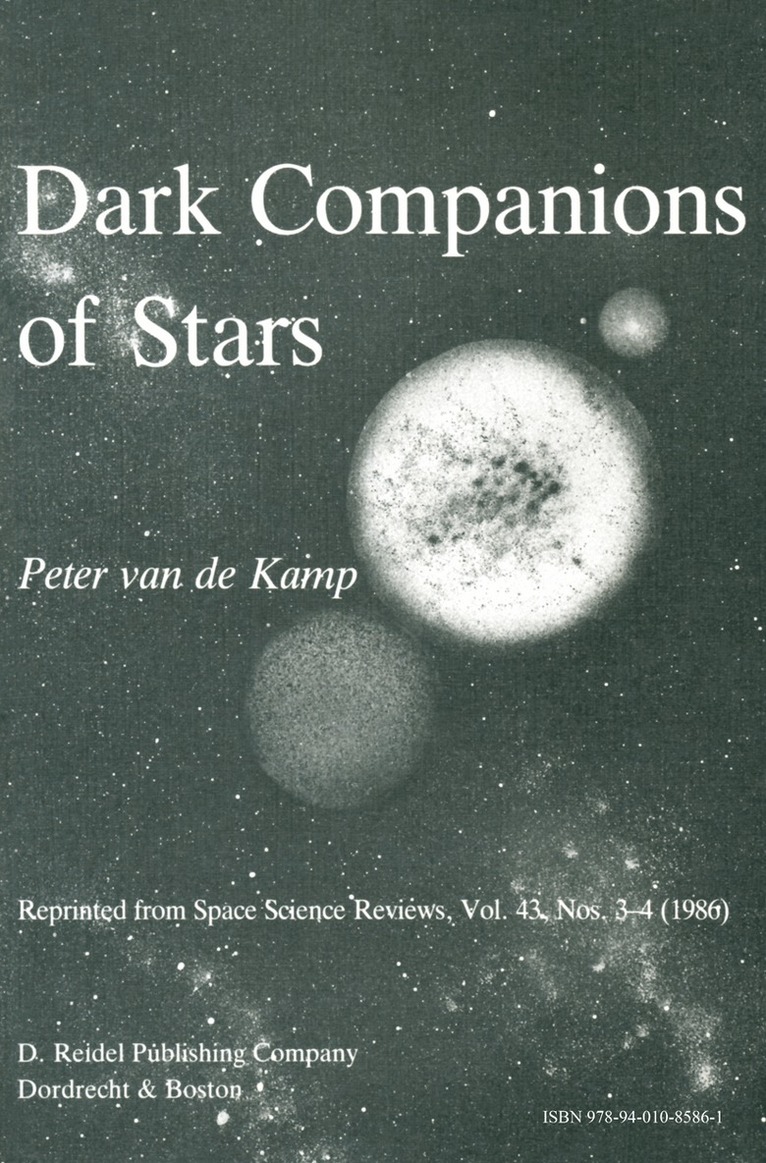
Dark Companions of Stars
Astrometric Commentary on the Lower End of the Main Sequence
Häftad, Engelska, 2011
534 kr
Skickas inom 10-15 vardagar
If you want to understand the invisible, look careful at the visible. The Talmud A 'bird's eye' or rather a distant spacecraft's view of the solar system reveals an assembly of planets, terrestrial, giant and Pluto. The orbital motions are in the same sense, counter clockwise, as seen from the north of the general flattened space within which the planetary motions are confined. This state of affairs is corevolving and, more or less, coplanar. The rotations are in the same sense as the revolutions, with the strikiiig exception of Uranus whose sense of rotation is perpendicular to its plane of revolution. As time goes by, most of the planets remain fairly close to a general plane and at no time stray unduly far from it; they remain confined within a rather narrow box or disk with a large 'equatorial' extent. The most distant planet, Pluto, requires a diameter of some 80 astronomical units for the disk. One astronomical unit is the distance of the Earth to the Sun, to be more precise the length of half the major axis of the Earth's slightly elliptical orbit around the Sun, and amounts to nearly 149600000 km.