Palle Yourgrau - Böcker
Visar alla böcker från författaren Palle Yourgrau. Handla med fri frakt och snabb leverans.
5 produkter
5 produkter
938 kr
Skickas inom 5-8 vardagar
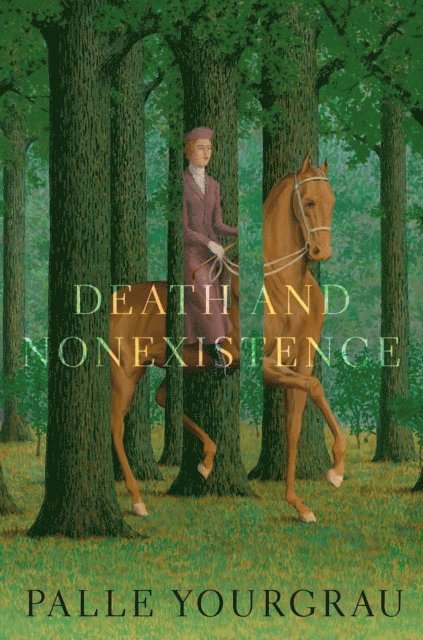
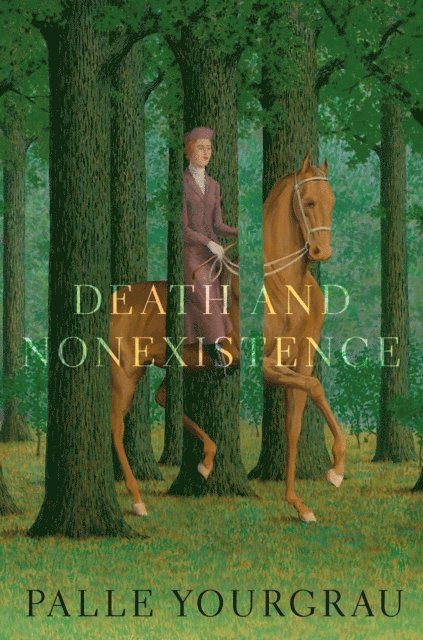
The dead are gone. They count for nothing. Yet, if we count the dead, their number is staggering. And they account for most of what is great about civilization. Compared to the greatness of the dead, the accomplishments of the living are paltry. Which is it then: are the dead still there to be counted or not? And if they are still there, where exactly is "there"? We are confronted with the ancient paradox of nonexistence bequeathed us by Parmenides. The mystery of death is the mystery of nonexistence.A successful attempt to provide a metaphysics of death, then, must resolve the paradox of nonexistence. That is the aim of this study. At the same time, the metaphysics of death, of ceasing to exist, must serve as an account of birth, of coming to exist; the primary thesis of this book is that this demands going beyond existence and nonexistence to include what underlies both, which one can call, following tradition, "being." The dead and the unborn are therefore objects that lack existence but not being. Nonexistent objects - not corpses, or skeletons, or memories, all of which are existent objects - are what are "there" to be counted when we count the dead.
791 kr
Skickas inom 7-10 vardagar
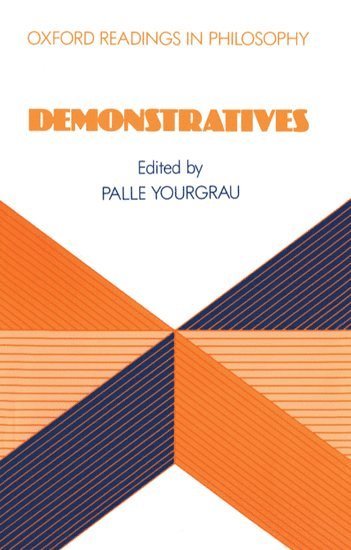
The philosophical elucidation of demonstratives is a task of considerable and wide-ranging significance. These words, like "I", "now", and "this", seem to represent a point of contact between thought and reality. Any account of these must therefore deal with metaphysical issues such as the nature of the "self" and the reality and significance of the present. This collection brings together for the first time an important set of previously published papers, some of which have been slightly altered to suit this volume. They seek to provide the correct semantic account of thoughts involving demonstratives, as well as giving an insight into the metaphysical concepts which lie behind. Philosophers, especially those interested in philosophy of religion, philosophy of language, philosophy of mind and philosophy of science will be interested in this book.
242 kr
Skickas inom 3-6 vardagar
352 kr
Skickas inom 3-6 vardagar
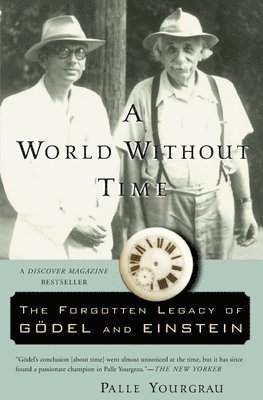
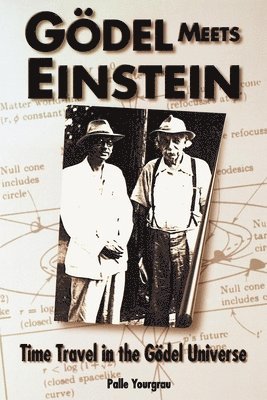
What happens when the century's greatest logician meets the century's greatest physicist? In the case of Kurt Gdel and Albert Einstein, the result is Gdel's revolutionary new world models for relativity theoryAlthough most famous for his Incompleteness Theorems in mathematical logic, Gdel was a philosopher in his own right, with a special interest in the philosophical problem of Time.Most people are unaware that Gdel and Einstein were close friends for many years at Princeton's Institute for Advanced Study. Gdel extended Einstein's General Theory of Relativity with cosmological models-now known as "Gdel Universes"-with extraordinary properties, including the possibility of closed, timelike curves that allow the philosophical fantasy of time travel to become a scientific reality.For Gdel, however, the reality of time travel signals the unreality of time. If he's right, the real meaning of the Einstein revolution remained a secret for half a century and is only being revealed now.
146 kr
Skickas
Simone Weil, legendary French philosopher, mystic and political activist who died in England in 1943 at the age of thirty-four, belongs to a select group of thinkers: as with St Augustine, Pascal and Nietzsche, so with Weil a single phrase can permanently change one’s life. In this book, Palle Yourgrau follows Weil on her life’s journey, from her philosophical studies at the École Normale Supérieure, to her years as a Marxist labour organizer, her explosive encounter with Leon Trotsky, her abortive attempt to fight against Franco in the Spanish Civil War, her mystical experience in the town of Assisi. We see how Weil’s struggle to make sense of a world consumed by despotism and war culminated in her monumental attempt, following St Augustine, to re-imagine Christianity along Platonistic lines, to find a bridge between human suffering and divine perfection.How seriously, however, should Weil's ideas be taken? They were admired by Albert Camus and T. S. Eliot, yet Susan Sontag wrote famously that ‘I can’t imagine more than a handful of the tens of thousands of readers she has won . . . really share her ideas.’ If this is really true, Palle Yourgrau must count as one of the handful. Though he brings to life the pathos of Weil's tragi-comic journey, Yourgrau devotes equal attention to the question of truth. He shines a bright light on the paradox of Simone Weil: at once a kind of modern saint, and a bête noire, a Jew accused of having abandoned her own people in their hour of greatest need. The result is a critical biography that is in places as disturbing as Weil's own writings, an account that confronts head-on her controversial critique of the Hebrew Bible, as well as her radical rejection of the received wisdom that the Resurrection lies at the heart of Christianity.