Paola Gaeta - Böcker
Visar alla böcker från författaren Paola Gaeta. Handla med fri frakt och snabb leverans.
7 produkter
7 produkter
589 kr
Skickas inom 5-8 vardagar
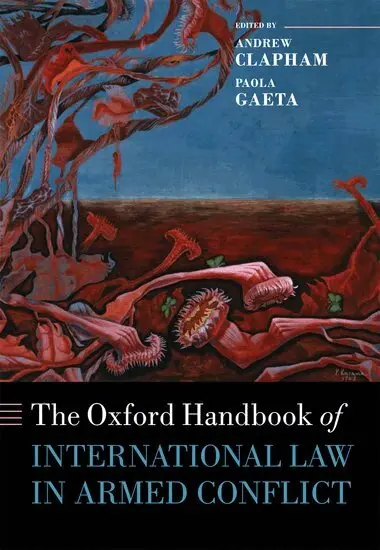
Over the past ten years the content and application of international law in armed conflict has changed dramatically. This Oxford Handbook provides an authoritative and comprehensive study of the role of international law in armed conflict and engages in a broad analysis of international humanitarian law, human rights law, refugee law, international criminal law, environmental law, and the law on the use of force. With an international group of expert contributors, the Handbook has a global, multi-disciplinary perspective on the place of law in war. The Handbook consists of 32 chapters in seven parts. Part I provides the historical background of international law in armed conflict and sets out its contemporary challenges. Part II considers the relevant sources of international law. Part III describes the different legal regimes: land warfare, air warfare, maritime warfare, the law of occupation, the law applicable to peace operations, and the law of neutrality. Part IV introduces crucial concepts in humanitarian law: the use of weapons, proportionality, the principle of distinction, and internal armed conflict. Part V looks at rights issues: life, torture, fair trials, the environment, economic, social and cultural rights, the protection of cultural property, and the human rights of members of the armed forces. Part VI covers key issues in times of conflict: the use of force, terrorism, unlawful combatants, mercenaries, forced migration, and issues of gender. Part VII deals with accountability for war crimes, the responsibility of non-state actors, compensation before national courts, and, finally, transitional justice.
1 166 kr
Skickas inom 5-8 vardagar
The four Geneva Conventions, adopted in 1949, remain the fundamental basis of contemporary international humanitarian law. They protect the wounded and sick on the battlefield, those wounded, sick or shipwrecked at sea, prisoners of war, and civilians in time of war. However, since they were adopted warfare has changed considerably. In this groundbreaking commentary over sixty international law experts investigate the application of the Geneva Conventions and explain how they should be interpreted today. It places the Conventions in the light of the developing obligations imposed by international law on states, armed groups, and individuals, most notably through international human rights law and international criminal law. The context in which the Conventions are to be applied and interpreted has changed considerably since they were first written. The borderline between international and non-international armed conflicts is not as clear-cut as was once thought, and is complicated further by the use of armed force mandated by the United Nations and the complex mixed and transnational nature of certain non-international armed conflicts. The influence of other developing branches of international law, such as human rights law and refugee law has been considerable. The development of international criminal law has breathed new life into multiple provisions of the Geneva Conventions. This commentary adopts a thematic approach to provide detailed analysis of each key issue dealt with by the Conventions, taking into account both judicial decisions and state practice. Cross-cutting chapters on issues such as transnational conflicts and the geographical scope of the Conventions also give readers a full understanding of the meaning of the Geneva Conventions in their contemporary context. Prepared under the auspices of the Geneva Academy of International Humanitarian Law and Human Rights, this commentary on four of the most important treaties in international law is unmissable for anyone working in or studying situations of armed conflicts.
620 kr
Skickas inom 5-8 vardagar
Cassese's International Law is a new edition of an established classic. Authors Gaeta, Viñuales, and Zappalá have built on the legacy of international law luminary Antonio Cassese to offer a thought-provoking and lucid account for today's undergraduates and postgraduates.The authors have refreshed Cassese's original approach, ensuring the book continues to compare the traditional legal position with the developing and evolving law. Advancing areas such as the law of the sea, territorial matters, and international environmental law have been expanded to give proper place to their evolving development, while brand new chapters on international trade and foreign investment have been written to reflect the advancements of these areas. In maintaining the broad structure and approach but providing new material, the authors bring fresh context to Cassese's thinking and provide students with an up-to-date, compelling account of the landscape of international legal thinking.Digital formatsThis edition is available for students and institutions to purchase in a variety of formats.The e-book offers a mobile experience and convenient access along with functionality tools, navigation features, and links that offer extra learning support: www.oxfordtextbooks.co.uk/ebooks
1 977 kr
Skickas inom 5-8 vardagar
This book collects together the most important papers of Antonio Cassese, the first President of the International Criminal Tribunal for the former Yugoslavia and chairman of the UN Commission of Inquiry into the crimes committed in Darfur.Written over a period of 25 years, from 1974 to 2001, the papers chart the development of Cassese's thought on the central issues that have shaped his life's work: the laws relating to armed conflict, respect of individual rights and the prosecution of individuals for international crimes. Emerging from the papers is Cassese's vision of the individual and human dignity as the lynchpin of the international legal system, and the need to balance the fact of statehood as an essential feature of modern international society with the protection of individual rights.In a new paper, written especially for the collection, Cassese looks back over the development of his understanding of international law and presents his current view of the issues discussed throughout the volume. The volume also features an exhaustive bibliography of Cassese's publications, and biographical notes from Cassese's colleagues.By gathering together the most important writings of one of the pre-eminent figures in contemporary international criminal justice, this collection provides not only the definitive statement of Cassese's thought, but a unique insight into some of the key developments in international law over the last quarter of the twentieth century.
2 579 kr
Skickas inom 5-8 vardagar
Which human rights violations or war crimes allegations result in exclusion from the refugee regime? What human rights protections apply to someone declared an unlawful combatant? Which human rights obligations apply to the actions of armed forces acting abroad? Over the past ten years the content and application of international law in armed conflict has changed dramatically. An authoritative and comprehensive study of the role of international law in armed conflicts, this Oxford Handbook engages in a broad analysis of international humanitarian law, human rights law, refugee law, international criminal law, environmental law, and the law on the use of force. With an international group of expert contributors, this book has a global, multi-disciplinary perspective on the place of law in war.The Handbook consists of 35 Chapters in seven parts. Part A provides the historical background and sets out some of the contemporary challenges. Part B considers the relevant sources of international law. Part C describes the different legal regimes: land warfare, air war fare, maritime warfare, the law of occupation, the law applicable to peace operations, and the law of neutrality. Part D introduces crucial concepts in international humanitarian law: weapons and the concepts of superfluous injury and unnecessary suffering, the principle of distinction, proportionality, genocide and crimes against humanity, grave breaches and war crimes, and internal armed conflict. Part E looks at fundamental rights: the right to life, the prohibition on torture, the right to fair trial, economic, social and cultural rights, the protection of the environment, the protection of cultural property, the human rights of the members of the armed forces, and the protection of children. Part F covers important issues such as: the use of force, terrorism, unlawful combatants, the application of human rights in times of armed conflict, refugee law, and the issues of gender in times of armed conflict. Part G deals with accountability issues including those related to private security companies and armed groups, as well as questions of state responsibility brought before national courts and issues related to transitional justice.
2 393 kr
Skickas inom 5-8 vardagar
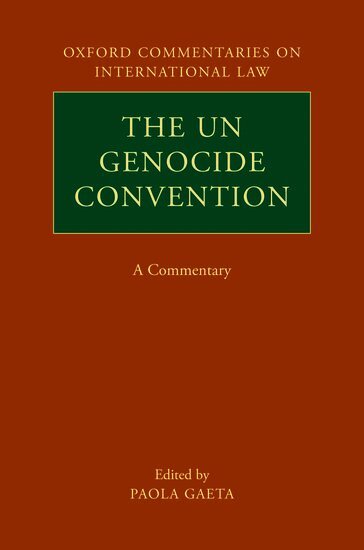
The Convention for the Prevention and Punishment of the Crime of Genocide, adopted by the United Nations General Assembly on 9 December 1948, is one of the most important instruments of contemporary international law. It was drafted in the aftermath of the Nuremberg trial to give flesh and blood to the well-known dictum of the International Military Tribunal, according to which 'Crimes against international law are committed by men, not by abstract entities, and only by punishing individuals who commit such crimes can the provisions of international law be enforced'. At Nuremberg, senior state officials who had committed heinous crimes on behalf or with the protection of their state were brought to trial for the first time in history and were held personally accountable regardless of whether they acted in their official capacity. The drafters of the Convention on Genocide crystallized the results of the Nuremberg trial and thus ensured its legacy. The Convention established a mechanism to hold those who committed or participated in the commission of genocide, the crime of crimes, criminally responsible. Almost fifty years before the adoption of the Rome Statute, the Convention laid the foundations for the establishment of the International Criminal Court. It also obliged its Contracting Parties to criminalise and punish genocide.This book is a much-needed Commentary on the Genocide Convention. It analyses and interprets the Convention thematically, thoroughly covering every article, drawing on the Convention's travaux préparatoires and subsequent developments in international law. The most complex and important provisions of the Convention, including the definitions of genocide and genocidal acts, have more than one contribution dedicated to them, allowing the Commentary to explore all aspects of these concepts. The Commentary also goes beyond the explicit provisions of the Convention to discuss topics such as the retroactive application of the Convention, its status in customary international law and its future.
888 kr
Skickas
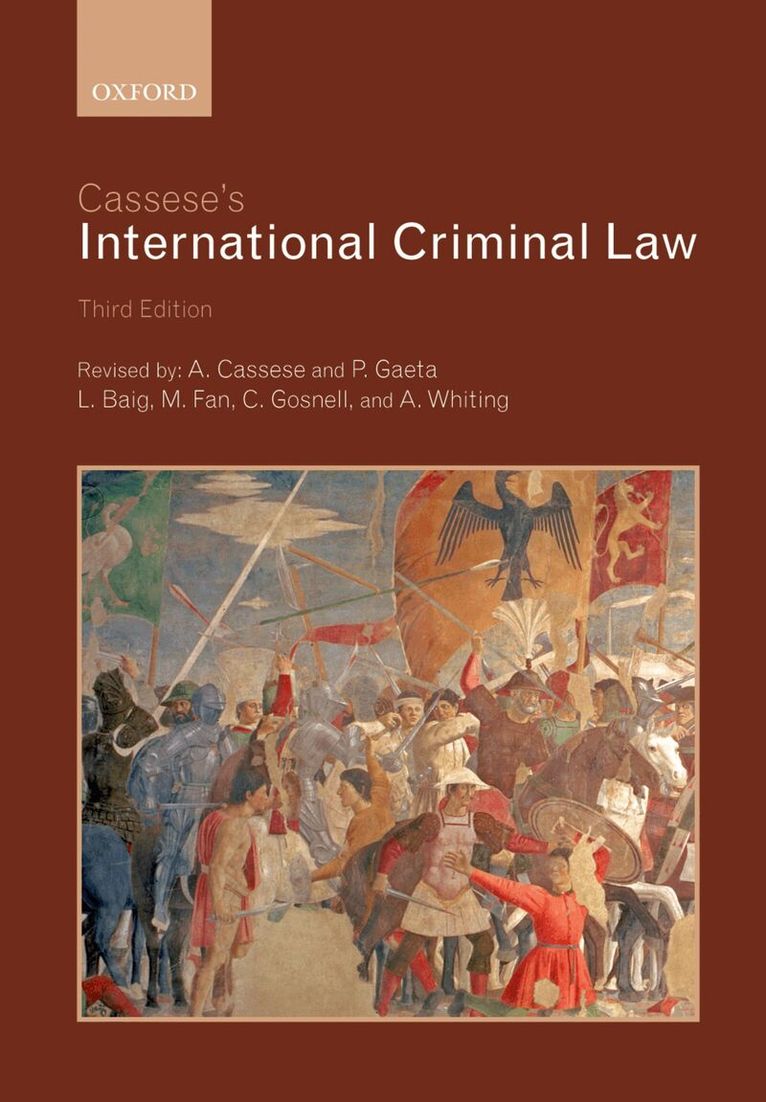
The third edition of Cassese's International Criminal Law provides a clear account of the main substantive and procedural aspects of international criminal law. Adopting a combination of the classic common law and more theoretical approaches to the subject, it discusses:· the historical evolution of international criminal law; · the legal definition of the so-called core crimes (war crimes, crimes against humanity, genocide) plus aggression, torture and terrorism;· the forms and modes of criminal responsibility; and · the main issues related to the prosecution and punishment of international crimes at the national and international level, including amnesties, statutes of limitations and immunities. Cassese guides the reader through a vast array of cases and materials from a number of jurisdictions, providing thought-provoking analysis that brings the political and human contexts to the fore.The International Criminal Court and all the other modern international criminal courts are fully covered, both as regards their structure, functioning and proceedings and as far as their case law is concerned.Online ResourcesCase materials: Key international documents and foreign legislation relating to chapters of the textbook Your questions answered: responses to questions from international law students Web links: Links to web sites relating to topics within the text