Patrick Bolton - Böcker
Visar alla böcker från författaren Patrick Bolton. Handla med fri frakt och snabb leverans.
10 produkter
10 produkter
2 492 kr
Skickas inom 3-6 vardagar
Sovereign wealth funds (SWFs) are state-owned investment funds with combined asset holdings that are fast approaching four trillion dollars. Recently emerging as a major force in global financial markets, SWFs have other distinctive features besides their state-owned status: they are mainly located in developing countries and are intimately tied to energy and commodities exports, and they carry virtually no liabilities and have little redemption risk, which allows them to take a longer-term investment outlook than most other institutional investors. Edited by a Nobel laureate, a respected academic at the Columbia Business School, and a longtime international banker and asset manager, this volume examines the specificities of SWFs in greater detail and discusses the implications of their growing presence for the world economy. Based on essays delivered in 2011 at a major conference on SWFs held at Columbia University, this volume discusses the objectives and performance of SWFs, as well as their benchmarks and governance. What are the opportunities for SWFs as long-term investments? How do they fulfill their socially responsible mission?And what role can SWFs play in fostering sustainable development and greater global financial stability? These are some of the crucial questions addressed in this one-of-a-kind volume.
685 kr
Skickas inom 3-6 vardagar
Sovereign wealth funds (SWFs) are state-owned investment funds with combined asset holdings that are fast approaching four trillion dollars. Recently emerging as a major force in global financial markets, SWFs have other distinctive features besides their state-owned status: they are mainly located in developing countries and are intimately tied to energy and commodities exports, and they carry virtually no liabilities and have little redemption risk, which allows them to take a longer-term investment outlook than most other institutional investors. Edited by a Nobel laureate, a respected academic at the Columbia Business School, and a longtime international banker and asset manager, this volume examines the specificities of SWFs in greater detail and discusses the implications of their growing presence for the world economy. Based on essays delivered in 2011 at a major conference on SWFs held at Columbia University, this volume discusses the objectives and performance of SWFs, as well as their benchmarks and governance. What are the opportunities for SWFs as long-term investments? How do they fulfill their socially responsible mission?And what role can SWFs play in fostering sustainable development and greater global financial stability? These are some of the crucial questions addressed in this one-of-a-kind volume.
1 031 kr
Skickas inom 3-6 vardagar
Reducing carbon emissions is the most complex political and economic problem humanity has ever confronted. Coping with the Climate Crisis brings together leading experts from academia and policy circles to explore issues related to the implementation of the COP21 Paris Agreement and the challenges of accelerating the transition toward sustainable development.The book synthesizes the key insights that emerge from the latest research in climate-change economics in an accessible and useful guide for policy makers and researchers. Contributors consider a wide range of issues, including the economic implications and realities of shifting away from fossil fuels, the role of financial markets in incentivizing development and construction of sustainable infrastructure, the challenges of evaluating the well-being of future generations, the risk associated with uncertainty surrounding the pace of climate change, and how to make climate agreements enforceable. They demonstrate the need for a carbon tax, considering the issues of efficiently pricing carbon as well as the role of supply-side policies on fossil fuels. Through a range of perspectives from academic economists and practitioners in the public and private sectors who work either at the country level or under the auspices of multilateral organizations, Coping with the Climate Crisis outlines what it will take to achieve a viable, global climate-stabilization path.
615 kr
Tillfälligt slut
296 kr
Skickas inom 7-10 vardagar
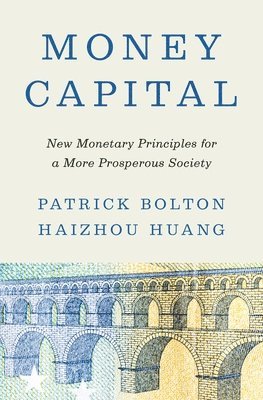
A novel perspective on monetary and fiscal policy that views money as the equity capital of a nationA conventional economic theory, monetarism, holds that inflation is a monetary phenomenon driven by changes in the supply of money. Yet recent experience—including the aftermath of the financial crisis of 2008 and the economic development of China—contradicts this basic prediction. In this book, leading economists Patrick Bolton and Haizhou Huang offer a novel perspective, viewing monetary economics through the lens of corporate finance. They propose a rich theory of money supply where money can be seen as the equity capital of a nation, playing a similar role as stocks for a company. This innovative framework integrates the real and monetary sides of the economy, with a banking sector and debt at its core.In the financial world, companies issue new shares only if it results in some kind of value creation; this is a basic principle of corporate finance that Bolton and Huang argue can be applied to monetary economics. When the government increases the money supply to finance positive net value investments—when it prints money to keep the economy going—it increases output, not inflation. This is evidenced by the strong growth in GDP and money in China over the last four decades, and in the United States during World War II. The effect of increasing money supply, they argue, depends on how money enters the system and what the money buys. The principles outlined by Bolton and Huang shed new light on a range of issues, including inflation, monetary and fiscal policy, central banking, money and growth, and the international monetary system.
237 kr
Skickas inom 7-10 vardagar
A novel perspective on monetary and fiscal policy that views money as the equity capital of a nationA conventional economic theory, monetarism, holds that inflation is a monetary phenomenon driven by changes in the supply of money. Yet recent experience—including the aftermath of the financial crisis of 2008 and the economic development of China—contradicts this basic prediction. In this book, leading economists Patrick Bolton and Haizhou Huang offer a novel perspective, viewing monetary economics through the lens of corporate finance. They propose a rich theory of money supply where money can be seen as the equity capital of a nation, playing a similar role as stocks for a company. This innovative framework integrates the real and monetary sides of the economy, with a banking sector and debt at its core.In the financial world, companies issue new shares only if it results in some kind of value creation; this is a basic principle of corporate finance that Bolton and Huang argue can be applied to monetary economics. When the government increases the money supply to finance positive net value investments—when it prints money to keep the economy going—it increases output, not inflation. This is evidenced by the strong growth in GDP and money in China over the last four decades, and in the United States during World War II. The effect of increasing money supply, they argue, depends on how money enters the system and what the money buys. The principles outlined by Bolton and Huang shed new light on a range of issues, including inflation, monetary and fiscal policy, central banking, money and growth, and the international monetary system.
336 kr
Skickas inom 5-8 vardagar
168 kr
Skickas inom 5-8 vardagar
159 kr
Skickas inom 5-8 vardagar
Del 232 - The International Library of Critical Writings in Economics series
Economics of Contracts
Inbunden, Engelska, 2008
6 920 kr
Skickas inom 7-10 vardagar
The Economics of Contracts provides a guided tour to the leading ideas in contract theory. It assembles some of the foundational writings on contracting under limited and asymmetric information, incentives and mechanism design. It contains, in particular, the key contributions of five recent Nobel Prize winners in economics and brings together the most important articles that have followed these path-breaking works.